

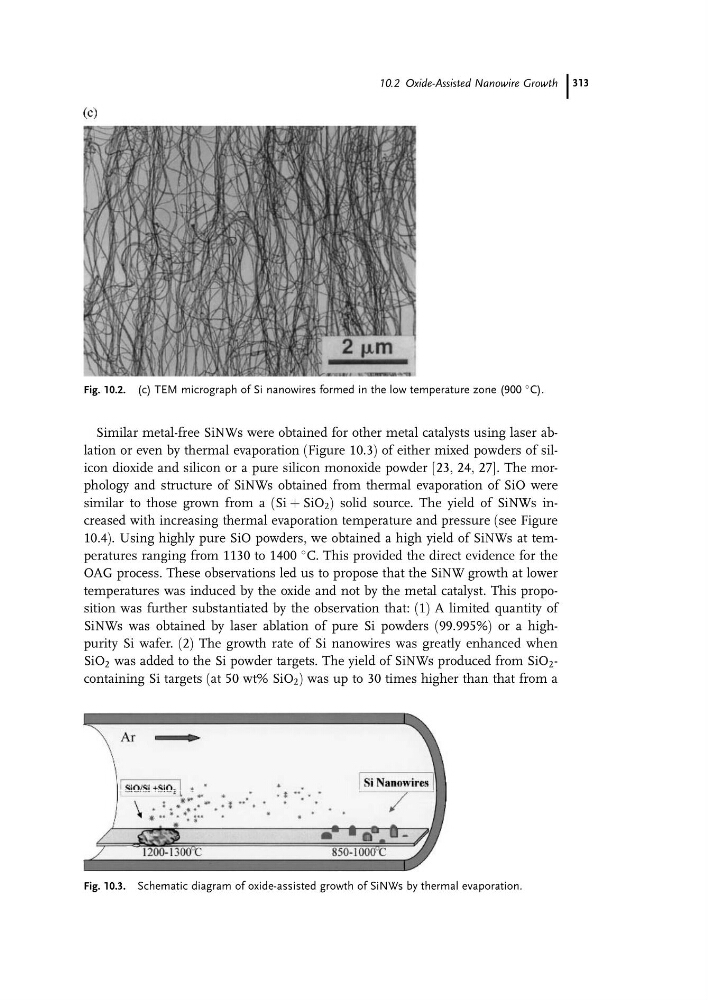
Similar metal-free SiNWs were obtained for other metal catalysts using laser ablation or even by thermal evaporation (Figure 10.3) of either mixed powders of silicon dioxide and silicon or a pure silicon monoxide powder [23, 24, 27]. The morphology and structure of SiNWs obtained from thermal evaporation of SiO were
similar to those grown from a (Si þ SiO 2 ) solid source. The yield of SiNWs increased with increasing thermal evaporation temperature and pressure (see Figure
10.4). Using highly pure SiO powders, we obtained a high yield of SiNWs at temperatures ranging from 1130 to 1400
C. This provided the direct evidence for the
OAG process. These observations led us to propose that the SiNW growth at lower
temperatures was induced by the oxide and not by the metal catalyst. This proposition was further substantiated by the observation that: (1) A limited quantity of
SiNWs was obtained by laser ablation of pure Si powders (99.995%) or a highpurity Si wafer. (2) The growth rate of Si nanowires was greatly enhanced when
SiO 2 was added to the Si powder targets. The yield of SiNWs produced from SiO 2 -
containing Si targets (at 50 wt% SiO 2 ) was up to 30 times higher than that from a
Fig. 10.2. (c) TEM micrograph of Si nanowires formed in the low temperature zone (900
C).
Fig. 10.3. Schematic diagram of oxide-assisted growth of SiNWs by thermal evaporation.
10.2 Oxide-Assisted Nanowire Growth 313
similar to those grown from a (Si þ SiO 2 ) solid source. The yield of SiNWs increased with increasing thermal evaporation temperature and pressure (see Figure
10.4). Using highly pure SiO powders, we obtained a high yield of SiNWs at temperatures ranging from 1130 to 1400
C. This provided the direct evidence for the
OAG process. These observations led us to propose that the SiNW growth at lower
temperatures was induced by the oxide and not by the metal catalyst. This proposition was further substantiated by the observation that: (1) A limited quantity of
SiNWs was obtained by laser ablation of pure Si powders (99.995%) or a highpurity Si wafer. (2) The growth rate of Si nanowires was greatly enhanced when
SiO 2 was added to the Si powder targets. The yield of SiNWs produced from SiO 2 -
containing Si targets (at 50 wt% SiO 2 ) was up to 30 times higher than that from a
Fig. 10.2. (c) TEM micrograph of Si nanowires formed in the low temperature zone (900
C).
Fig. 10.3. Schematic diagram of oxide-assisted growth of SiNWs by thermal evaporation.
10.2 Oxide-Assisted Nanowire Growth 313