

spectra indicate that the intermediate particles were smaller 1.8 aspect ratio spheroids (inset of Figure 9.12).
Gold nanorods with 17 nm short axis and aspect ratio of 18 have a weak plasmon
band at 503 nm and (presumably) a longitudinal plasmon band beyond @2000 nm.
With increasing cyanide concentration the 503 nm band gradually decreased in
intensity and finally vanished in @60 min (data not shown). No plasmon band in
the 600–1850 nm region was detected at intermediate cyanide concentrations,
suggesting that short rods were not intermediates. TEMs of the nanorods showed
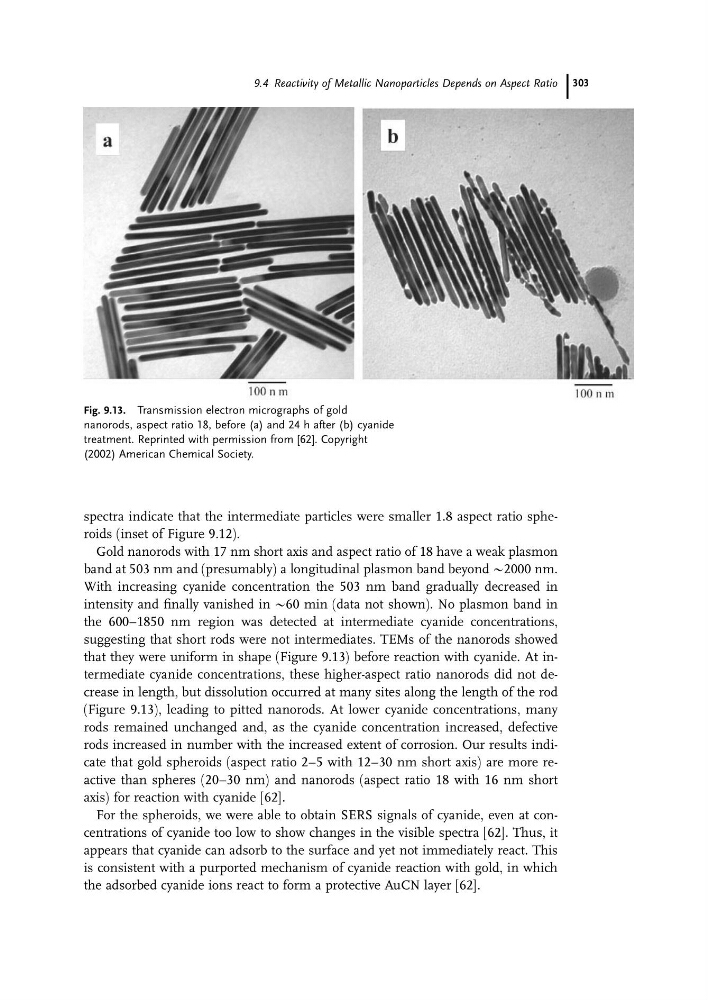
that they were uniform in shape (Figure 9.13) before reaction with cyanide. At intermediate cyanide concentrations, these higher-aspect ratio nanorods did not decrease in length, but dissolution occurred at many sites along the length of the rod
(Figure 9.13), leading to pitted nanorods. At lower cyanide concentrations, many
rods remained unchanged and, as the cyanide concentration increased, defective
rods increased in number with the increased extent of corrosion. Our results indicate that gold spheroids (aspect ratio 2–5 with 12–30 nm short axis) are more reactive than spheres (20–30 nm) and nanorods (aspect ratio 18 with 16 nm short
axis) for reaction with cyanide [62].
For the spheroids, we were able to obtain SERS signals of cyanide, even at concentrations of cyanide too low to show changes in the visible spectra [62]. Thus, it
appears that cyanide can adsorb to the surface and yet not immediately react. This
is consistent with a purported mechanism of cyanide reaction with gold, in which
the adsorbed cyanide ions react to form a protective AuCN layer [62].
Fig. 9.13. Transmission electron micrographs of gold
nanorods, aspect ratio 18, before (a) and 24 h after (b) cyanide
treatment. Reprinted with permission from [62]. Copyright
(2002) American Chemical Society.
9.4 Reactivity of Metallic Nanoparticles Depends on Aspect Ratio 303
Gold nanorods with 17 nm short axis and aspect ratio of 18 have a weak plasmon
band at 503 nm and (presumably) a longitudinal plasmon band beyond @2000 nm.
With increasing cyanide concentration the 503 nm band gradually decreased in
intensity and finally vanished in @60 min (data not shown). No plasmon band in
the 600–1850 nm region was detected at intermediate cyanide concentrations,
suggesting that short rods were not intermediates. TEMs of the nanorods showed
that they were uniform in shape (Figure 9.13) before reaction with cyanide. At intermediate cyanide concentrations, these higher-aspect ratio nanorods did not decrease in length, but dissolution occurred at many sites along the length of the rod
(Figure 9.13), leading to pitted nanorods. At lower cyanide concentrations, many
rods remained unchanged and, as the cyanide concentration increased, defective
rods increased in number with the increased extent of corrosion. Our results indicate that gold spheroids (aspect ratio 2–5 with 12–30 nm short axis) are more reactive than spheres (20–30 nm) and nanorods (aspect ratio 18 with 16 nm short
axis) for reaction with cyanide [62].
For the spheroids, we were able to obtain SERS signals of cyanide, even at concentrations of cyanide too low to show changes in the visible spectra [62]. Thus, it
appears that cyanide can adsorb to the surface and yet not immediately react. This
is consistent with a purported mechanism of cyanide reaction with gold, in which
the adsorbed cyanide ions react to form a protective AuCN layer [62].
Fig. 9.13. Transmission electron micrographs of gold
nanorods, aspect ratio 18, before (a) and 24 h after (b) cyanide
treatment. Reprinted with permission from [62]. Copyright
(2002) American Chemical Society.
9.4 Reactivity of Metallic Nanoparticles Depends on Aspect Ratio 303