

The high aspect ratio gold nanorods were not ‘‘eaten’’ from the ends by cyanide,
as were their spheroidal counterparts. The topology and chemical potential of edge
atoms of spheroids may not favor the formation of stable films of protective AuCN.
This may be the reason for enhanced reactivity and anisotropic dissolution of
spheroids.
Non-uniform cyanide dissolution of cylindrical nanorods starts at many sites
along the length of the nanorod. This may be related to local crystal structures
within the rods, which is a twinned defect structure [55]. It is also possible that the
CTAB bilayer that is likely to be most strongly bound on the long sides of the
nanorods may compete with cyanide for binding and subsequent reaction; thus,
the rods are pitted along their long axis due to CTAB pinholes [62]. Statistically,
there are many more gold atoms along the long axis of the nanorod than on the
end faces, so one might expect dissolution along the long axis of the nanorods to
appear there first. Clearly, however, this statistical argument is incorrect for the
spheroids of aspect ratios 2–5, which do react from the ends preferentially.
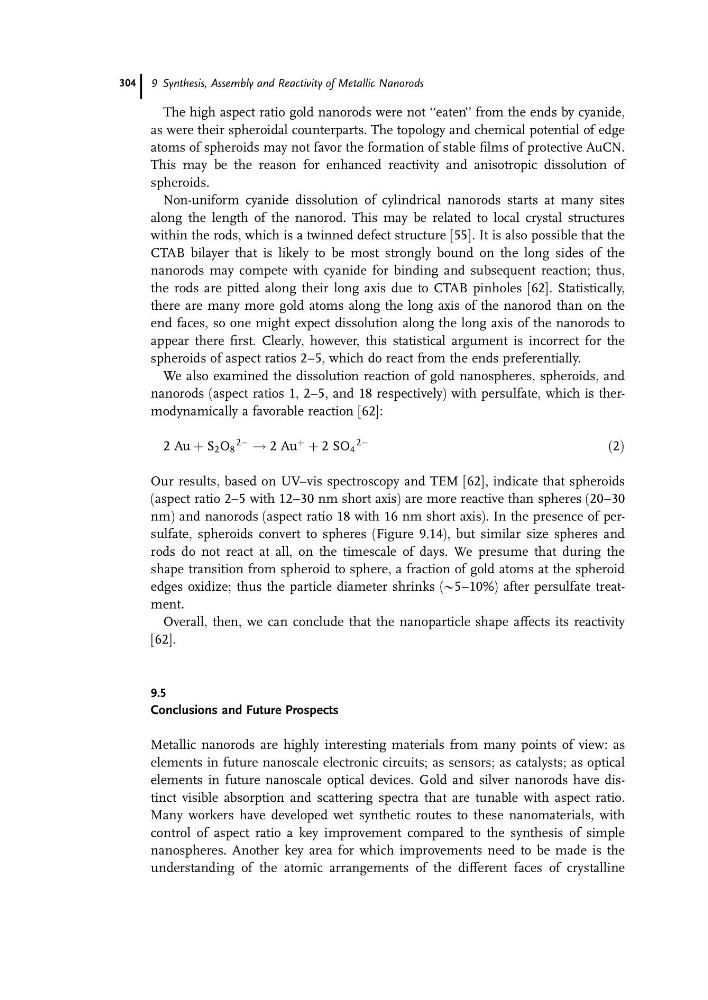
We also examined the dissolution reaction of gold nanospheres, spheroids, and
nanorods (aspect ratios 1, 2–5, and 18 respectively) with persulfate, which is thermodynamically a favorable reaction [62]:
2 Au þ S 2 O 8
2À ! 2 Au
þ þ 2 SO 4
2À
ð2Þ
Our results, based on UV–vis spectroscopy and TEM [62], indicate that spheroids
(aspect ratio 2–5 with 12–30 nm short axis) are more reactive than spheres (20–30
nm) and nanorods (aspect ratio 18 with 16 nm short axis). In the presence of persulfate, spheroids convert to spheres (Figure 9.14), but similar size spheres and
rods do not react at all, on the timescale of days. We presume that during the
shape transition from spheroid to sphere, a fraction of gold atoms at the spheroid
edges oxidize; thus the particle diameter shrinks (@5–10%) after persulfate treatment.
Overall, then, we can conclude that the nanoparticle shape affects its reactivity
[62].
9.5
Conclusions and Future Prospects
Metallic nanorods are highly interesting materials from many points of view: as
elements in future nanoscale electronic circuits; as sensors; as catalysts; as optical
elements in future nanoscale optical devices. Gold and silver nanorods have distinct visible absorption and scattering spectra that are tunable with aspect ratio.
Many workers have developed wet synthetic routes to these nanomaterials, with
control of aspect ratio a key improvement compared to the synthesis of simple
nanospheres. Another key area for which improvements need to be made is the
understanding of the atomic arrangements of the different faces of crystalline
9 Synthesis, Assembly and Reactivity of Metallic Nanorods
304
as were their spheroidal counterparts. The topology and chemical potential of edge
atoms of spheroids may not favor the formation of stable films of protective AuCN.
This may be the reason for enhanced reactivity and anisotropic dissolution of
spheroids.
Non-uniform cyanide dissolution of cylindrical nanorods starts at many sites
along the length of the nanorod. This may be related to local crystal structures
within the rods, which is a twinned defect structure [55]. It is also possible that the
CTAB bilayer that is likely to be most strongly bound on the long sides of the
nanorods may compete with cyanide for binding and subsequent reaction; thus,
the rods are pitted along their long axis due to CTAB pinholes [62]. Statistically,
there are many more gold atoms along the long axis of the nanorod than on the
end faces, so one might expect dissolution along the long axis of the nanorods to
appear there first. Clearly, however, this statistical argument is incorrect for the
spheroids of aspect ratios 2–5, which do react from the ends preferentially.
We also examined the dissolution reaction of gold nanospheres, spheroids, and
nanorods (aspect ratios 1, 2–5, and 18 respectively) with persulfate, which is thermodynamically a favorable reaction [62]:
2 Au þ S 2 O 8
2À ! 2 Au
þ þ 2 SO 4
2À
ð2Þ
Our results, based on UV–vis spectroscopy and TEM [62], indicate that spheroids
(aspect ratio 2–5 with 12–30 nm short axis) are more reactive than spheres (20–30
nm) and nanorods (aspect ratio 18 with 16 nm short axis). In the presence of persulfate, spheroids convert to spheres (Figure 9.14), but similar size spheres and
rods do not react at all, on the timescale of days. We presume that during the
shape transition from spheroid to sphere, a fraction of gold atoms at the spheroid
edges oxidize; thus the particle diameter shrinks (@5–10%) after persulfate treatment.
Overall, then, we can conclude that the nanoparticle shape affects its reactivity
[62].
9.5
Conclusions and Future Prospects
Metallic nanorods are highly interesting materials from many points of view: as
elements in future nanoscale electronic circuits; as sensors; as catalysts; as optical
elements in future nanoscale optical devices. Gold and silver nanorods have distinct visible absorption and scattering spectra that are tunable with aspect ratio.
Many workers have developed wet synthetic routes to these nanomaterials, with
control of aspect ratio a key improvement compared to the synthesis of simple
nanospheres. Another key area for which improvements need to be made is the
understanding of the atomic arrangements of the different faces of crystalline
9 Synthesis, Assembly and Reactivity of Metallic Nanorods
304