

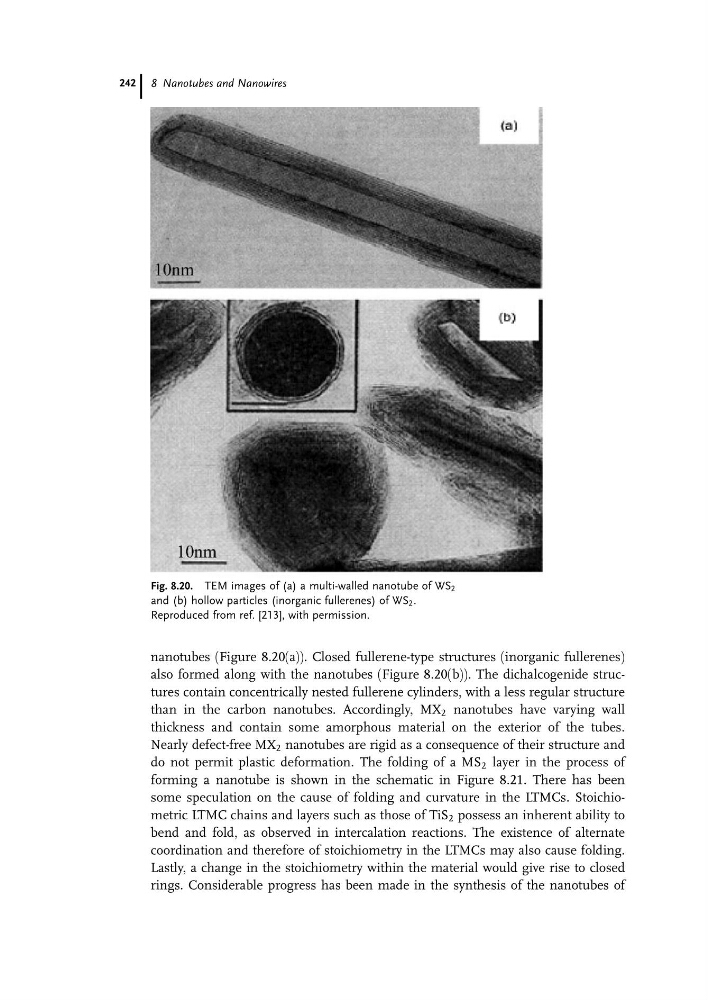
nanotubes (Figure 8.20(a)). Closed fullerene-type structures (inorganic fullerenes)
also formed along with the nanotubes (Figure 8.20(b)). The dichalcogenide structures contain concentrically nested fullerene cylinders, with a less regular structure
than in the carbon nanotubes. Accordingly, MX 2 nanotubes have varying wall
thickness and contain some amorphous material on the exterior of the tubes.
Nearly defect-free MX 2 nanotubes are rigid as a consequence of their structure and
do not permit plastic deformation. The folding of a MS 2 layer in the process of
forming a nanotube is shown in the schematic in Figure 8.21. There has been
some speculation on the cause of folding and curvature in the LTMCs. Stoichiometric LTMC chains and layers such as those of TiS 2 possess an inherent ability to
bend and fold, as observed in intercalation reactions. The existence of alternate
coordination and therefore of stoichiometry in the LTMCs may also cause folding.
Lastly, a change in the stoichiometry within the material would give rise to closed
rings. Considerable progress has been made in the synthesis of the nanotubes of
Fig. 8.20. TEM images of (a) a multi-walled nanotube of WS 2
and (b) hollow particles (inorganic fullerenes) of WS 2 .
Reproduced from ref. [213], with permission.
8 Nanotubes and Nanowires
242
also formed along with the nanotubes (Figure 8.20(b)). The dichalcogenide structures contain concentrically nested fullerene cylinders, with a less regular structure
than in the carbon nanotubes. Accordingly, MX 2 nanotubes have varying wall
thickness and contain some amorphous material on the exterior of the tubes.
Nearly defect-free MX 2 nanotubes are rigid as a consequence of their structure and
do not permit plastic deformation. The folding of a MS 2 layer in the process of
forming a nanotube is shown in the schematic in Figure 8.21. There has been
some speculation on the cause of folding and curvature in the LTMCs. Stoichiometric LTMC chains and layers such as those of TiS 2 possess an inherent ability to
bend and fold, as observed in intercalation reactions. The existence of alternate
coordination and therefore of stoichiometry in the LTMCs may also cause folding.
Lastly, a change in the stoichiometry within the material would give rise to closed
rings. Considerable progress has been made in the synthesis of the nanotubes of
Fig. 8.20. TEM images of (a) a multi-walled nanotube of WS 2
and (b) hollow particles (inorganic fullerenes) of WS 2 .
Reproduced from ref. [213], with permission.
8 Nanotubes and Nanowires
242