

mode [211]. The MX 2 layers are stacked along the c-direction in ABAB fashion.
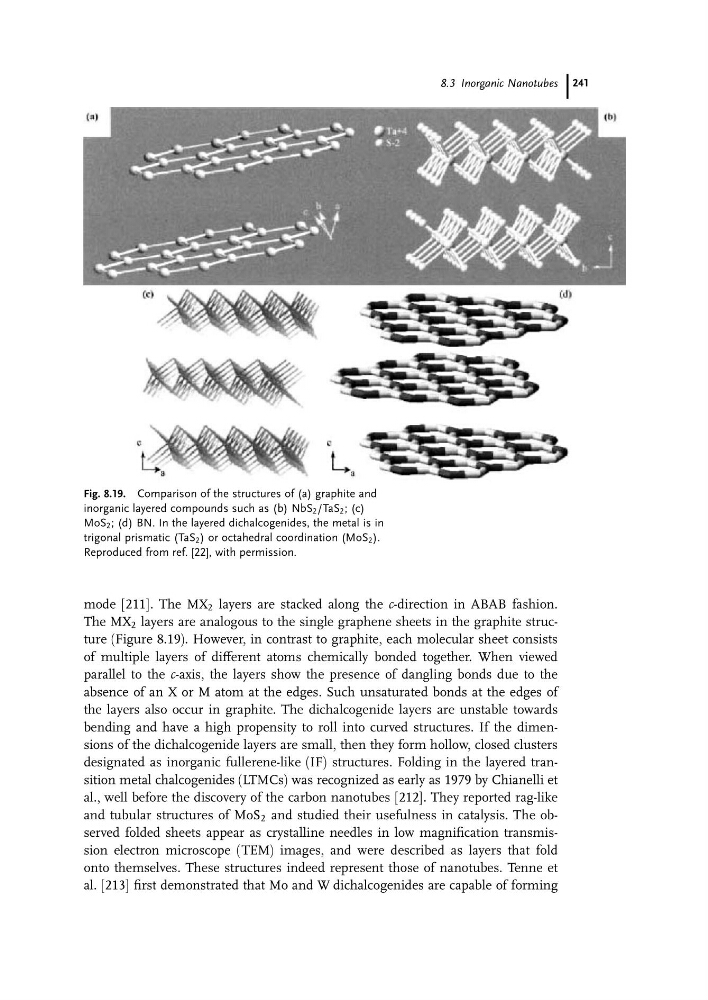
The MX 2 layers are analogous to the single graphene sheets in the graphite structure (Figure 8.19). However, in contrast to graphite, each molecular sheet consists
of multiple layers of different atoms chemically bonded together. When viewed
parallel to the c-axis, the layers show the presence of dangling bonds due to the
absence of an X or M atom at the edges. Such unsaturated bonds at the edges of
the layers also occur in graphite. The dichalcogenide layers are unstable towards
bending and have a high propensity to roll into curved structures. If the dimensions of the dichalcogenide layers are small, then they form hollow, closed clusters
designated as inorganic fullerene-like (IF) structures. Folding in the layered transition metal chalcogenides (LTMCs) was recognized as early as 1979 by Chianelli et
al., well before the discovery of the carbon nanotubes [212]. They reported rag-like
and tubular structures of MoS 2 and studied their usefulness in catalysis. The observed folded sheets appear as crystalline needles in low magnification transmission electron microscope (TEM) images, and were described as layers that fold
onto themselves. These structures indeed represent those of nanotubes. Tenne et
al. [213] first demonstrated that Mo and W dichalcogenides are capable of forming
Fig. 8.19. Comparison of the structures of (a) graphite and
inorganic layered compounds such as (b) NbS 2 /TaS 2 ; (c)
MoS 2 ; (d) BN. In the layered dichalcogenides, the metal is in
trigonal prismatic (TaS 2 ) or octahedral coordination (MoS 2 ).
Reproduced from ref. [22], with permission.
8.3 Inorganic Nanotubes 241
The MX 2 layers are analogous to the single graphene sheets in the graphite structure (Figure 8.19). However, in contrast to graphite, each molecular sheet consists
of multiple layers of different atoms chemically bonded together. When viewed
parallel to the c-axis, the layers show the presence of dangling bonds due to the
absence of an X or M atom at the edges. Such unsaturated bonds at the edges of
the layers also occur in graphite. The dichalcogenide layers are unstable towards
bending and have a high propensity to roll into curved structures. If the dimensions of the dichalcogenide layers are small, then they form hollow, closed clusters
designated as inorganic fullerene-like (IF) structures. Folding in the layered transition metal chalcogenides (LTMCs) was recognized as early as 1979 by Chianelli et
al., well before the discovery of the carbon nanotubes [212]. They reported rag-like
and tubular structures of MoS 2 and studied their usefulness in catalysis. The observed folded sheets appear as crystalline needles in low magnification transmission electron microscope (TEM) images, and were described as layers that fold
onto themselves. These structures indeed represent those of nanotubes. Tenne et
al. [213] first demonstrated that Mo and W dichalcogenides are capable of forming
Fig. 8.19. Comparison of the structures of (a) graphite and
inorganic layered compounds such as (b) NbS 2 /TaS 2 ; (c)
MoS 2 ; (d) BN. In the layered dichalcogenides, the metal is in
trigonal prismatic (TaS 2 ) or octahedral coordination (MoS 2 ).
Reproduced from ref. [22], with permission.
8.3 Inorganic Nanotubes 241