

halides (chlorides, bromides, and iodides), oxides, and numerous ternary (quaternary) compounds being important examples. The metal dichalcogenides, MX 2
(M ¼ Mo, W, Nb, Hf; X ¼ S, Se) contain a metal layer sandwiched between two
chalcogen layers with the metal in a trigonal pyramidal or octahedral coordination
0
100
200
300
400
500
600
0.0
0.5
1.0
1.5
2.0
2.5
3.0
3.5
4.0
I
II
III
IV
V
VI
VII
VIII
IX
Carbon fibres
Weight % H 2
adsorbed
Time / minutes
0
300
600
900
1200
0
10
20
30
40
50
3.75 wt.%, VIII
3.07 wt.%, Pd/MWNT
2.8 wt.%, II
1.97 wt.%, V
1.07 wt.%, Pt/MWNT
Number of cycles
Charging capacity / mAhg
-1
(b)
(a)
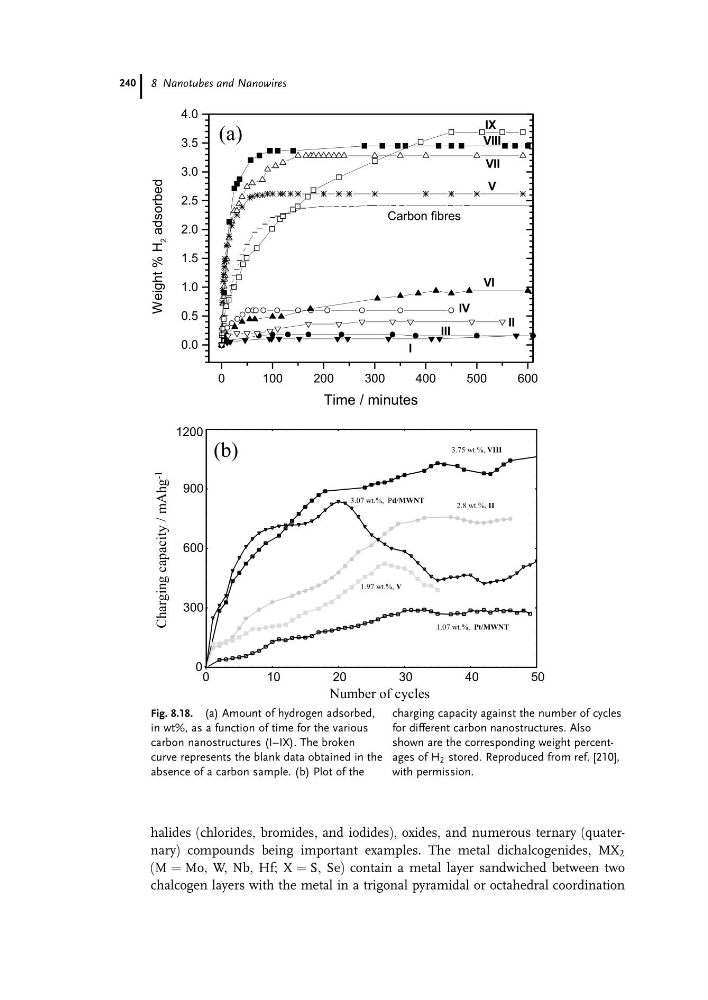
Fig. 8.18. (a) Amount of hydrogen adsorbed,
in wt%, as a function of time for the various
carbon nanostructures (I–IX). The broken
curve represents the blank data obtained in the
absence of a carbon sample. (b) Plot of the
charging capacity against the number of cycles
for different carbon nanostructures. Also
shown are the corresponding weight percentages of H 2 stored. Reproduced from ref. [210],
with permission.
8 Nanotubes and Nanowires
240
(M ¼ Mo, W, Nb, Hf; X ¼ S, Se) contain a metal layer sandwiched between two
chalcogen layers with the metal in a trigonal pyramidal or octahedral coordination
0
100
200
300
400
500
600
0.0
0.5
1.0
1.5
2.0
2.5
3.0
3.5
4.0
I
II
III
IV
V
VI
VII
VIII
IX
Carbon fibres
Weight % H 2
adsorbed
Time / minutes
0
300
600
900
1200
0
10
20
30
40
50
3.75 wt.%, VIII
3.07 wt.%, Pd/MWNT
2.8 wt.%, II
1.97 wt.%, V
1.07 wt.%, Pt/MWNT
Number of cycles
Charging capacity / mAhg
-1
(b)
(a)
Fig. 8.18. (a) Amount of hydrogen adsorbed,
in wt%, as a function of time for the various
carbon nanostructures (I–IX). The broken
curve represents the blank data obtained in the
absence of a carbon sample. (b) Plot of the
charging capacity against the number of cycles
for different carbon nanostructures. Also
shown are the corresponding weight percentages of H 2 stored. Reproduced from ref. [210],
with permission.
8 Nanotubes and Nanowires
240