

8.2.1.2 Aligned Carbon Nanotube Bundles
Carbon nanotubes are potential candidates for use as field emitters [36]. Of particular relevance to this application is the synthesis of aligned nanotube bundles.
Aligned nanotube bundles have been obtained by chemical vapor deposition (CVD)
over transition metal catalysts embedded in the pores of mesoporous silica or the
channels of alumina membranes [37, 38]. Terrones et al. [39, 40] prepared aligned
nanotubes over silica substrates, laser-patterned with cobalt. Ren et al. [41] employed plasma-enhanced chemical vapor deposition on nickel-coated glass, using
acetylene and ammonia mixtures, for this purpose. The mechanism of the growth
of nanotubes by this method and the exact role of the metal particles are not clear,
although a nucleation process involving the metal particles is considered to be important. Fan et al. [42] have obtained aligned nanotubes by employing CVD on
porous silicon and plain silicon substrates patterned with Fe films. The role of the
transition metal particles assumes importance in view of the report of Pan et al.
[43] that aligned nanotubes can be obtained by the pyrolysis of acetylene over iron/
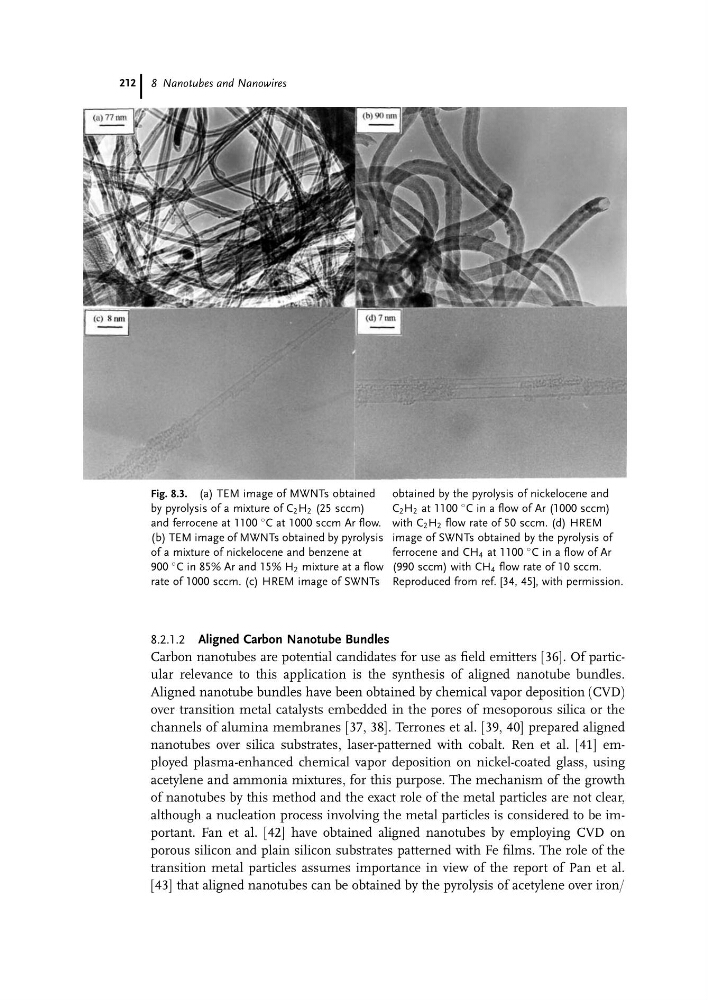
Fig. 8.3. (a) TEM image of MWNTs obtained
by pyrolysis of a mixture of C 2 H 2 (25 sccm)
and ferrocene at 1100
C at 1000 sccm Ar flow.
(b) TEM image of MWNTs obtained by pyrolysis
of a mixture of nickelocene and benzene at
900
C in 85% Ar and 15% H 2 mixture at a flow
rate of 1000 sccm. (c) HREM image of SWNTs
obtained by the pyrolysis of nickelocene and
C 2 H 2 at 1100
C in a flow of Ar (1000 sccm)
with C 2 H 2 flow rate of 50 sccm. (d) HREM
image of SWNTs obtained by the pyrolysis of
ferrocene and CH 4 at 1100
C in a flow of Ar
(990 sccm) with CH 4 flow rate of 10 sccm.
Reproduced from ref. [34, 45], with permission.
8 Nanotubes and Nanowires
212
Carbon nanotubes are potential candidates for use as field emitters [36]. Of particular relevance to this application is the synthesis of aligned nanotube bundles.
Aligned nanotube bundles have been obtained by chemical vapor deposition (CVD)
over transition metal catalysts embedded in the pores of mesoporous silica or the
channels of alumina membranes [37, 38]. Terrones et al. [39, 40] prepared aligned
nanotubes over silica substrates, laser-patterned with cobalt. Ren et al. [41] employed plasma-enhanced chemical vapor deposition on nickel-coated glass, using
acetylene and ammonia mixtures, for this purpose. The mechanism of the growth
of nanotubes by this method and the exact role of the metal particles are not clear,
although a nucleation process involving the metal particles is considered to be important. Fan et al. [42] have obtained aligned nanotubes by employing CVD on
porous silicon and plain silicon substrates patterned with Fe films. The role of the
transition metal particles assumes importance in view of the report of Pan et al.
[43] that aligned nanotubes can be obtained by the pyrolysis of acetylene over iron/
Fig. 8.3. (a) TEM image of MWNTs obtained
by pyrolysis of a mixture of C 2 H 2 (25 sccm)
and ferrocene at 1100
C at 1000 sccm Ar flow.
(b) TEM image of MWNTs obtained by pyrolysis
of a mixture of nickelocene and benzene at
900
C in 85% Ar and 15% H 2 mixture at a flow
rate of 1000 sccm. (c) HREM image of SWNTs
obtained by the pyrolysis of nickelocene and
C 2 H 2 at 1100
C in a flow of Ar (1000 sccm)
with C 2 H 2 flow rate of 50 sccm. (d) HREM
image of SWNTs obtained by the pyrolysis of
ferrocene and CH 4 at 1100
C in a flow of Ar
(990 sccm) with CH 4 flow rate of 10 sccm.
Reproduced from ref. [34, 45], with permission.
8 Nanotubes and Nanowires
212