

silica catalyst surfaces. In the light of the earlier work on the synthesis of carbon
nanotubes by the pyrolysis of mixtures of organometallic precursors and hydrocarbons, [34, 35] one would expect that the transition metal nanoparticles produced
in situ in the pyrolysis, may not only nucleate the formation of carbon nanotubes
but also align them. This aspect has been examined by carrying out the pyrolysis of
metallocenes along with additional hydrocarbon sources, in a suitably designed
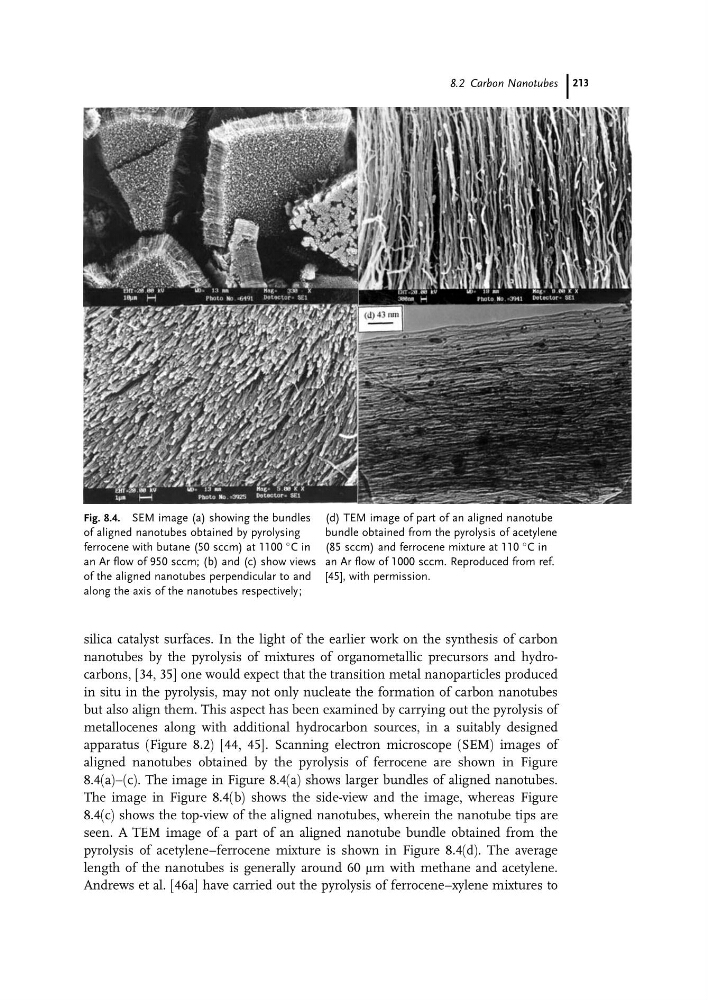
apparatus (Figure 8.2) [44, 45]. Scanning electron microscope (SEM) images of
aligned nanotubes obtained by the pyrolysis of ferrocene are shown in Figure
8.4(a)–(c). The image in Figure 8.4(a) shows larger bundles of aligned nanotubes.
The image in Figure 8.4(b) shows the side-view and the image, whereas Figure
8.4(c) shows the top-view of the aligned nanotubes, wherein the nanotube tips are
seen. A TEM image of a part of an aligned nanotube bundle obtained from the
pyrolysis of acetylene–ferrocene mixture is shown in Figure 8.4(d). The average
length of the nanotubes is generally around 60 mm with methane and acetylene.
Andrews et al. [46a] have carried out the pyrolysis of ferrocene–xylene mixtures to
Fig. 8.4. SEM image (a) showing the bundles
of aligned nanotubes obtained by pyrolysing
ferrocene with butane (50 sccm) at 1100
C in
an Ar flow of 950 sccm; (b) and (c) show views
of the aligned nanotubes perpendicular to and
along the axis of the nanotubes respectively;
(d) TEM image of part of an aligned nanotube
bundle obtained from the pyrolysis of acetylene
(85 sccm) and ferrocene mixture at 110
C in
an Ar flow of 1000 sccm. Reproduced from ref.
[45], with permission.
8.2 Carbon Nanotubes 213
nanotubes by the pyrolysis of mixtures of organometallic precursors and hydrocarbons, [34, 35] one would expect that the transition metal nanoparticles produced
in situ in the pyrolysis, may not only nucleate the formation of carbon nanotubes
but also align them. This aspect has been examined by carrying out the pyrolysis of
metallocenes along with additional hydrocarbon sources, in a suitably designed
apparatus (Figure 8.2) [44, 45]. Scanning electron microscope (SEM) images of
aligned nanotubes obtained by the pyrolysis of ferrocene are shown in Figure
8.4(a)–(c). The image in Figure 8.4(a) shows larger bundles of aligned nanotubes.
The image in Figure 8.4(b) shows the side-view and the image, whereas Figure
8.4(c) shows the top-view of the aligned nanotubes, wherein the nanotube tips are
seen. A TEM image of a part of an aligned nanotube bundle obtained from the
pyrolysis of acetylene–ferrocene mixture is shown in Figure 8.4(d). The average
length of the nanotubes is generally around 60 mm with methane and acetylene.
Andrews et al. [46a] have carried out the pyrolysis of ferrocene–xylene mixtures to
Fig. 8.4. SEM image (a) showing the bundles
of aligned nanotubes obtained by pyrolysing
ferrocene with butane (50 sccm) at 1100
C in
an Ar flow of 950 sccm; (b) and (c) show views
of the aligned nanotubes perpendicular to and
along the axis of the nanotubes respectively;
(d) TEM image of part of an aligned nanotube
bundle obtained from the pyrolysis of acetylene
(85 sccm) and ferrocene mixture at 110
C in
an Ar flow of 1000 sccm. Reproduced from ref.
[45], with permission.
8.2 Carbon Nanotubes 213