

evaporation technique, carbon nanotubes are produced by the decomposition of
hydrocarbons such as C 2 H 2 under inert conditions at around 700
C, over Fe/
graphite [30], Co/graphite [31] or Fe/silica [32] catalysts. The presence of transition
metal particles is essential for the formation of nanotubes by the pyrolysis process,
and the diameter of the nanotube is determined by the size of the metal particles
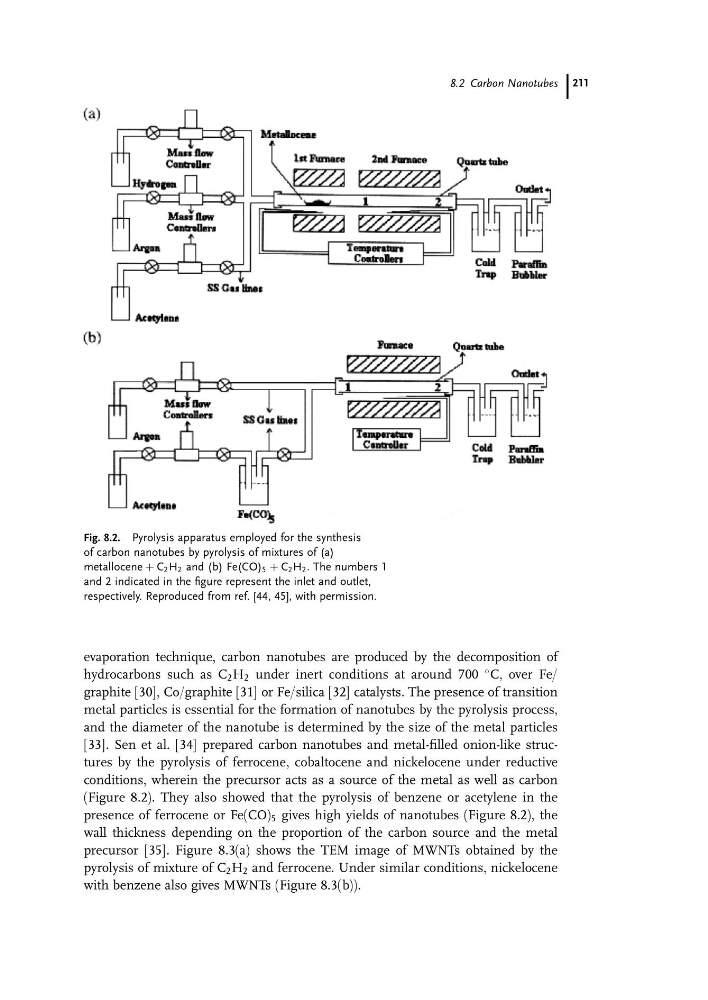
[33]. Sen et al. [34] prepared carbon nanotubes and metal-filled onion-like structures by the pyrolysis of ferrocene, cobaltocene and nickelocene under reductive
conditions, wherein the precursor acts as a source of the metal as well as carbon
(Figure 8.2). They also showed that the pyrolysis of benzene or acetylene in the
presence of ferrocene or Fe(CO) 5 gives high yields of nanotubes (Figure 8.2), the
wall thickness depending on the proportion of the carbon source and the metal
precursor [35]. Figure 8.3(a) shows the TEM image of MWNTs obtained by the
pyrolysis of mixture of C 2 H 2 and ferrocene. Under similar conditions, nickelocene
with benzene also gives MWNTs (Figure 8.3(b)).
Fig. 8.2. Pyrolysis apparatus employed for the synthesis
of carbon nanotubes by pyrolysis of mixtures of (a)
metallocene þ C 2 H 2 and (b) Fe(CO) 5 þ C 2 H 2 . The numbers 1
and 2 indicated in the figure represent the inlet and outlet,
respectively. Reproduced from ref. [44, 45], with permission.
8.2 Carbon Nanotubes 211
hydrocarbons such as C 2 H 2 under inert conditions at around 700
C, over Fe/
graphite [30], Co/graphite [31] or Fe/silica [32] catalysts. The presence of transition
metal particles is essential for the formation of nanotubes by the pyrolysis process,
and the diameter of the nanotube is determined by the size of the metal particles
[33]. Sen et al. [34] prepared carbon nanotubes and metal-filled onion-like structures by the pyrolysis of ferrocene, cobaltocene and nickelocene under reductive
conditions, wherein the precursor acts as a source of the metal as well as carbon
(Figure 8.2). They also showed that the pyrolysis of benzene or acetylene in the
presence of ferrocene or Fe(CO) 5 gives high yields of nanotubes (Figure 8.2), the
wall thickness depending on the proportion of the carbon source and the metal
precursor [35]. Figure 8.3(a) shows the TEM image of MWNTs obtained by the
pyrolysis of mixture of C 2 H 2 and ferrocene. Under similar conditions, nickelocene
with benzene also gives MWNTs (Figure 8.3(b)).
Fig. 8.2. Pyrolysis apparatus employed for the synthesis
of carbon nanotubes by pyrolysis of mixtures of (a)
metallocene þ C 2 H 2 and (b) Fe(CO) 5 þ C 2 H 2 . The numbers 1
and 2 indicated in the figure represent the inlet and outlet,
respectively. Reproduced from ref. [44, 45], with permission.
8.2 Carbon Nanotubes 211