

aggregates most heavily. By using CS 2 as the sulfur source, nanocrystalline CdS
of sphalerite and wurtzite structure [153] and nanocrystalline MS (M ¼ Pb or Cu)
[154] were prepared. Similarly, when NaSeSO 3 was used as the selenium source,
10 nm nonstoichiometric Cu 2Àx Se was obtained [155].
As various organic monomers, such as acrylamide, acrylonitrile, vinyl acetate,
maleic acid and styrene, can polymerize at the same time as forming inorganic
nanomaterials, various kinds of polymer–inorganic nanocomposites can be prepared at room temperature by a g-irradiation synthesis method.
The g-ray irradiation method offers a practical means for fabrication of
inorganic/polymer core/sheath nanostructures under ambient conditions. From a
heterogeneous system of vinyl acetate momomer, CdSO 4 Á8H 2 O and Na 2 SeSO 3 in
aqueous isopropanol solution, novel nanocables of CdSe-core/poly(vinyl acetate)sheath were prepared under g-irradiation at room temperature [156]. As shown in
Figure 7.37, the TEM images show that the as-prepared nanocable has an inner
diameter as small as 6 nm, an outer diameter of about 80 nm and is some 5 mm in
overall length. The image contrast of CdSe and amorphous polymer can be clearly
observed. The electron diffraction pattern indicates the crystalline CdSe core. The
HRTEM image reveals the lattice fringes of CdSe nanowire and the amorphous
polymer sheath, in which plane the intervals of the CdSe area exactly agree with
the (200) plane of cubic CdSe. In the synthetic process, the organic monomers may
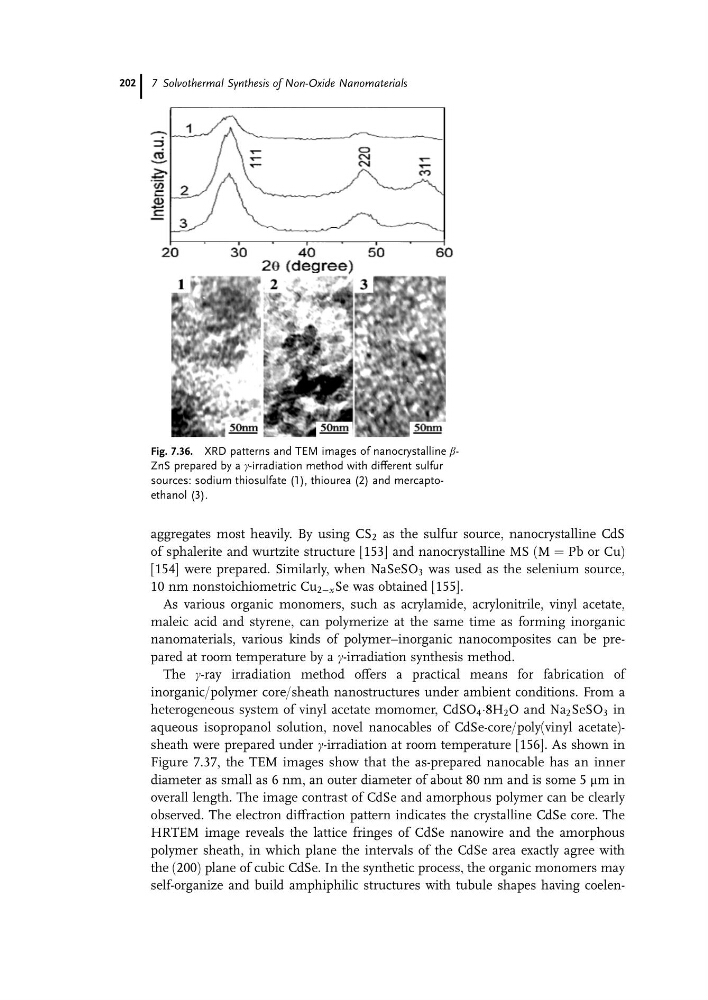
self-organize and build amphiphilic structures with tubule shapes having coelenFig. 7.36. XRD patterns and TEM images of nanocrystalline bZnS prepared by a g-irradiation method with different sulfur
sources: sodium thiosulfate (1), thiourea (2) and mercaptoethanol (3).
7 Solvothermal Synthesis of Non-Oxide Nanomaterials
202
of sphalerite and wurtzite structure [153] and nanocrystalline MS (M ¼ Pb or Cu)
[154] were prepared. Similarly, when NaSeSO 3 was used as the selenium source,
10 nm nonstoichiometric Cu 2Àx Se was obtained [155].
As various organic monomers, such as acrylamide, acrylonitrile, vinyl acetate,
maleic acid and styrene, can polymerize at the same time as forming inorganic
nanomaterials, various kinds of polymer–inorganic nanocomposites can be prepared at room temperature by a g-irradiation synthesis method.
The g-ray irradiation method offers a practical means for fabrication of
inorganic/polymer core/sheath nanostructures under ambient conditions. From a
heterogeneous system of vinyl acetate momomer, CdSO 4 Á8H 2 O and Na 2 SeSO 3 in
aqueous isopropanol solution, novel nanocables of CdSe-core/poly(vinyl acetate)sheath were prepared under g-irradiation at room temperature [156]. As shown in
Figure 7.37, the TEM images show that the as-prepared nanocable has an inner
diameter as small as 6 nm, an outer diameter of about 80 nm and is some 5 mm in
overall length. The image contrast of CdSe and amorphous polymer can be clearly
observed. The electron diffraction pattern indicates the crystalline CdSe core. The
HRTEM image reveals the lattice fringes of CdSe nanowire and the amorphous
polymer sheath, in which plane the intervals of the CdSe area exactly agree with
the (200) plane of cubic CdSe. In the synthetic process, the organic monomers may
self-organize and build amphiphilic structures with tubule shapes having coelenFig. 7.36. XRD patterns and TEM images of nanocrystalline bZnS prepared by a g-irradiation method with different sulfur
sources: sodium thiosulfate (1), thiourea (2) and mercaptoethanol (3).
7 Solvothermal Synthesis of Non-Oxide Nanomaterials
202