

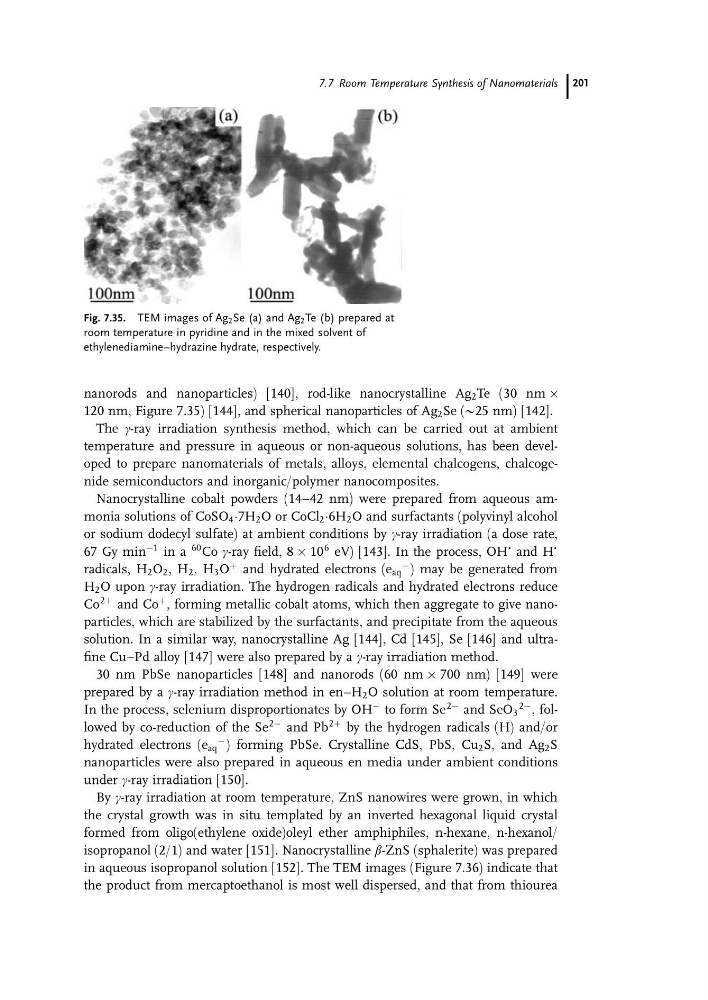
nanorods and nanoparticles) [140], rod-like nanocrystalline Ag 2 Te (30 nm Â
120 nm, Figure 7.35) [144], and spherical nanoparticles of Ag 2 Se (@25 nm) [142].
The g-ray irradiation synthesis method, which can be carried out at ambient
temperature and pressure in aqueous or non-aqueous solutions, has been developed to prepare nanomaterials of metals, alloys, elemental chalcogens, chalcogenide semiconductors and inorganic/polymer nanocomposites.
Nanocrystalline cobalt powders (14–42 nm) were prepared from aqueous ammonia solutions of CoSO 4 Á7H 2 O or CoCl 2 Á6H 2 O and surfactants (polyvinyl alcohol
or sodium dodecyl sulfate) at ambient conditions by g-ray irradiation (a dose rate,
67 Gy min
À1 in a
60 Co g-ray field, 8 Â 10
6 eV) [143]. In the process, OH . and H .
radicals, H 2 O 2 , H 2 , H 3 O
þ and hydrated electrons (e aq
À ) may be generated from
H 2 O upon g-ray irradiation. The hydrogen radicals and hydrated electrons reduce
Co
2þ and Co
þ , forming metallic cobalt atoms, which then aggregate to give nanoparticles, which are stabilized by the surfactants, and precipitate from the aqueous
solution. In a similar way, nanocrystalline Ag [144], Cd [145], Se [146] and ultrafine CuaPd alloy [147] were also prepared by a g-ray irradiation method.
30 nm PbSe nanoparticles [148] and nanorods (60 nm  700 nm) [149] were
prepared by a g-ray irradiation method in en–H 2 O solution at room temperature.
In the process, selenium disproportionates by OH
À to form Se
2À and SeO 3
2À , followed by co-reduction of the Se
2À and Pb
2þ by the hydrogen radicals (H) and/or
hydrated electrons (e aq
À ) forming PbSe. Crystalline CdS, PbS, Cu 2 S, and Ag 2 S
nanoparticles were also prepared in aqueous en media under ambient conditions
under g-ray irradiation [150].
By g-ray irradiation at room temperature, ZnS nanowires were grown, in which
the crystal growth was in situ templated by an inverted hexagonal liquid crystal
formed from oligo(ethylene oxide)oleyl ether amphiphiles, n-hexane, n-hexanol/
isopropanol (2/1) and water [151]. Nanocrystalline b-ZnS (sphalerite) was prepared
in aqueous isopropanol solution [152]. The TEM images (Figure 7.36) indicate that
the product from mercaptoethanol is most well dispersed, and that from thiourea
Fig. 7.35. TEM images of Ag 2 Se (a) and Ag 2 Te (b) prepared at
room temperature in pyridine and in the mixed solvent of
ethylenediamine–hydrazine hydrate, respectively.
7.7 Room Temperature Synthesis of Nanomaterials 201
120 nm, Figure 7.35) [144], and spherical nanoparticles of Ag 2 Se (@25 nm) [142].
The g-ray irradiation synthesis method, which can be carried out at ambient
temperature and pressure in aqueous or non-aqueous solutions, has been developed to prepare nanomaterials of metals, alloys, elemental chalcogens, chalcogenide semiconductors and inorganic/polymer nanocomposites.
Nanocrystalline cobalt powders (14–42 nm) were prepared from aqueous ammonia solutions of CoSO 4 Á7H 2 O or CoCl 2 Á6H 2 O and surfactants (polyvinyl alcohol
or sodium dodecyl sulfate) at ambient conditions by g-ray irradiation (a dose rate,
67 Gy min
À1 in a
60 Co g-ray field, 8 Â 10
6 eV) [143]. In the process, OH . and H .
radicals, H 2 O 2 , H 2 , H 3 O
þ and hydrated electrons (e aq
À ) may be generated from
H 2 O upon g-ray irradiation. The hydrogen radicals and hydrated electrons reduce
Co
2þ and Co
þ , forming metallic cobalt atoms, which then aggregate to give nanoparticles, which are stabilized by the surfactants, and precipitate from the aqueous
solution. In a similar way, nanocrystalline Ag [144], Cd [145], Se [146] and ultrafine CuaPd alloy [147] were also prepared by a g-ray irradiation method.
30 nm PbSe nanoparticles [148] and nanorods (60 nm  700 nm) [149] were
prepared by a g-ray irradiation method in en–H 2 O solution at room temperature.
In the process, selenium disproportionates by OH
À to form Se
2À and SeO 3
2À , followed by co-reduction of the Se
2À and Pb
2þ by the hydrogen radicals (H) and/or
hydrated electrons (e aq
À ) forming PbSe. Crystalline CdS, PbS, Cu 2 S, and Ag 2 S
nanoparticles were also prepared in aqueous en media under ambient conditions
under g-ray irradiation [150].
By g-ray irradiation at room temperature, ZnS nanowires were grown, in which
the crystal growth was in situ templated by an inverted hexagonal liquid crystal
formed from oligo(ethylene oxide)oleyl ether amphiphiles, n-hexane, n-hexanol/
isopropanol (2/1) and water [151]. Nanocrystalline b-ZnS (sphalerite) was prepared
in aqueous isopropanol solution [152]. The TEM images (Figure 7.36) indicate that
the product from mercaptoethanol is most well dispersed, and that from thiourea
Fig. 7.35. TEM images of Ag 2 Se (a) and Ag 2 Te (b) prepared at
room temperature in pyridine and in the mixed solvent of
ethylenediamine–hydrazine hydrate, respectively.
7.7 Room Temperature Synthesis of Nanomaterials 201