

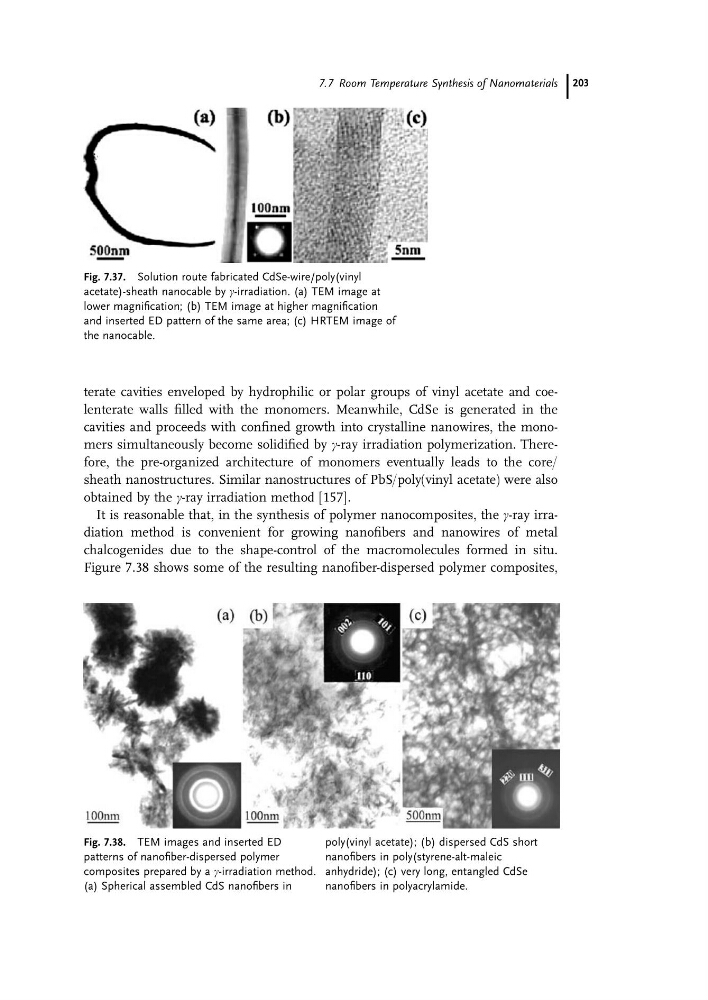
terate cavities enveloped by hydrophilic or polar groups of vinyl acetate and coelenterate walls filled with the monomers. Meanwhile, CdSe is generated in the
cavities and proceeds with confined growth into crystalline nanowires, the monomers simultaneously become solidified by g-ray irradiation polymerization. Therefore, the pre-organized architecture of monomers eventually leads to the core/
sheath nanostructures. Similar nanostructures of PbS/poly(vinyl acetate) were also
obtained by the g-ray irradiation method [157].
It is reasonable that, in the synthesis of polymer nanocomposites, the g-ray irradiation method is convenient for growing nanofibers and nanowires of metal
chalcogenides due to the shape-control of the macromolecules formed in situ.
Figure 7.38 shows some of the resulting nanofiber-dispersed polymer composites,
Fig. 7.37. Solution route fabricated CdSe-wire/poly(vinyl
acetate)-sheath nanocable by g-irradiation. (a) TEM image at
lower magnification; (b) TEM image at higher magnification
and inserted ED pattern of the same area; (c) HRTEM image of
the nanocable.
Fig. 7.38. TEM images and inserted ED
patterns of nanofiber-dispersed polymer
composites prepared by a g-irradiation method.
(a) Spherical assembled CdS nanofibers in
poly(vinyl acetate); (b) dispersed CdS short
nanofibers in poly(styrene-alt-maleic
anhydride); (c) very long, entangled CdSe
nanofibers in polyacrylamide.
7.7 Room Temperature Synthesis of Nanomaterials 203
cavities and proceeds with confined growth into crystalline nanowires, the monomers simultaneously become solidified by g-ray irradiation polymerization. Therefore, the pre-organized architecture of monomers eventually leads to the core/
sheath nanostructures. Similar nanostructures of PbS/poly(vinyl acetate) were also
obtained by the g-ray irradiation method [157].
It is reasonable that, in the synthesis of polymer nanocomposites, the g-ray irradiation method is convenient for growing nanofibers and nanowires of metal
chalcogenides due to the shape-control of the macromolecules formed in situ.
Figure 7.38 shows some of the resulting nanofiber-dispersed polymer composites,
Fig. 7.37. Solution route fabricated CdSe-wire/poly(vinyl
acetate)-sheath nanocable by g-irradiation. (a) TEM image at
lower magnification; (b) TEM image at higher magnification
and inserted ED pattern of the same area; (c) HRTEM image of
the nanocable.
Fig. 7.38. TEM images and inserted ED
patterns of nanofiber-dispersed polymer
composites prepared by a g-irradiation method.
(a) Spherical assembled CdS nanofibers in
poly(vinyl acetate); (b) dispersed CdS short
nanofibers in poly(styrene-alt-maleic
anhydride); (c) very long, entangled CdSe
nanofibers in polyacrylamide.
7.7 Room Temperature Synthesis of Nanomaterials 203