

7.6
Synthesis of One-Dimensional Metal Chalcogenide Nanocrystallites
Morphology control is very important for nanomaterials preparation due to the remarkable properties and potential applications of these materials ranging from
microscopy probes to nanoelectronic devices. Therefore, current attention has focused on the development of convenient approaches to the preparation of nanomaterials with controlled shapes and sizes. The solvothermal method has been
developed into a practical means of synthesis and controlling the morphology.
By designing reactions, choosing solvents, controlling reaction temperatures and
so forth, a series of metal chalcogenide nanomaterials, especially those with onedimensional and special shapes, have been prepared.
Quantum-confined CdS nanowires (Figure 7.27) (4 nm  150–250 nm) were
grown from the decomposition of the precursor, cadmium bis(diethyldithiocarbamate), in en at 117
C for 2 min [91]. Using this synthetic route, CdIn 2 S 4 nanorods
were prepared in an en/ethanol mixed solvent at 180
C (Figure 7.28). The ethanol
acts as the transportation reagent for InCl 3 while the en serves as the nucleophile,
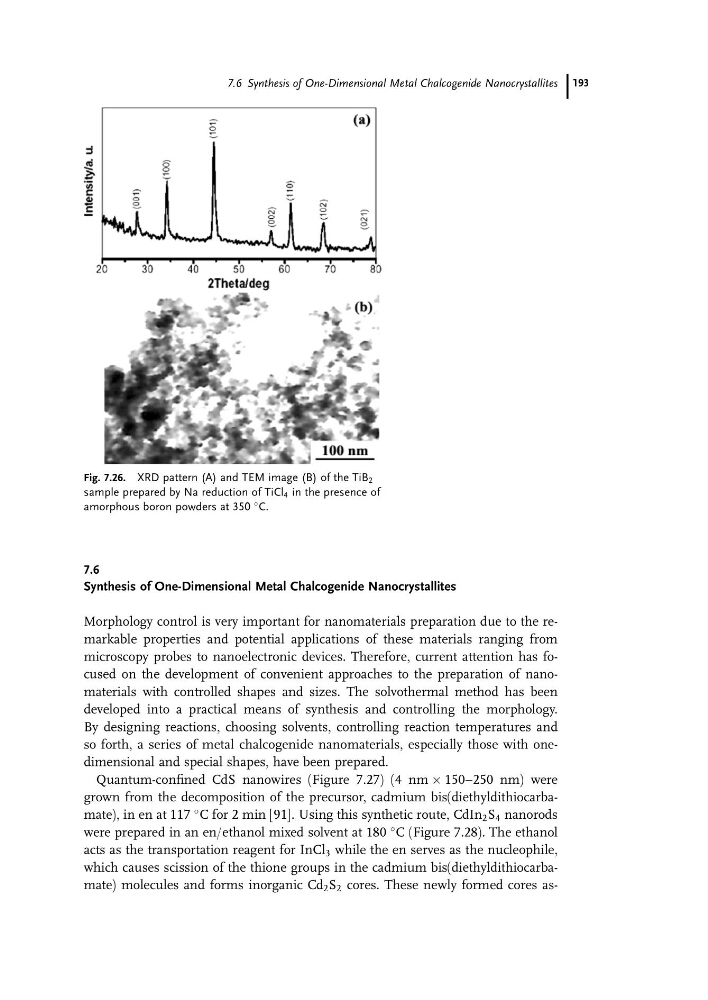
which causes scission of the thione groups in the cadmium bis(diethyldithiocarbamate) molecules and forms inorganic Cd 2 S 2 cores. These newly formed cores asFig. 7.26. XRD pattern (A) and TEM image (B) of the TiB 2
sample prepared by Na reduction of TiCl 4 in the presence of
amorphous boron powders at 350
C.
7.6 Synthesis of One-Dimensional Metal Chalcogenide Nanocrystallites 193
Synthesis of One-Dimensional Metal Chalcogenide Nanocrystallites
Morphology control is very important for nanomaterials preparation due to the remarkable properties and potential applications of these materials ranging from
microscopy probes to nanoelectronic devices. Therefore, current attention has focused on the development of convenient approaches to the preparation of nanomaterials with controlled shapes and sizes. The solvothermal method has been
developed into a practical means of synthesis and controlling the morphology.
By designing reactions, choosing solvents, controlling reaction temperatures and
so forth, a series of metal chalcogenide nanomaterials, especially those with onedimensional and special shapes, have been prepared.
Quantum-confined CdS nanowires (Figure 7.27) (4 nm  150–250 nm) were
grown from the decomposition of the precursor, cadmium bis(diethyldithiocarbamate), in en at 117
C for 2 min [91]. Using this synthetic route, CdIn 2 S 4 nanorods
were prepared in an en/ethanol mixed solvent at 180
C (Figure 7.28). The ethanol
acts as the transportation reagent for InCl 3 while the en serves as the nucleophile,
which causes scission of the thione groups in the cadmium bis(diethyldithiocarbamate) molecules and forms inorganic Cd 2 S 2 cores. These newly formed cores asFig. 7.26. XRD pattern (A) and TEM image (B) of the TiB 2
sample prepared by Na reduction of TiCl 4 in the presence of
amorphous boron powders at 350
C.
7.6 Synthesis of One-Dimensional Metal Chalcogenide Nanocrystallites 193