

prepared by various high-temperature reactions (up to 1000
C). Through metal
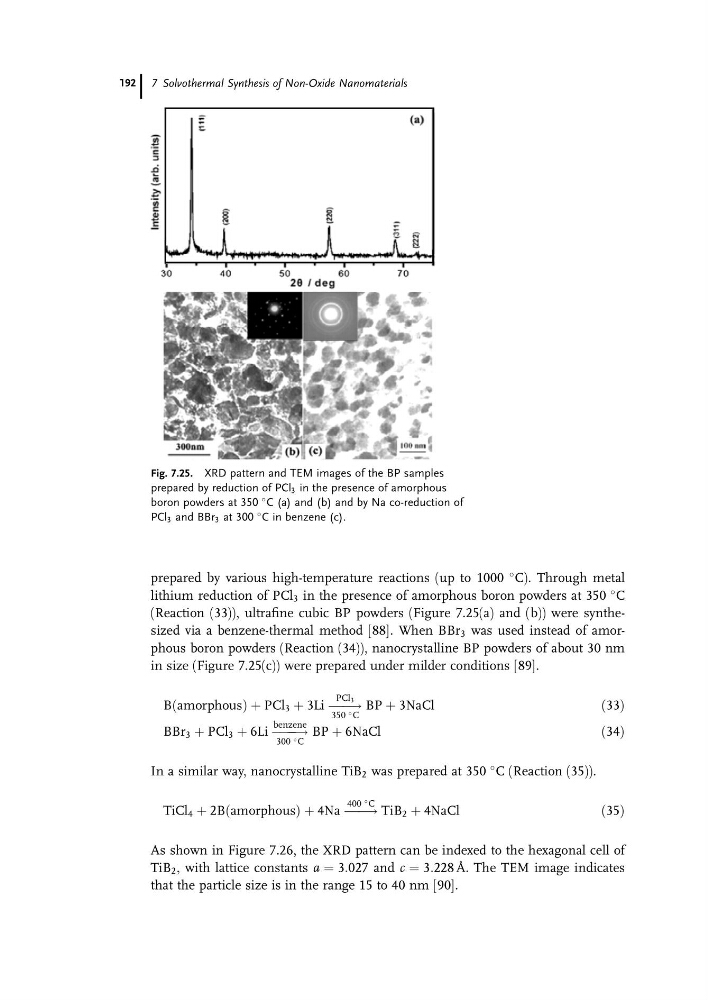
lithium reduction of PCl 3 in the presence of amorphous boron powders at 350
C
(Reaction (33)), ultrafine cubic BP powders (Figure 7.25(a) and (b)) were synthesized via a benzene-thermal method [88]. When BBr 3 was used instead of amorphous boron powders (Reaction (34)), nanocrystalline BP powders of about 30 nm
in size (Figure 7.25(c)) were prepared under milder conditions [89].
BðamorphousÞ þ PCl 3 þ 3Li !
PCl 3
350 C
BP þ 3NaCl
ð33Þ
BBr 3 þ PCl 3 þ 6Li !
benzene
300 C
BP þ 6NaCl
ð34Þ
In a similar way, nanocrystalline TiB 2 was prepared at 350
C (Reaction (35)).
TiCl 4 þ 2BðamorphousÞ þ 4Na !
400
C TiB 2 þ 4NaCl
ð35Þ
As shown in Figure 7.26, the XRD pattern can be indexed to the hexagonal cell of
TiB 2 , with lattice constants a ¼ 3:027 and c ¼ 3:228 A ˚ . The TEM image indicates
that the particle size is in the range 15 to 40 nm [90].
Fig. 7.25. XRD pattern and TEM images of the BP samples
prepared by reduction of PCl 3 in the presence of amorphous
boron powders at 350
C (a) and (b) and by Na co-reduction of
PCl 3 and BBr 3 at 300
C in benzene (c).
7 Solvothermal Synthesis of Non-Oxide Nanomaterials
192
C). Through metal
lithium reduction of PCl 3 in the presence of amorphous boron powders at 350
C
(Reaction (33)), ultrafine cubic BP powders (Figure 7.25(a) and (b)) were synthesized via a benzene-thermal method [88]. When BBr 3 was used instead of amorphous boron powders (Reaction (34)), nanocrystalline BP powders of about 30 nm
in size (Figure 7.25(c)) were prepared under milder conditions [89].
BðamorphousÞ þ PCl 3 þ 3Li !
PCl 3
350 C
BP þ 3NaCl
ð33Þ
BBr 3 þ PCl 3 þ 6Li !
benzene
300 C
BP þ 6NaCl
ð34Þ
In a similar way, nanocrystalline TiB 2 was prepared at 350
C (Reaction (35)).
TiCl 4 þ 2BðamorphousÞ þ 4Na !
400
C TiB 2 þ 4NaCl
ð35Þ
As shown in Figure 7.26, the XRD pattern can be indexed to the hexagonal cell of
TiB 2 , with lattice constants a ¼ 3:027 and c ¼ 3:228 A ˚ . The TEM image indicates
that the particle size is in the range 15 to 40 nm [90].
Fig. 7.25. XRD pattern and TEM images of the BP samples
prepared by reduction of PCl 3 in the presence of amorphous
boron powders at 350
C (a) and (b) and by Na co-reduction of
PCl 3 and BBr 3 at 300
C in benzene (c).
7 Solvothermal Synthesis of Non-Oxide Nanomaterials
192