

Boron carbide (B 4 C) is one of the hardest known materials with excellent properties of low density, very high chemical and thermal stability, and high neutron
absorption cross-section. Bulk B 4 C is conventionally synthesized by high temperature (up to 2400
C) reactions, such as the carbothermal reduction of boric acid or
boron oxide. Nanocrystalline B 4 C was solvothermally synthesized in CCl 4 at 600
C
(Reaction (32)).
4BðamorphousÞ þ CCl 4 þ 4Li !
CCl4
600 C
B 4 C þ 4LiCl
ð32Þ
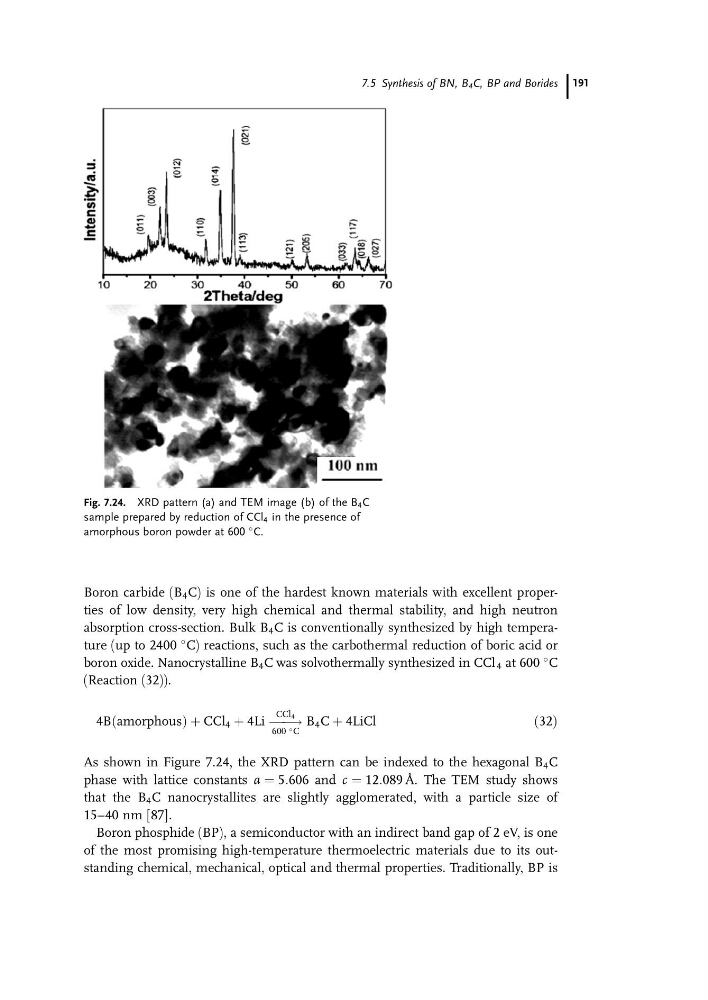
As shown in Figure 7.24, the XRD pattern can be indexed to the hexagonal B 4 C
phase with lattice constants a ¼ 5:606 and c ¼ 12:089 A ˚ . The TEM study shows
that the B 4 C nanocrystallites are slightly agglomerated, with a particle size of
15–40 nm [87].
Boron phosphide (BP), a semiconductor with an indirect band gap of 2 eV, is one
of the most promising high-temperature thermoelectric materials due to its outstanding chemical, mechanical, optical and thermal properties. Traditionally, BP is
Fig. 7.24. XRD pattern (a) and TEM image (b) of the B 4 C
sample prepared by reduction of CCl 4 in the presence of
amorphous boron powder at 600
C.
7.5 Synthesis of BN, B 4 C, BP and Borides 191
absorption cross-section. Bulk B 4 C is conventionally synthesized by high temperature (up to 2400
C) reactions, such as the carbothermal reduction of boric acid or
boron oxide. Nanocrystalline B 4 C was solvothermally synthesized in CCl 4 at 600
C
(Reaction (32)).
4BðamorphousÞ þ CCl 4 þ 4Li !
CCl4
600 C
B 4 C þ 4LiCl
ð32Þ
As shown in Figure 7.24, the XRD pattern can be indexed to the hexagonal B 4 C
phase with lattice constants a ¼ 5:606 and c ¼ 12:089 A ˚ . The TEM study shows
that the B 4 C nanocrystallites are slightly agglomerated, with a particle size of
15–40 nm [87].
Boron phosphide (BP), a semiconductor with an indirect band gap of 2 eV, is one
of the most promising high-temperature thermoelectric materials due to its outstanding chemical, mechanical, optical and thermal properties. Traditionally, BP is
Fig. 7.24. XRD pattern (a) and TEM image (b) of the B 4 C
sample prepared by reduction of CCl 4 in the presence of
amorphous boron powder at 600
C.
7.5 Synthesis of BN, B 4 C, BP and Borides 191