

tics, catalysis, and magnetic storage. Unlike the traditional methods, which involve
using high temperatures, toxic organometallic precursors, or complicated reactions
and post-treatments, the solvothermal method may be a mild synthetic route to
these materials.
Cubic BN is widely used in cutting tools and as grinding, and abrasive material.
Nanocrystalline BN was prepared by the reaction of KBH 4 and NH 4 Cl at 650
C
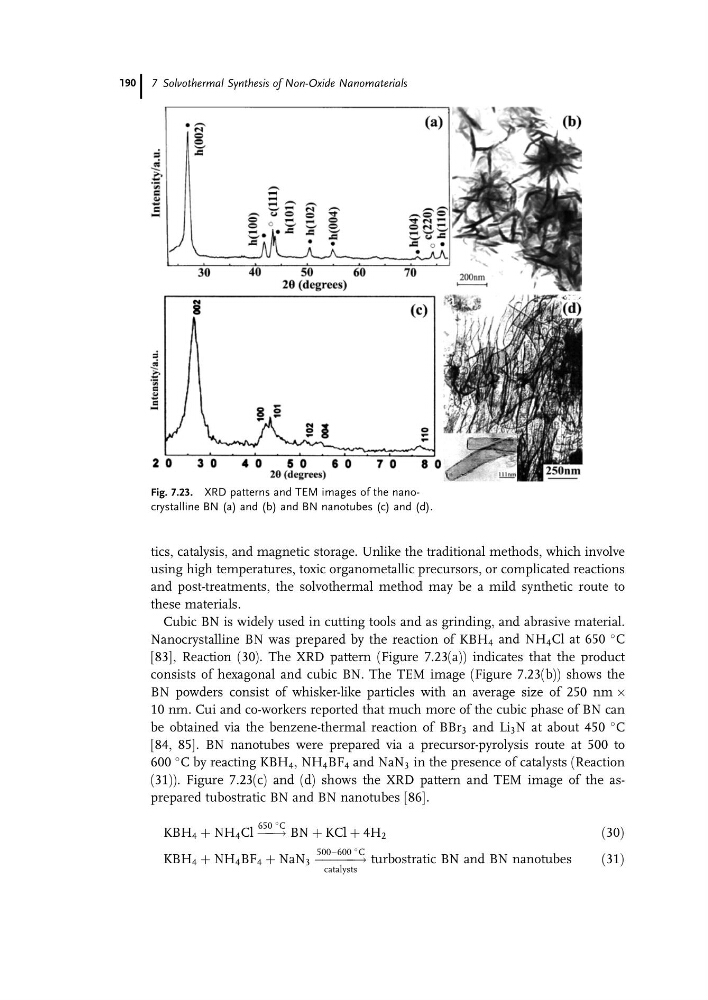
[83], Reaction (30). The XRD pattern (Figure 7.23(a)) indicates that the product
consists of hexagonal and cubic BN. The TEM image (Figure 7.23(b)) shows the
BN powders consist of whisker-like particles with an average size of 250 nm Â
10 nm. Cui and co-workers reported that much more of the cubic phase of BN can
be obtained via the benzene-thermal reaction of BBr 3 and Li 3 N at about 450
C
[84, 85]. BN nanotubes were prepared via a precursor-pyrolysis route at 500 to
600
C by reacting KBH 4 , NH 4 BF 4 and NaN 3 in the presence of catalysts (Reaction
(31)). Figure 7.23(c) and (d) shows the XRD pattern and TEM image of the asprepared tubostratic BN and BN nanotubes [86].
KBH 4 þ NH 4 Cl !
650
C BN þ KCl þ 4H 2
ð30Þ
KBH 4 þ NH 4 BF 4 þ NaN 3 !
500a600
C
catalysts
turbostratic BN and BN nanotubes
ð31Þ
Fig. 7.23. XRD patterns and TEM images of the nanocrystalline BN (a) and (b) and BN nanotubes (c) and (d).
7 Solvothermal Synthesis of Non-Oxide Nanomaterials
190
using high temperatures, toxic organometallic precursors, or complicated reactions
and post-treatments, the solvothermal method may be a mild synthetic route to
these materials.
Cubic BN is widely used in cutting tools and as grinding, and abrasive material.
Nanocrystalline BN was prepared by the reaction of KBH 4 and NH 4 Cl at 650
C
[83], Reaction (30). The XRD pattern (Figure 7.23(a)) indicates that the product
consists of hexagonal and cubic BN. The TEM image (Figure 7.23(b)) shows the
BN powders consist of whisker-like particles with an average size of 250 nm Â
10 nm. Cui and co-workers reported that much more of the cubic phase of BN can
be obtained via the benzene-thermal reaction of BBr 3 and Li 3 N at about 450
C
[84, 85]. BN nanotubes were prepared via a precursor-pyrolysis route at 500 to
600
C by reacting KBH 4 , NH 4 BF 4 and NaN 3 in the presence of catalysts (Reaction
(31)). Figure 7.23(c) and (d) shows the XRD pattern and TEM image of the asprepared tubostratic BN and BN nanotubes [86].
KBH 4 þ NH 4 Cl !
650
C BN þ KCl þ 4H 2
ð30Þ
KBH 4 þ NH 4 BF 4 þ NaN 3 !
500a600
C
catalysts
turbostratic BN and BN nanotubes
ð31Þ
Fig. 7.23. XRD patterns and TEM images of the nanocrystalline BN (a) and (b) and BN nanotubes (c) and (d).
7 Solvothermal Synthesis of Non-Oxide Nanomaterials
190