

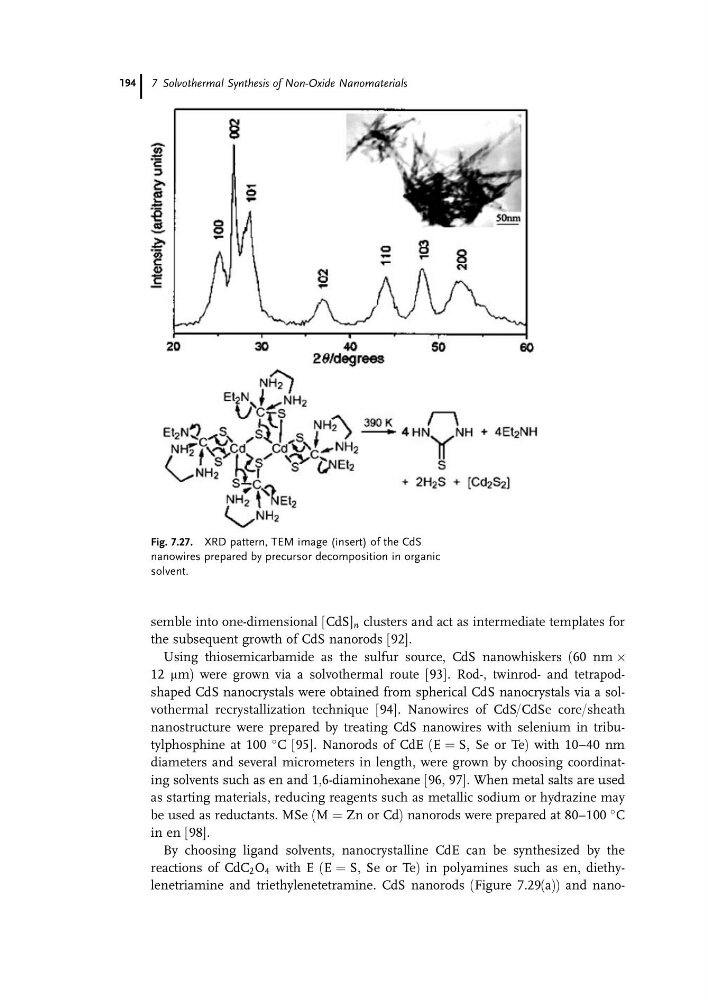
semble into one-dimensional [CdS] n clusters and act as intermediate templates for
the subsequent growth of CdS nanorods [92].
Using thiosemicarbamide as the sulfur source, CdS nanowhiskers (60 nm Â
12 mm) were grown via a solvothermal route [93]. Rod-, twinrod- and tetrapodshaped CdS nanocrystals were obtained from spherical CdS nanocrystals via a solvothermal recrystallization technique [94]. Nanowires of CdS/CdSe core/sheath
nanostructure were prepared by treating CdS nanowires with selenium in tributylphosphine at 100
C [95]. Nanorods of CdE (E ¼ S, Se or Te) with 10–40 nm
diameters and several micrometers in length, were grown by choosing coordinating solvents such as en and 1,6-diaminohexane [96, 97]. When metal salts are used
as starting materials, reducing reagents such as metallic sodium or hydrazine may
be used as reductants. MSe (M ¼ Zn or Cd) nanorods were prepared at 80–100
C
in en [98].
By choosing ligand solvents, nanocrystalline CdE can be synthesized by the
reactions of CdC 2 O 4 with E (E ¼ S, Se or Te) in polyamines such as en, diethylenetriamine and triethylenetetramine. CdS nanorods (Figure 7.29(a)) and nanoFig. 7.27. XRD pattern, TEM image (insert) of the CdS
nanowires prepared by precursor decomposition in organic
solvent.
7 Solvothermal Synthesis of Non-Oxide Nanomaterials
194
the subsequent growth of CdS nanorods [92].
Using thiosemicarbamide as the sulfur source, CdS nanowhiskers (60 nm Â
12 mm) were grown via a solvothermal route [93]. Rod-, twinrod- and tetrapodshaped CdS nanocrystals were obtained from spherical CdS nanocrystals via a solvothermal recrystallization technique [94]. Nanowires of CdS/CdSe core/sheath
nanostructure were prepared by treating CdS nanowires with selenium in tributylphosphine at 100
C [95]. Nanorods of CdE (E ¼ S, Se or Te) with 10–40 nm
diameters and several micrometers in length, were grown by choosing coordinating solvents such as en and 1,6-diaminohexane [96, 97]. When metal salts are used
as starting materials, reducing reagents such as metallic sodium or hydrazine may
be used as reductants. MSe (M ¼ Zn or Cd) nanorods were prepared at 80–100
C
in en [98].
By choosing ligand solvents, nanocrystalline CdE can be synthesized by the
reactions of CdC 2 O 4 with E (E ¼ S, Se or Te) in polyamines such as en, diethylenetriamine and triethylenetetramine. CdS nanorods (Figure 7.29(a)) and nanoFig. 7.27. XRD pattern, TEM image (insert) of the CdS
nanowires prepared by precursor decomposition in organic
solvent.
7 Solvothermal Synthesis of Non-Oxide Nanomaterials
194