

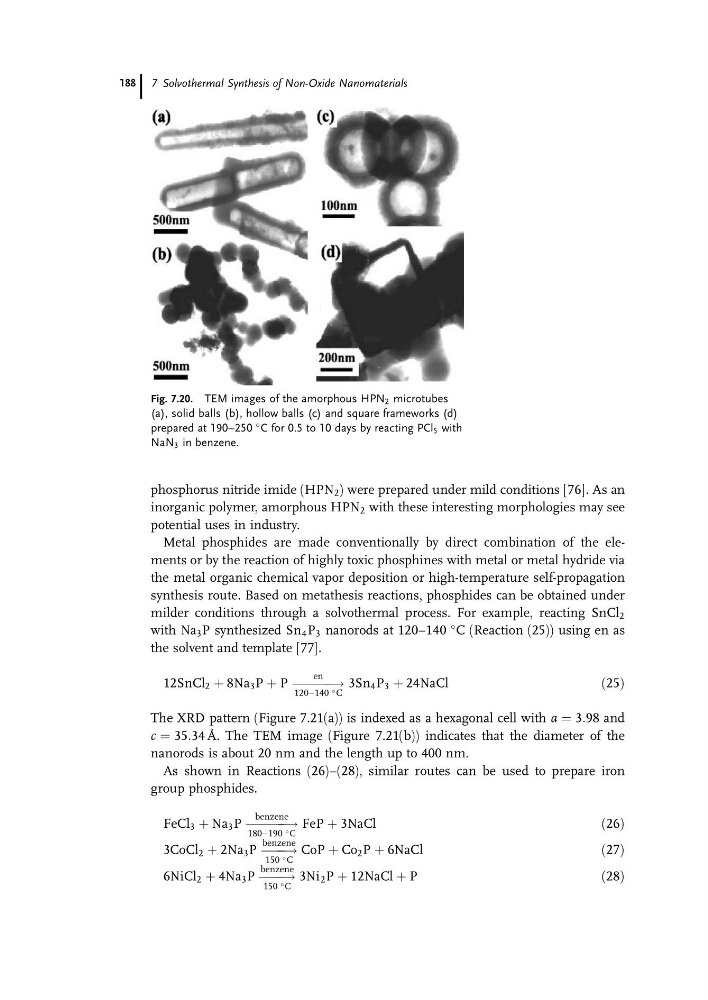
phosphorus nitride imide (HPN 2 ) were prepared under mild conditions [76]. As an
inorganic polymer, amorphous HPN 2 with these interesting morphologies may see
potential uses in industry.
Metal phosphides are made conventionally by direct combination of the elements or by the reaction of highly toxic phosphines with metal or metal hydride via
the metal organic chemical vapor deposition or high-temperature self-propagation
synthesis route. Based on metathesis reactions, phosphides can be obtained under
milder conditions through a solvothermal process. For example, reacting SnCl 2
with Na 3 P synthesized Sn 4 P 3 nanorods at 120–140
C (Reaction (25)) using en as
the solvent and template [77].
12SnCl 2 þ 8Na 3 P þ P !
en
120a140 C
3Sn 4 P 3 þ 24NaCl
ð25Þ
The XRD pattern (Figure 7.21(a)) is indexed as a hexagonal cell with a ¼ 3:98 and
c ¼ 35:34 A ˚ . The TEM image (Figure 7.21(b)) indicates that the diameter of the
nanorods is about 20 nm and the length up to 400 nm.
As shown in Reactions (26)–(28), similar routes can be used to prepare iron
group phosphides.
FeCl 3 þ Na 3 P !
benzene
180a190 C
FeP þ 3NaCl
ð26Þ
3CoCl 2 þ 2Na 3 P !
benzene
150 C
CoP þ Co 2 P þ 6NaCl
ð27Þ
6NiCl 2 þ 4Na 3 P !
benzene
150 C
3Ni 2 P þ 12NaCl þ P
ð28Þ
Fig. 7.20. TEM images of the amorphous HPN 2 microtubes
(a), solid balls (b), hollow balls (c) and square frameworks (d)
prepared at 190–250
C for 0.5 to 10 days by reacting PCl 5 with
NaN 3 in benzene.
7 Solvothermal Synthesis of Non-Oxide Nanomaterials
188
inorganic polymer, amorphous HPN 2 with these interesting morphologies may see
potential uses in industry.
Metal phosphides are made conventionally by direct combination of the elements or by the reaction of highly toxic phosphines with metal or metal hydride via
the metal organic chemical vapor deposition or high-temperature self-propagation
synthesis route. Based on metathesis reactions, phosphides can be obtained under
milder conditions through a solvothermal process. For example, reacting SnCl 2
with Na 3 P synthesized Sn 4 P 3 nanorods at 120–140
C (Reaction (25)) using en as
the solvent and template [77].
12SnCl 2 þ 8Na 3 P þ P !
en
120a140 C
3Sn 4 P 3 þ 24NaCl
ð25Þ
The XRD pattern (Figure 7.21(a)) is indexed as a hexagonal cell with a ¼ 3:98 and
c ¼ 35:34 A ˚ . The TEM image (Figure 7.21(b)) indicates that the diameter of the
nanorods is about 20 nm and the length up to 400 nm.
As shown in Reactions (26)–(28), similar routes can be used to prepare iron
group phosphides.
FeCl 3 þ Na 3 P !
benzene
180a190 C
FeP þ 3NaCl
ð26Þ
3CoCl 2 þ 2Na 3 P !
benzene
150 C
CoP þ Co 2 P þ 6NaCl
ð27Þ
6NiCl 2 þ 4Na 3 P !
benzene
150 C
3Ni 2 P þ 12NaCl þ P
ð28Þ
Fig. 7.20. TEM images of the amorphous HPN 2 microtubes
(a), solid balls (b), hollow balls (c) and square frameworks (d)
prepared at 190–250
C for 0.5 to 10 days by reacting PCl 5 with
NaN 3 in benzene.
7 Solvothermal Synthesis of Non-Oxide Nanomaterials
188