

in traditional methods. At 600–700
C, with excess SiCl 4 as reactant and solvent,
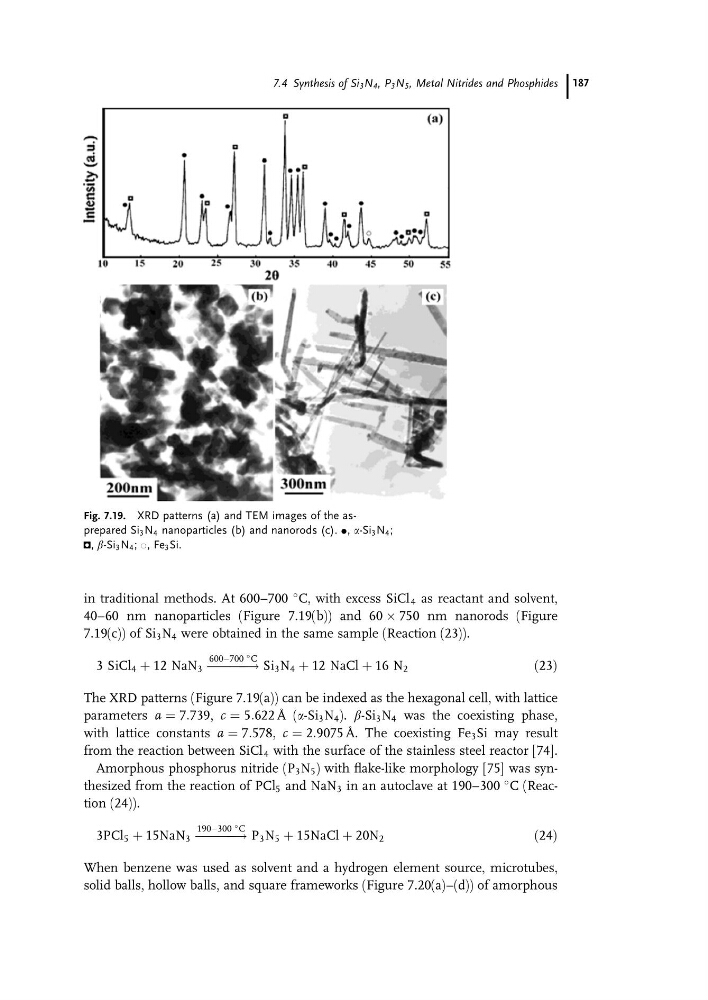
40–60 nm nanoparticles (Figure 7.19(b)) and 60 Â 750 nm nanorods (Figure
7.19(c)) of Si 3 N 4 were obtained in the same sample (Reaction (23)).
3 SiCl 4 þ 12 NaN 3 !
600a700
C Si 3 N 4 þ 12 NaCl þ 16 N 2
ð23Þ
The XRD patterns (Figure 7.19(a)) can be indexed as the hexagonal cell, with lattice
parameters a ¼ 7:739, c ¼ 5:622 A ˚ (a-Si 3 N 4 ). b-Si 3 N 4 was the coexisting phase,
with lattice constants a ¼ 7:578, c ¼ 2:9075 A ˚ . The coexisting Fe 3 Si may result
from the reaction between SiCl 4 with the surface of the stainless steel reactor [74].
Amorphous phosphorus nitride (P 3 N 5 ) with flake-like morphology [75] was synthesized from the reaction of PCl 5 and NaN 3 in an autoclave at 190–300
C (Reaction (24)).
3PCl 5 þ 15NaN 3 !
190a300
C P 3 N 5 þ 15NaCl þ 20N 2
ð24Þ
When benzene was used as solvent and a hydrogen element source, microtubes,
solid balls, hollow balls, and square frameworks (Figure 7.20(a)–(d)) of amorphous
Fig. 7.19. XRD patterns (a) and TEM images of the asprepared Si 3 N 4 nanoparticles (b) and nanorods (c). e, a-Si 3 N 4 ;
, b-Si 3 N 4 ; a, Fe 3 Si.
7.4 Synthesis of Si 3 N 4 , P 3 N 5 , Metal Nitrides and Phosphides 187
C, with excess SiCl 4 as reactant and solvent,
40–60 nm nanoparticles (Figure 7.19(b)) and 60 Â 750 nm nanorods (Figure
7.19(c)) of Si 3 N 4 were obtained in the same sample (Reaction (23)).
3 SiCl 4 þ 12 NaN 3 !
600a700
C Si 3 N 4 þ 12 NaCl þ 16 N 2
ð23Þ
The XRD patterns (Figure 7.19(a)) can be indexed as the hexagonal cell, with lattice
parameters a ¼ 7:739, c ¼ 5:622 A ˚ (a-Si 3 N 4 ). b-Si 3 N 4 was the coexisting phase,
with lattice constants a ¼ 7:578, c ¼ 2:9075 A ˚ . The coexisting Fe 3 Si may result
from the reaction between SiCl 4 with the surface of the stainless steel reactor [74].
Amorphous phosphorus nitride (P 3 N 5 ) with flake-like morphology [75] was synthesized from the reaction of PCl 5 and NaN 3 in an autoclave at 190–300
C (Reaction (24)).
3PCl 5 þ 15NaN 3 !
190a300
C P 3 N 5 þ 15NaCl þ 20N 2
ð24Þ
When benzene was used as solvent and a hydrogen element source, microtubes,
solid balls, hollow balls, and square frameworks (Figure 7.20(a)–(d)) of amorphous
Fig. 7.19. XRD patterns (a) and TEM images of the asprepared Si 3 N 4 nanoparticles (b) and nanorods (c). e, a-Si 3 N 4 ;
, b-Si 3 N 4 ; a, Fe 3 Si.
7.4 Synthesis of Si 3 N 4 , P 3 N 5 , Metal Nitrides and Phosphides 187