

7.4
Synthesis of Si 3 N 4 , P 3 N 5 , Metal Nitrides and Phosphides
As shown in Reaction (21), in the liquid–solid reaction of CrCl 3 and Li 3 N, nanocrystalline CrN with average particle size of about 25 nm was prepared via a
benzene-thermal method in the temperature range 350–420
C [70]. By using
lithium nitride (Li 3 N) instead of explosive NaN 3 , ultrafine cubic ZrN powders of
size about 180 nm were prepared in benzene [71].
CrCl 3 þ Li 3 N !
benzene
350a420 C
CrN þ 3LiCl
ð21Þ
Nanocrystalline TiN of size 50 nm [72] and nanocrystalline ZrN of size 10–20 nm
[73] were prepared through the benzene-thermal reaction with NaN 3 (Reaction
(22)).
MCl 4 þ 4NaN 3 !
benzene
350a380 C
MN þ 4NaCl þ 11=2 N 2 M ¼ Ti; Zr
ð22Þ
Silicon nitride (Si 3 N 4 ) is an important material for high-temperature engineering
applications due to its chemical stability, high-temperature strength, and excellent
creep resistance. A low-temperature preparation of crystalline Si 3 N 4 has been developed that avoids the elevated temperatures above 1200
C, which are necessary
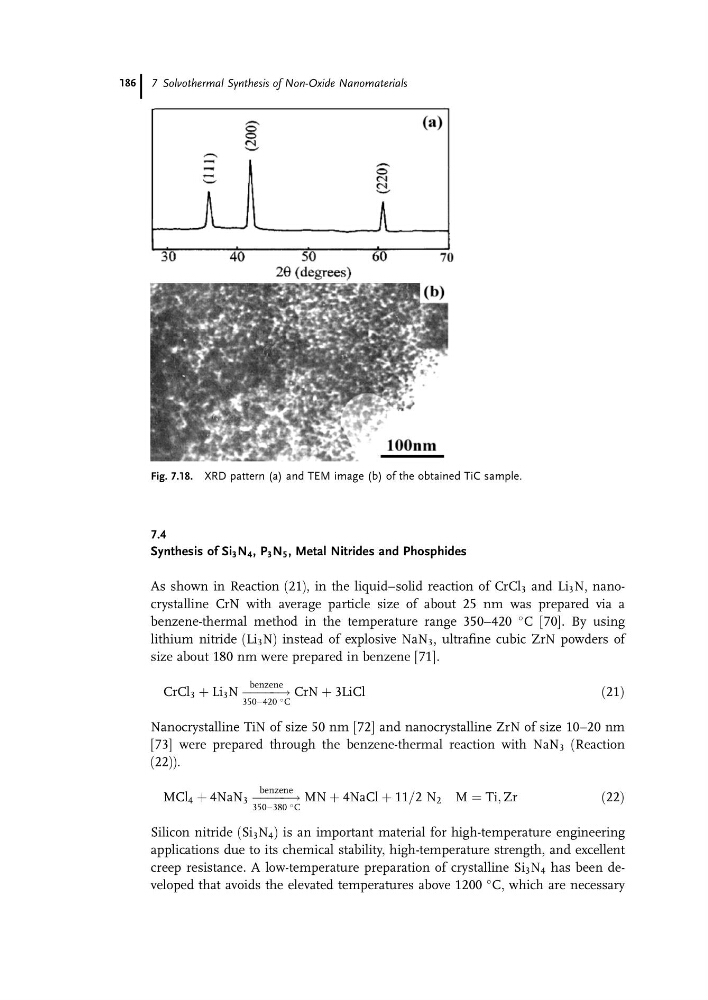
Fig. 7.18. XRD pattern (a) and TEM image (b) of the obtained TiC sample.
7 Solvothermal Synthesis of Non-Oxide Nanomaterials
186
Synthesis of Si 3 N 4 , P 3 N 5 , Metal Nitrides and Phosphides
As shown in Reaction (21), in the liquid–solid reaction of CrCl 3 and Li 3 N, nanocrystalline CrN with average particle size of about 25 nm was prepared via a
benzene-thermal method in the temperature range 350–420
C [70]. By using
lithium nitride (Li 3 N) instead of explosive NaN 3 , ultrafine cubic ZrN powders of
size about 180 nm were prepared in benzene [71].
CrCl 3 þ Li 3 N !
benzene
350a420 C
CrN þ 3LiCl
ð21Þ
Nanocrystalline TiN of size 50 nm [72] and nanocrystalline ZrN of size 10–20 nm
[73] were prepared through the benzene-thermal reaction with NaN 3 (Reaction
(22)).
MCl 4 þ 4NaN 3 !
benzene
350a380 C
MN þ 4NaCl þ 11=2 N 2 M ¼ Ti; Zr
ð22Þ
Silicon nitride (Si 3 N 4 ) is an important material for high-temperature engineering
applications due to its chemical stability, high-temperature strength, and excellent
creep resistance. A low-temperature preparation of crystalline Si 3 N 4 has been developed that avoids the elevated temperatures above 1200
C, which are necessary
Fig. 7.18. XRD pattern (a) and TEM image (b) of the obtained TiC sample.
7 Solvothermal Synthesis of Non-Oxide Nanomaterials
186