

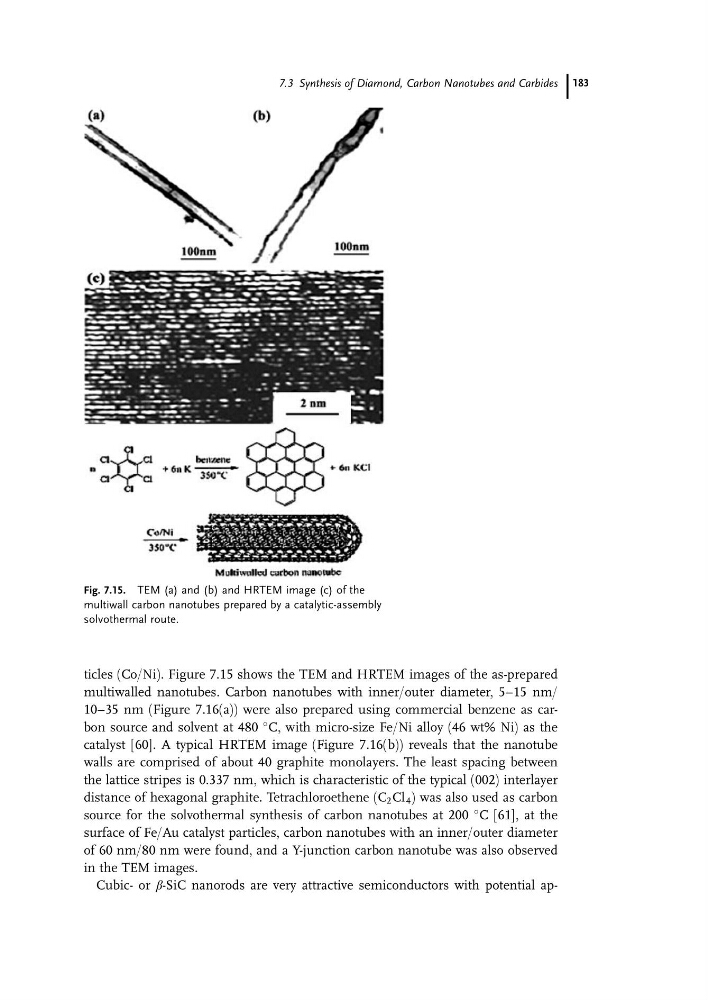
ticles (Co/Ni). Figure 7.15 shows the TEM and HRTEM images of the as-prepared
multiwalled nanotubes. Carbon nanotubes with inner/outer diameter, 5–15 nm/
10–35 nm (Figure 7.16(a)) were also prepared using commercial benzene as carbon source and solvent at 480
C, with micro-size Fe/Ni alloy (46 wt% Ni) as the
catalyst [60]. A typical HRTEM image (Figure 7.16(b)) reveals that the nanotube
walls are comprised of about 40 graphite monolayers. The least spacing between
the lattice stripes is 0.337 nm, which is characteristic of the typical (002) interlayer
distance of hexagonal graphite. Tetrachloroethene (C 2 Cl 4 ) was also used as carbon
source for the solvothermal synthesis of carbon nanotubes at 200
C [61], at the
surface of Fe/Au catalyst particles, carbon nanotubes with an inner/outer diameter
of 60 nm/80 nm were found, and a Y-junction carbon nanotube was also observed
in the TEM images.
Cubic- or b-SiC nanorods are very attractive semiconductors with potential apFig. 7.15. TEM (a) and (b) and HRTEM image (c) of the
multiwall carbon nanotubes prepared by a catalytic-assembly
solvothermal route.
7.3 Synthesis of Diamond, Carbon Nanotubes and Carbides 183
multiwalled nanotubes. Carbon nanotubes with inner/outer diameter, 5–15 nm/
10–35 nm (Figure 7.16(a)) were also prepared using commercial benzene as carbon source and solvent at 480
C, with micro-size Fe/Ni alloy (46 wt% Ni) as the
catalyst [60]. A typical HRTEM image (Figure 7.16(b)) reveals that the nanotube
walls are comprised of about 40 graphite monolayers. The least spacing between
the lattice stripes is 0.337 nm, which is characteristic of the typical (002) interlayer
distance of hexagonal graphite. Tetrachloroethene (C 2 Cl 4 ) was also used as carbon
source for the solvothermal synthesis of carbon nanotubes at 200
C [61], at the
surface of Fe/Au catalyst particles, carbon nanotubes with an inner/outer diameter
of 60 nm/80 nm were found, and a Y-junction carbon nanotube was also observed
in the TEM images.
Cubic- or b-SiC nanorods are very attractive semiconductors with potential apFig. 7.15. TEM (a) and (b) and HRTEM image (c) of the
multiwall carbon nanotubes prepared by a catalytic-assembly
solvothermal route.
7.3 Synthesis of Diamond, Carbon Nanotubes and Carbides 183