

plications in very-high-speed, high-temperature and high-power devices. The reduction of SiCl 4 with sodium has already been used to prepare crystalline Si at
375
C under high pressure [62]. Ritter [63] has reported a sodium co-reduction of
SiCl 4 and CCl 4 in a non-polar solvent at 130
C to give an amorphous precursor
containing Si and C, which required heating at 1450–1750
C to form crystalline
SiC. When this reaction with excess sodium metal as reductant and flux was carried out in an autoclave at 400
C (Reaction (16)), b-SiC nanorods were grown [64].
The TEM images (Figure 7.17(a) and (b)) show that the product consists of nanorods with diameters from 10–40 nm and lengths up to several micrometers. When
activated carbon and SiCl 4 were used as the starting materials (Reaction (17)),
nanocrystalline b-SiC was also synthesized at 600
C [65]. The TEM images indicate that the SiC powders consist only of spherical particles with an average diameter of 25 nm. Conversely, when using silicon powders and CCl 4 as the silicon and
carbon sources (Reaction (18)), 3CaSiC nanowires (Figure 7.17(c)) of 15–20 nm
diameter and length 5–10 mm were prepared through a reduction–carburization
route at 700
C [66]. In addition, an interesting tubular-like SiC nanowire (Figure
7.17(d)) was also found co-existing in the sample.
SiCl 4 þ CCl 4 þ 8Na !
400
C SiC þ 8NaCl
ð16Þ
C þ SiCl 4 þ 4Na !
600
C SiC þ 4NaCl
ð17Þ
Si þ CCl 4 þ 4Na !
700
C SiC þ 4NaCl
ð18Þ
TiC nanocrystallites were similarly synthesized at 450
C (Reaction (19)).
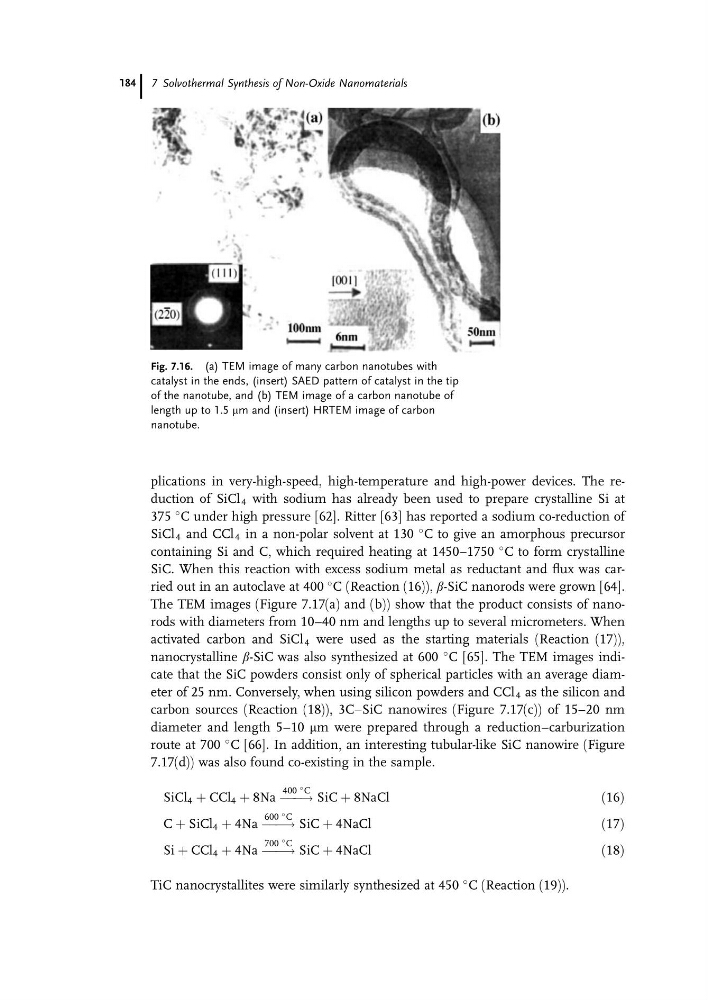
Fig. 7.16. (a) TEM image of many carbon nanotubes with
catalyst in the ends, (insert) SAED pattern of catalyst in the tip
of the nanotube, and (b) TEM image of a carbon nanotube of
length up to 1.5 mm and (insert) HRTEM image of carbon
nanotube.
7 Solvothermal Synthesis of Non-Oxide Nanomaterials
184
375
C under high pressure [62]. Ritter [63] has reported a sodium co-reduction of
SiCl 4 and CCl 4 in a non-polar solvent at 130
C to give an amorphous precursor
containing Si and C, which required heating at 1450–1750
C to form crystalline
SiC. When this reaction with excess sodium metal as reductant and flux was carried out in an autoclave at 400
C (Reaction (16)), b-SiC nanorods were grown [64].
The TEM images (Figure 7.17(a) and (b)) show that the product consists of nanorods with diameters from 10–40 nm and lengths up to several micrometers. When
activated carbon and SiCl 4 were used as the starting materials (Reaction (17)),
nanocrystalline b-SiC was also synthesized at 600
C [65]. The TEM images indicate that the SiC powders consist only of spherical particles with an average diameter of 25 nm. Conversely, when using silicon powders and CCl 4 as the silicon and
carbon sources (Reaction (18)), 3CaSiC nanowires (Figure 7.17(c)) of 15–20 nm
diameter and length 5–10 mm were prepared through a reduction–carburization
route at 700
C [66]. In addition, an interesting tubular-like SiC nanowire (Figure
7.17(d)) was also found co-existing in the sample.
SiCl 4 þ CCl 4 þ 8Na !
400
C SiC þ 8NaCl
ð16Þ
C þ SiCl 4 þ 4Na !
600
C SiC þ 4NaCl
ð17Þ
Si þ CCl 4 þ 4Na !
700
C SiC þ 4NaCl
ð18Þ
TiC nanocrystallites were similarly synthesized at 450
C (Reaction (19)).
Fig. 7.16. (a) TEM image of many carbon nanotubes with
catalyst in the ends, (insert) SAED pattern of catalyst in the tip
of the nanotube, and (b) TEM image of a carbon nanotube of
length up to 1.5 mm and (insert) HRTEM image of carbon
nanotube.
7 Solvothermal Synthesis of Non-Oxide Nanomaterials
184