

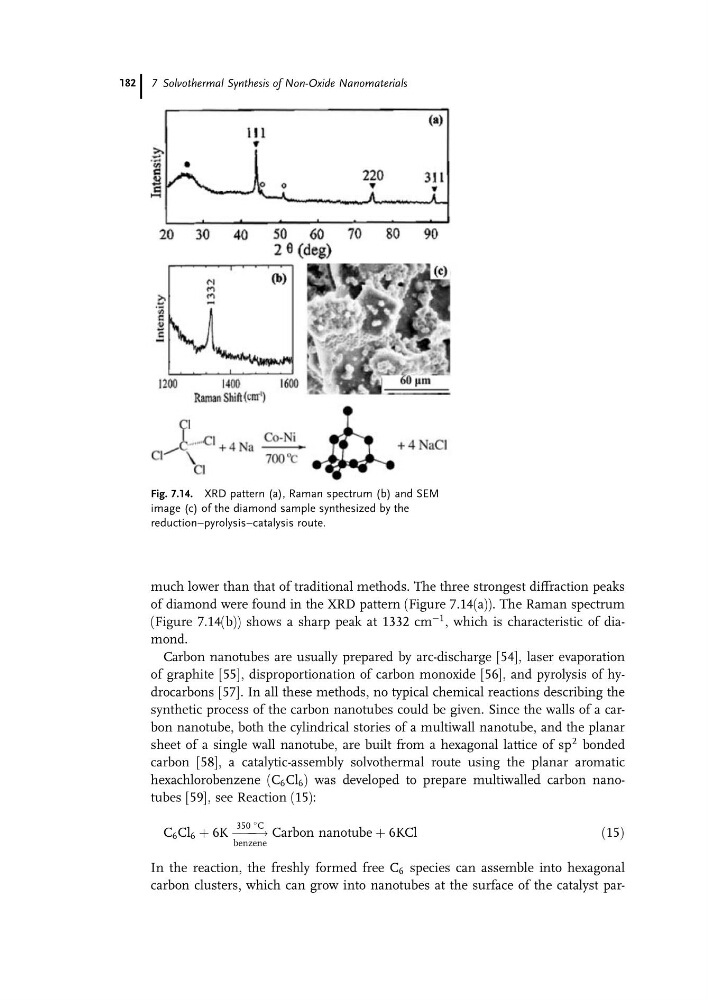
much lower than that of traditional methods. The three strongest diffraction peaks
of diamond were found in the XRD pattern (Figure 7.14(a)). The Raman spectrum
(Figure 7.14(b)) shows a sharp peak at 1332 cm
À1 , which is characteristic of diamond.
Carbon nanotubes are usually prepared by arc-discharge [54], laser evaporation
of graphite [55], disproportionation of carbon monoxide [56], and pyrolysis of hydrocarbons [57]. In all these methods, no typical chemical reactions describing the
synthetic process of the carbon nanotubes could be given. Since the walls of a carbon nanotube, both the cylindrical stories of a multiwall nanotube, and the planar
sheet of a single wall nanotube, are built from a hexagonal lattice of sp
2 bonded
carbon [58], a catalytic-assembly solvothermal route using the planar aromatic
hexachlorobenzene (C 6 Cl 6 ) was developed to prepare multiwalled carbon nanotubes [59], see Reaction (15):
C 6 Cl 6 þ 6K !
350
C
benzene
Carbon nanotube þ 6KCl
ð15Þ
In the reaction, the freshly formed free C 6 species can assemble into hexagonal
carbon clusters, which can grow into nanotubes at the surface of the catalyst parFig. 7.14. XRD pattern (a), Raman spectrum (b) and SEM
image (c) of the diamond sample synthesized by the
reduction–pyrolysis–catalysis route.
7 Solvothermal Synthesis of Non-Oxide Nanomaterials
182
of diamond were found in the XRD pattern (Figure 7.14(a)). The Raman spectrum
(Figure 7.14(b)) shows a sharp peak at 1332 cm
À1 , which is characteristic of diamond.
Carbon nanotubes are usually prepared by arc-discharge [54], laser evaporation
of graphite [55], disproportionation of carbon monoxide [56], and pyrolysis of hydrocarbons [57]. In all these methods, no typical chemical reactions describing the
synthetic process of the carbon nanotubes could be given. Since the walls of a carbon nanotube, both the cylindrical stories of a multiwall nanotube, and the planar
sheet of a single wall nanotube, are built from a hexagonal lattice of sp
2 bonded
carbon [58], a catalytic-assembly solvothermal route using the planar aromatic
hexachlorobenzene (C 6 Cl 6 ) was developed to prepare multiwalled carbon nanotubes [59], see Reaction (15):
C 6 Cl 6 þ 6K !
350
C
benzene
Carbon nanotube þ 6KCl
ð15Þ
In the reaction, the freshly formed free C 6 species can assemble into hexagonal
carbon clusters, which can grow into nanotubes at the surface of the catalyst parFig. 7.14. XRD pattern (a), Raman spectrum (b) and SEM
image (c) of the diamond sample synthesized by the
reduction–pyrolysis–catalysis route.
7 Solvothermal Synthesis of Non-Oxide Nanomaterials
182