

in the case of self-assembled two-dimensional arrays of Co nanocrystals and Au
nanocrystals [204, 205].
The optical properties of a superlattice of semiconductor nanocrystals are different from those of the individual nanocrystals due to interparticle interactions [32].
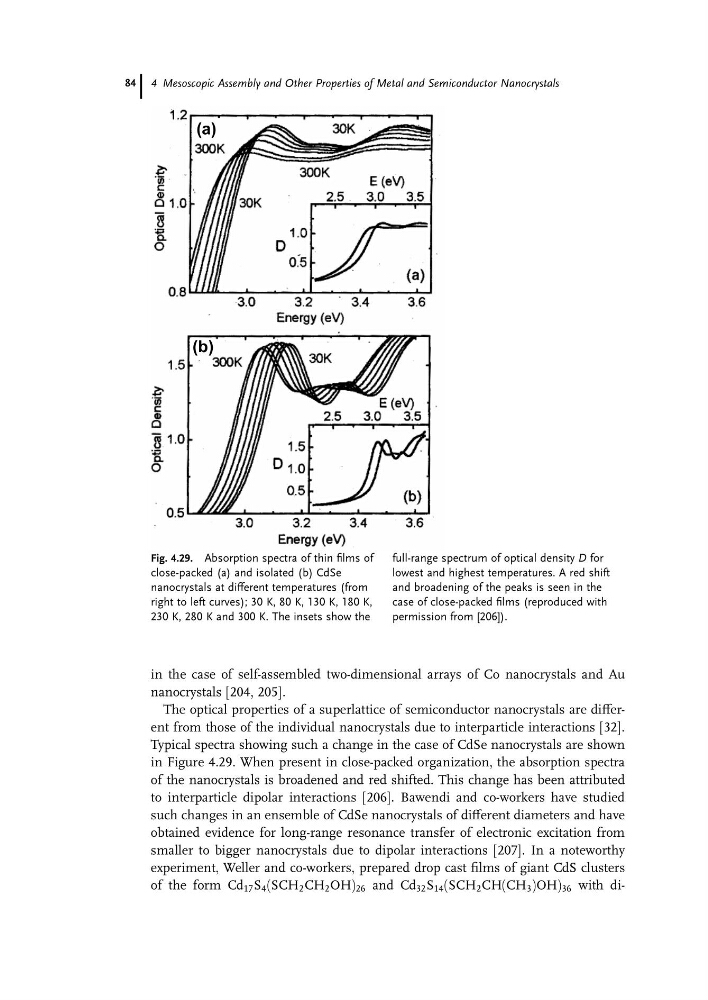
Typical spectra showing such a change in the case of CdSe nanocrystals are shown
in Figure 4.29. When present in close-packed organization, the absorption spectra
of the nanocrystals is broadened and red shifted. This change has been attributed
to interparticle dipolar interactions [206]. Bawendi and co-workers have studied
such changes in an ensemble of CdSe nanocrystals of different diameters and have
obtained evidence for long-range resonance transfer of electronic excitation from
smaller to bigger nanocrystals due to dipolar interactions [207]. In a noteworthy
experiment, Weller and co-workers, prepared drop cast films of giant CdS clusters
of the form Cd 17 S 4 (SCH 2 CH 2 OH) 26 and Cd 32 S 14 (SCH 2 CH(CH 3 )OH) 36 with di(a)
(b)
Fig. 4.29. Absorption spectra of thin films of
close-packed (a) and isolated (b) CdSe
nanocrystals at different temperatures (from
right to left curves); 30 K, 80 K, 130 K, 180 K,
230 K, 280 K and 300 K. The insets show the
full-range spectrum of optical density D for
lowest and highest temperatures. A red shift
and broadening of the peaks is seen in the
case of close-packed films (reproduced with
permission from [206]).
4 Mesoscopic Assembly and Other Properties of Metal and Semiconductor Nanocrystals
84
nanocrystals [204, 205].
The optical properties of a superlattice of semiconductor nanocrystals are different from those of the individual nanocrystals due to interparticle interactions [32].
Typical spectra showing such a change in the case of CdSe nanocrystals are shown
in Figure 4.29. When present in close-packed organization, the absorption spectra
of the nanocrystals is broadened and red shifted. This change has been attributed
to interparticle dipolar interactions [206]. Bawendi and co-workers have studied
such changes in an ensemble of CdSe nanocrystals of different diameters and have
obtained evidence for long-range resonance transfer of electronic excitation from
smaller to bigger nanocrystals due to dipolar interactions [207]. In a noteworthy
experiment, Weller and co-workers, prepared drop cast films of giant CdS clusters
of the form Cd 17 S 4 (SCH 2 CH 2 OH) 26 and Cd 32 S 14 (SCH 2 CH(CH 3 )OH) 36 with di(a)
(b)
Fig. 4.29. Absorption spectra of thin films of
close-packed (a) and isolated (b) CdSe
nanocrystals at different temperatures (from
right to left curves); 30 K, 80 K, 130 K, 180 K,
230 K, 280 K and 300 K. The insets show the
full-range spectrum of optical density D for
lowest and highest temperatures. A red shift
and broadening of the peaks is seen in the
case of close-packed films (reproduced with
permission from [206]).
4 Mesoscopic Assembly and Other Properties of Metal and Semiconductor Nanocrystals
84