

ameters of 1.4 and 1.8 nm respectively. Futher, an integrating sphere was used
to collect absorption data, thereby virtually eliminating errors from inhomogenities
and size distributions [208]. The experiments due to Weller also support the idea of
dipolar interaction leading to the red shift and broadening. The signature of such
interactions has also been seen in the case of CdS multilayer deposits [145]. The
interparticle interactions, however, could range from weak dipolar interactions to
strong exchange interactions based on the interparticle separation. Delocalization
of the electronic states of nanocrystals in ensembles due to exchage interactions
have been observed in experiments with CdSe nanocrystals. Gaponenko and coworkers have shown that the optical properties of an ensemble of small (@1.6 nm)
CdSe nanocrystals are similar to those of bulk CdSe and are due to complete delocalization of the electronic states of individual nanocrystals [209].
Nanocrystals of Co when organized into two-dimensional arrays exhibit a higher
superparamagnetic blocking temperature than isolated nanocrystals, i.e., they display a higher resistance to thermal reversal of their spins than when they are isolated [210]. Sun et al. report a lattice of nanocrystals each consisting of a Fe core
and a Pt shell prepared by heating FeaPt alloy nanocrystals [61]. Following phase
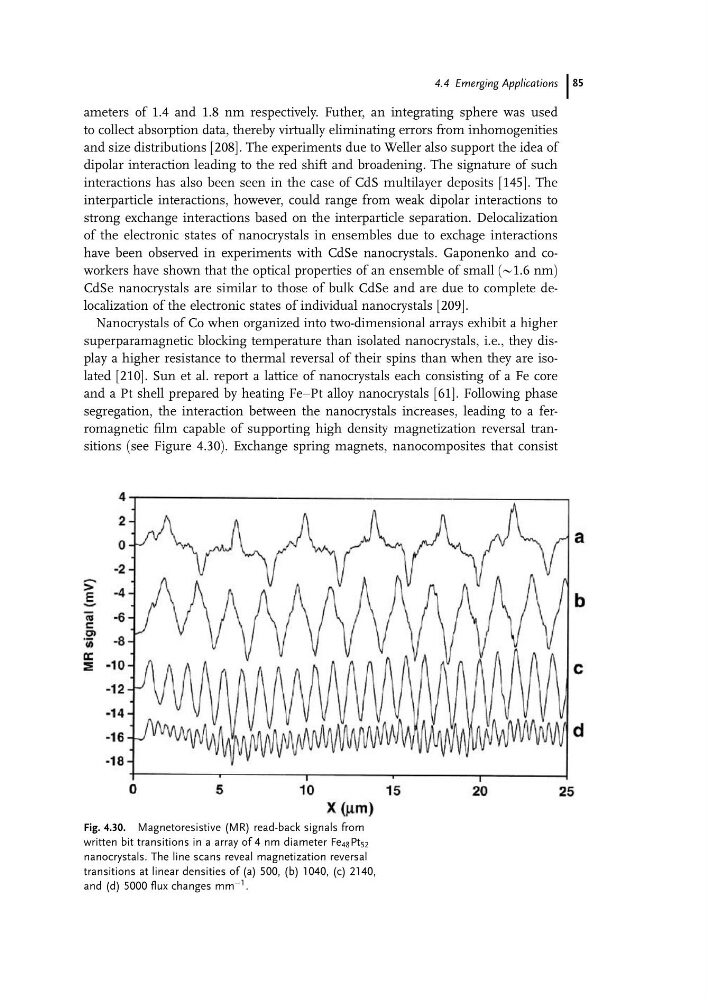
segregation, the interaction between the nanocrystals increases, leading to a ferromagnetic film capable of supporting high density magnetization reversal transitions (see Figure 4.30). Exchange spring magnets, nanocomposites that consist
Fig. 4.30. Magnetoresistive (MR) read-back signals from
written bit transitions in a array of 4 nm diameter Fe 48 Pt 52
nanocrystals. The line scans reveal magnetization reversal
transitions at linear densities of (a) 500, (b) 1040, (c) 2140,
and (d) 5000 flux changes mm
À1 .
4.4 Emerging Applications 85
to collect absorption data, thereby virtually eliminating errors from inhomogenities
and size distributions [208]. The experiments due to Weller also support the idea of
dipolar interaction leading to the red shift and broadening. The signature of such
interactions has also been seen in the case of CdS multilayer deposits [145]. The
interparticle interactions, however, could range from weak dipolar interactions to
strong exchange interactions based on the interparticle separation. Delocalization
of the electronic states of nanocrystals in ensembles due to exchage interactions
have been observed in experiments with CdSe nanocrystals. Gaponenko and coworkers have shown that the optical properties of an ensemble of small (@1.6 nm)
CdSe nanocrystals are similar to those of bulk CdSe and are due to complete delocalization of the electronic states of individual nanocrystals [209].
Nanocrystals of Co when organized into two-dimensional arrays exhibit a higher
superparamagnetic blocking temperature than isolated nanocrystals, i.e., they display a higher resistance to thermal reversal of their spins than when they are isolated [210]. Sun et al. report a lattice of nanocrystals each consisting of a Fe core
and a Pt shell prepared by heating FeaPt alloy nanocrystals [61]. Following phase
segregation, the interaction between the nanocrystals increases, leading to a ferromagnetic film capable of supporting high density magnetization reversal transitions (see Figure 4.30). Exchange spring magnets, nanocomposites that consist
Fig. 4.30. Magnetoresistive (MR) read-back signals from
written bit transitions in a array of 4 nm diameter Fe 48 Pt 52
nanocrystals. The line scans reveal magnetization reversal
transitions at linear densities of (a) 500, (b) 1040, (c) 2140,
and (d) 5000 flux changes mm
À1 .
4.4 Emerging Applications 85