

The conductivity of such layers can be enhanced by replacing alkane thiol with an
aromatic thiol in situ [200, 201]. That the interaction energy of nanocrystals in
such organizations can be continually varied by changing the interparticle distance
was exploited by Heath and co-workers [202, 203], who prepared a monolayer of Ag
(@3 nm) nanocrystals at the air–water interface in a LB trough and varied the interparticle distance by applying pressure. A host of measurements including
reflectivity and non-linear optical spectroscopic techniques were carried out in situ.
This study led to the observation of a reversible Mott–Hubbard metal–insulator
transition in the nanocrystal ensemble wherein the coulomb gap closes at a critical
distance between the particles. Tunnelling spectroscopic measurements on films of
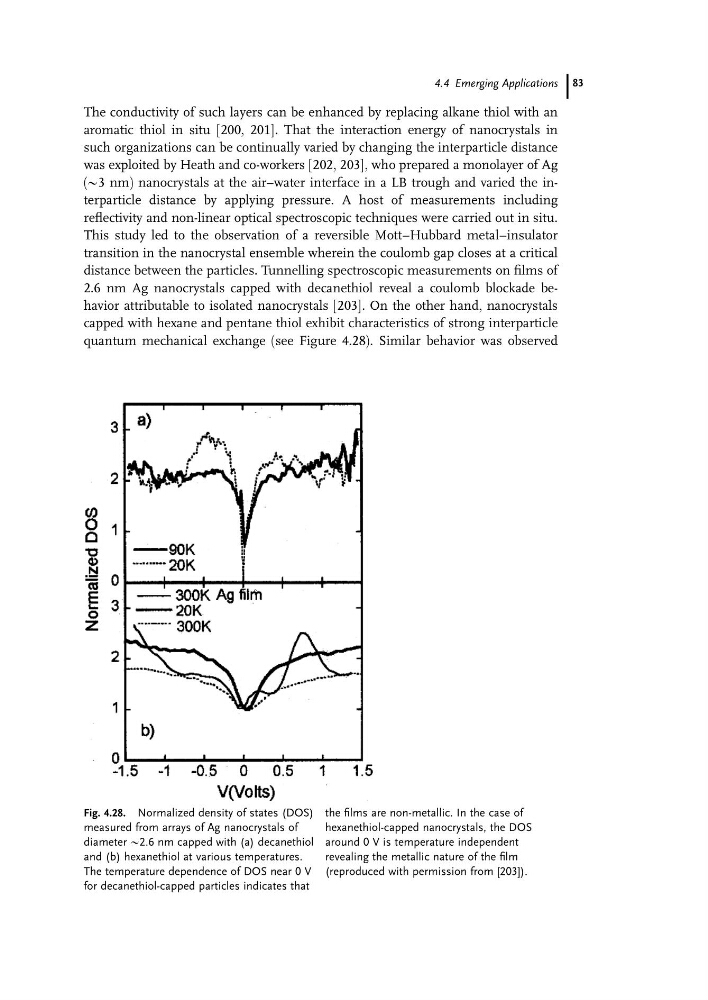
2.6 nm Ag nanocrystals capped with decanethiol reveal a coulomb blockade behavior attributable to isolated nanocrystals [203]. On the other hand, nanocrystals
capped with hexane and pentane thiol exhibit characteristics of strong interparticle
quantum mechanical exchange (see Figure 4.28). Similar behavior was observed
Fig. 4.28. Normalized density of states (DOS)
measured from arrays of Ag nanocrystals of
diameter @2.6 nm capped with (a) decanethiol
and (b) hexanethiol at various temperatures.
The temperature dependence of DOS near 0 V
for decanethiol-capped particles indicates that
the films are non-metallic. In the case of
hexanethiol-capped nanocrystals, the DOS
around 0 V is temperature independent
revealing the metallic nature of the film
(reproduced with permission from [203]).
4.4 Emerging Applications 83
aromatic thiol in situ [200, 201]. That the interaction energy of nanocrystals in
such organizations can be continually varied by changing the interparticle distance
was exploited by Heath and co-workers [202, 203], who prepared a monolayer of Ag
(@3 nm) nanocrystals at the air–water interface in a LB trough and varied the interparticle distance by applying pressure. A host of measurements including
reflectivity and non-linear optical spectroscopic techniques were carried out in situ.
This study led to the observation of a reversible Mott–Hubbard metal–insulator
transition in the nanocrystal ensemble wherein the coulomb gap closes at a critical
distance between the particles. Tunnelling spectroscopic measurements on films of
2.6 nm Ag nanocrystals capped with decanethiol reveal a coulomb blockade behavior attributable to isolated nanocrystals [203]. On the other hand, nanocrystals
capped with hexane and pentane thiol exhibit characteristics of strong interparticle
quantum mechanical exchange (see Figure 4.28). Similar behavior was observed
Fig. 4.28. Normalized density of states (DOS)
measured from arrays of Ag nanocrystals of
diameter @2.6 nm capped with (a) decanethiol
and (b) hexanethiol at various temperatures.
The temperature dependence of DOS near 0 V
for decanethiol-capped particles indicates that
the films are non-metallic. In the case of
hexanethiol-capped nanocrystals, the DOS
around 0 V is temperature independent
revealing the metallic nature of the film
(reproduced with permission from [203]).
4.4 Emerging Applications 83