

This postulate assumes the existence of the entropy only for equilibrium states. In
the absence of constraints, the system is free to select anyone number of states;
however, the state of maximum entropy is always selected by the system.
As stated earlier, the basic problem of thermodynamics is “The single,
all-encompassing problem of thermodynamic is the determination of the equilibrium
state that eventually results after the removal of internal constraints in a closed
composite system” Callen (1985). This basic problem can be solved if the entropy
of the system is known as a function of the intrinsic parameters of the system. The
relation that gives the entropy as a function of the system parameters is known as a
fundamental relation. It, therefore, follows that if the fundamental relation of a
particular system is known, all conceivable thermodynamic information about the
system can be obtained from it. Essentially, if the fundamental relation of a system is
known, every thermodynamic attribute is completely and precisely determined.
Callen (1985) does an outstanding job in establishing postulator basis for
thermodynamics.
Postulate III
The entropy of a composite system is additive over the constituent subsystems. The
entropy is continuous and differentiable and is a monotonically increasing function
of the energy.
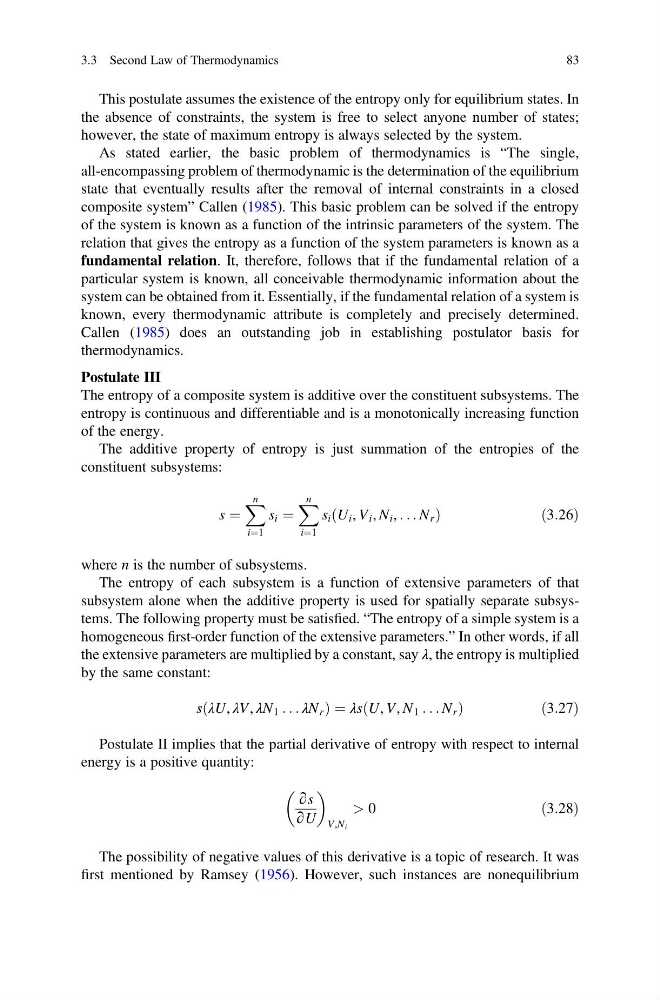
The additive property of entropy is just summation of the entropies of the
constituent subsystems:
s ¼
X n
i¼1
s i ¼
X n
i¼1
s i U i , V i , N i , . . . N r
ð
Þ
ð 3:26Þ
where n is the number of subsystems.
The entropy of each subsystem is a function of extensive parameters of that
subsystem alone when the additive property is used for spatially separate subsystems. The following property must be satisfied. “The entropy of a simple system is a
homogeneous first-order function of the extensive parameters.” In other words, if all
the extensive parameters are multiplied by a constant, say λ, the entropy is multiplied
by the same constant:
s λU, λV, λN 1 . . . λN r
ð
Þ ¼ λs U, V, N 1 . . . N r
ð
Þ
ð 3:27Þ
Postulate II implies that the partial derivative of entropy with respect to internal
energy is a positive quantity:
∂s
∂U
V,N i
> 0
ð3:28Þ
The possibility of negative values of this derivative is a topic of research. It was
first mentioned by Ramsey (1956). However, such instances are nonequilibrium
3.3 Second Law of Thermodynamics
83
the absence of constraints, the system is free to select anyone number of states;
however, the state of maximum entropy is always selected by the system.
As stated earlier, the basic problem of thermodynamics is “The single,
all-encompassing problem of thermodynamic is the determination of the equilibrium
state that eventually results after the removal of internal constraints in a closed
composite system” Callen (1985). This basic problem can be solved if the entropy
of the system is known as a function of the intrinsic parameters of the system. The
relation that gives the entropy as a function of the system parameters is known as a
fundamental relation. It, therefore, follows that if the fundamental relation of a
particular system is known, all conceivable thermodynamic information about the
system can be obtained from it. Essentially, if the fundamental relation of a system is
known, every thermodynamic attribute is completely and precisely determined.
Callen (1985) does an outstanding job in establishing postulator basis for
thermodynamics.
Postulate III
The entropy of a composite system is additive over the constituent subsystems. The
entropy is continuous and differentiable and is a monotonically increasing function
of the energy.
The additive property of entropy is just summation of the entropies of the
constituent subsystems:
s ¼
X n
i¼1
s i ¼
X n
i¼1
s i U i , V i , N i , . . . N r
ð
Þ
ð 3:26Þ
where n is the number of subsystems.
The entropy of each subsystem is a function of extensive parameters of that
subsystem alone when the additive property is used for spatially separate subsystems. The following property must be satisfied. “The entropy of a simple system is a
homogeneous first-order function of the extensive parameters.” In other words, if all
the extensive parameters are multiplied by a constant, say λ, the entropy is multiplied
by the same constant:
s λU, λV, λN 1 . . . λN r
ð
Þ ¼ λs U, V, N 1 . . . N r
ð
Þ
ð 3:27Þ
Postulate II implies that the partial derivative of entropy with respect to internal
energy is a positive quantity:
∂s
∂U
V,N i
> 0
ð3:28Þ
The possibility of negative values of this derivative is a topic of research. It was
first mentioned by Ramsey (1956). However, such instances are nonequilibrium
3.3 Second Law of Thermodynamics
83