

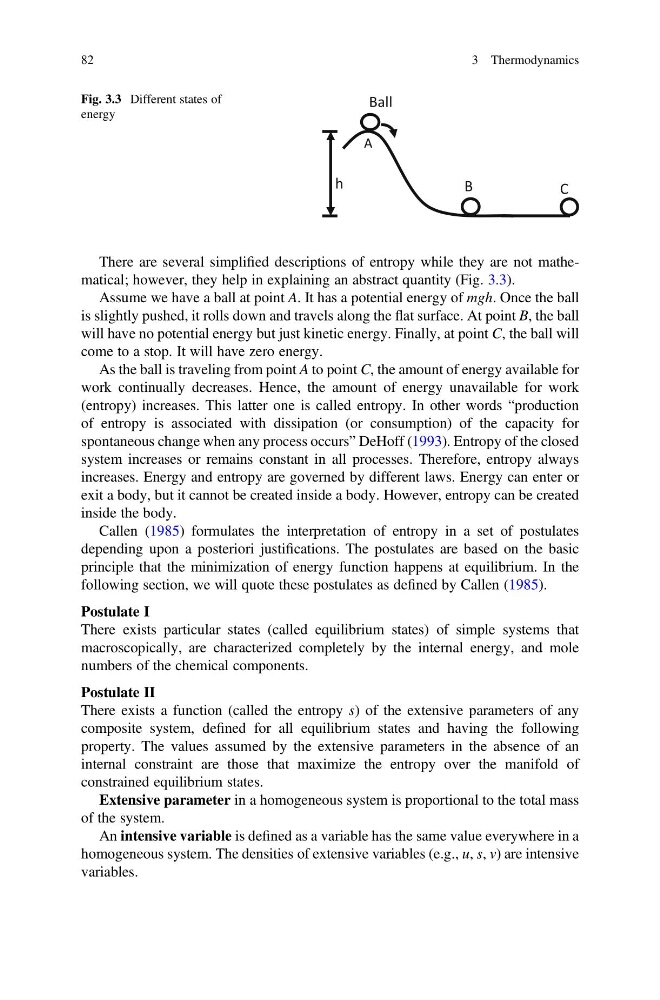
There are several simplified descriptions of entropy while they are not mathematical; however, they help in explaining an abstract quantity (Fig. 3.3).
Assume we have a ball at point A. It has a potential energy of mgh. Once the ball
is slightly pushed, it rolls down and travels along the flat surface. At point B, the ball
will have no potential energy but just kinetic energy. Finally, at point C, the ball will
come to a stop. It will have zero energy.
As the ball is traveling from point A to point C, the amount of energy available for
work continually decreases. Hence, the amount of energy unavailable for work
(entropy) increases. This latter one is called entropy. In other words “production
of entropy is associated with dissipation (or consumption) of the capacity for
spontaneous change when any process occurs” DeHoff (1993). Entropy of the closed
system increases or remains constant in all processes. Therefore, entropy always
increases. Energy and entropy are governed by different laws. Energy can enter or
exit a body, but it cannot be created inside a body. However, entropy can be created
inside the body.
Callen (1985) formulates the interpretation of entropy in a set of postulates
depending upon a posteriori justifications. The postulates are based on the basic
principle that the minimization of energy function happens at equilibrium. In the
following section, we will quote these postulates as defined by Callen (1985).
Postulate I
There exists particular states (called equilibrium states) of simple systems that
macroscopically, are characterized completely by the internal energy, and mole
numbers of the chemical components.
Postulate II
There exists a function (called the entropy s) of the extensive parameters of any
composite system, defined for all equilibrium states and having the following
property. The values assumed by the extensive parameters in the absence of an
internal constraint are those that maximize the entropy over the manifold of
constrained equilibrium states.
Extensive parameter in a homogeneous system is proportional to the total mass
of the system.
An intensive variable is defined as a variable has the same value everywhere in a
homogeneous system. The densities of extensive variables (e.g., u, s, v) are intensive
variables.
Ball
h
A
B
C
Fig. 3.3 Different states of
energy
82
3 Thermodynamics
Assume we have a ball at point A. It has a potential energy of mgh. Once the ball
is slightly pushed, it rolls down and travels along the flat surface. At point B, the ball
will have no potential energy but just kinetic energy. Finally, at point C, the ball will
come to a stop. It will have zero energy.
As the ball is traveling from point A to point C, the amount of energy available for
work continually decreases. Hence, the amount of energy unavailable for work
(entropy) increases. This latter one is called entropy. In other words “production
of entropy is associated with dissipation (or consumption) of the capacity for
spontaneous change when any process occurs” DeHoff (1993). Entropy of the closed
system increases or remains constant in all processes. Therefore, entropy always
increases. Energy and entropy are governed by different laws. Energy can enter or
exit a body, but it cannot be created inside a body. However, entropy can be created
inside the body.
Callen (1985) formulates the interpretation of entropy in a set of postulates
depending upon a posteriori justifications. The postulates are based on the basic
principle that the minimization of energy function happens at equilibrium. In the
following section, we will quote these postulates as defined by Callen (1985).
Postulate I
There exists particular states (called equilibrium states) of simple systems that
macroscopically, are characterized completely by the internal energy, and mole
numbers of the chemical components.
Postulate II
There exists a function (called the entropy s) of the extensive parameters of any
composite system, defined for all equilibrium states and having the following
property. The values assumed by the extensive parameters in the absence of an
internal constraint are those that maximize the entropy over the manifold of
constrained equilibrium states.
Extensive parameter in a homogeneous system is proportional to the total mass
of the system.
An intensive variable is defined as a variable has the same value everywhere in a
homogeneous system. The densities of extensive variables (e.g., u, s, v) are intensive
variables.
Ball
h
A
B
C
Fig. 3.3 Different states of
energy
82
3 Thermodynamics