

The second law of thermodynamics also defines a preferred direction in any
natural process. This is clearly stated by the definition of the second law given by
Clausius (1850). He stated that the heat never flows on its own from the colder
system to the warmer system. This defines a preferred direction in the flow of heat
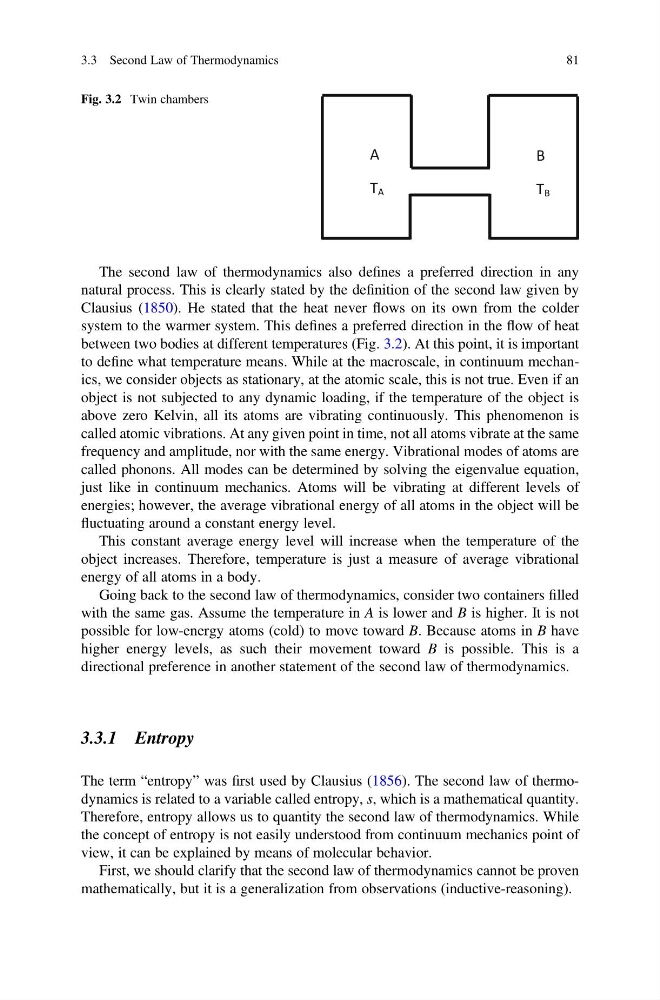
between two bodies at different temperatures (Fig. 3.2). At this point, it is important
to define what temperature means. While at the macroscale, in continuum mechanics, we consider objects as stationary, at the atomic scale, this is not true. Even if an
object is not subjected to any dynamic loading, if the temperature of the object is
above zero Kelvin, all its atoms are vibrating continuously. This phenomenon is
called atomic vibrations. At any given point in time, not all atoms vibrate at the same
frequency and amplitude, nor with the same energy. Vibrational modes of atoms are
called phonons. All modes can be determined by solving the eigenvalue equation,
just like in continuum mechanics. Atoms will be vibrating at different levels of
energies; however, the average vibrational energy of all atoms in the object will be
fluctuating around a constant energy level.
This constant average energy level will increase when the temperature of the
object increases. Therefore, temperature is just a measure of average vibrational
energy of all atoms in a body.
Going back to the second law of thermodynamics, consider two containers filled
with the same gas. Assume the temperature in A is lower and B is higher. It is not
possible for low-energy atoms (cold) to move toward B. Because atoms in B have
higher energy levels, as such their movement toward B is possible. This is a
directional preference in another statement of the second law of thermodynamics.
3.3.1 Entropy
The term “entropy” was first used by Clausius (1856). The second law of thermodynamics is related to a variable called entropy, s, which is a mathematical quantity.
Therefore, entropy allows us to quantity the second law of thermodynamics. While
the concept of entropy is not easily understood from continuum mechanics point of
view, it can be explained by means of molecular behavior.
First, we should clarify that the second law of thermodynamics cannot be proven
mathematically, but it is a generalization from observations (inductive-reasoning).
A
T A
B
T B
Fig. 3.2 Twin chambers
3.3 Second Law of Thermodynamics
81
natural process. This is clearly stated by the definition of the second law given by
Clausius (1850). He stated that the heat never flows on its own from the colder
system to the warmer system. This defines a preferred direction in the flow of heat
between two bodies at different temperatures (Fig. 3.2). At this point, it is important
to define what temperature means. While at the macroscale, in continuum mechanics, we consider objects as stationary, at the atomic scale, this is not true. Even if an
object is not subjected to any dynamic loading, if the temperature of the object is
above zero Kelvin, all its atoms are vibrating continuously. This phenomenon is
called atomic vibrations. At any given point in time, not all atoms vibrate at the same
frequency and amplitude, nor with the same energy. Vibrational modes of atoms are
called phonons. All modes can be determined by solving the eigenvalue equation,
just like in continuum mechanics. Atoms will be vibrating at different levels of
energies; however, the average vibrational energy of all atoms in the object will be
fluctuating around a constant energy level.
This constant average energy level will increase when the temperature of the
object increases. Therefore, temperature is just a measure of average vibrational
energy of all atoms in a body.
Going back to the second law of thermodynamics, consider two containers filled
with the same gas. Assume the temperature in A is lower and B is higher. It is not
possible for low-energy atoms (cold) to move toward B. Because atoms in B have
higher energy levels, as such their movement toward B is possible. This is a
directional preference in another statement of the second law of thermodynamics.
3.3.1 Entropy
The term “entropy” was first used by Clausius (1856). The second law of thermodynamics is related to a variable called entropy, s, which is a mathematical quantity.
Therefore, entropy allows us to quantity the second law of thermodynamics. While
the concept of entropy is not easily understood from continuum mechanics point of
view, it can be explained by means of molecular behavior.
First, we should clarify that the second law of thermodynamics cannot be proven
mathematically, but it is a generalization from observations (inductive-reasoning).
A
T A
B
T B
Fig. 3.2 Twin chambers
3.3 Second Law of Thermodynamics
81