

states. They can only be produced in unique systems and most importantly, they
decay away very quickly. Therefore, these nonequilibrium transient points do not
invalidate the positive value of the partial derivative for steady-state equilibrium
states. Since entropy is a continuous, differentiable, and monotonic function of
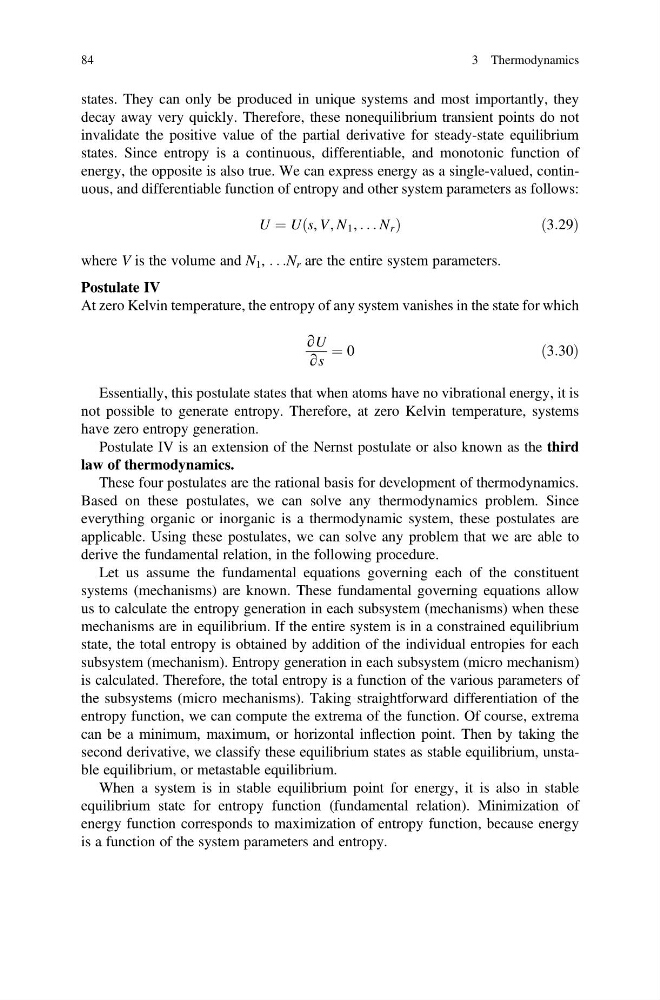
energy, the opposite is also true. We can express energy as a single-valued, continuous, and differentiable function of entropy and other system parameters as follows:
U ¼ U s, V, N 1 , . . . N r
ð
Þ
ð 3:29Þ
where V is the volume and N 1 , . . .N r are the entire system parameters.
Postulate IV
At zero Kelvin temperature, the entropy of any system vanishes in the state for which
∂U
∂s
¼ 0
ð3:30Þ
Essentially, this postulate states that when atoms have no vibrational energy, it is
not possible to generate entropy. Therefore, at zero Kelvin temperature, systems
have zero entropy generation.
Postulate IV is an extension of the Nernst postulate or also known as the third
law of thermodynamics.
These four postulates are the rational basis for development of thermodynamics.
Based on these postulates, we can solve any thermodynamics problem. Since
everything organic or inorganic is a thermodynamic system, these postulates are
applicable. Using these postulates, we can solve any problem that we are able to
derive the fundamental relation, in the following procedure.
Let us assume the fundamental equations governing each of the constituent
systems (mechanisms) are known. These fundamental governing equations allow
us to calculate the entropy generation in each subsystem (mechanisms) when these
mechanisms are in equilibrium. If the entire system is in a constrained equilibrium
state, the total entropy is obtained by addition of the individual entropies for each
subsystem (mechanism). Entropy generation in each subsystem (micro mechanism)
is calculated. Therefore, the total entropy is a function of the various parameters of
the subsystems (micro mechanisms). Taking straightforward differentiation of the
entropy function, we can compute the extrema of the function. Of course, extrema
can be a minimum, maximum, or horizontal inflection point. Then by taking the
second derivative, we classify these equilibrium states as stable equilibrium, unstable equilibrium, or metastable equilibrium.
When a system is in stable equilibrium point for energy, it is also in stable
equilibrium state for entropy function (fundamental relation). Minimization of
energy function corresponds to maximization of entropy function, because energy
is a function of the system parameters and entropy.
84
3 Thermodynamics
decay away very quickly. Therefore, these nonequilibrium transient points do not
invalidate the positive value of the partial derivative for steady-state equilibrium
states. Since entropy is a continuous, differentiable, and monotonic function of
energy, the opposite is also true. We can express energy as a single-valued, continuous, and differentiable function of entropy and other system parameters as follows:
U ¼ U s, V, N 1 , . . . N r
ð
Þ
ð 3:29Þ
where V is the volume and N 1 , . . .N r are the entire system parameters.
Postulate IV
At zero Kelvin temperature, the entropy of any system vanishes in the state for which
∂U
∂s
¼ 0
ð3:30Þ
Essentially, this postulate states that when atoms have no vibrational energy, it is
not possible to generate entropy. Therefore, at zero Kelvin temperature, systems
have zero entropy generation.
Postulate IV is an extension of the Nernst postulate or also known as the third
law of thermodynamics.
These four postulates are the rational basis for development of thermodynamics.
Based on these postulates, we can solve any thermodynamics problem. Since
everything organic or inorganic is a thermodynamic system, these postulates are
applicable. Using these postulates, we can solve any problem that we are able to
derive the fundamental relation, in the following procedure.
Let us assume the fundamental equations governing each of the constituent
systems (mechanisms) are known. These fundamental governing equations allow
us to calculate the entropy generation in each subsystem (mechanisms) when these
mechanisms are in equilibrium. If the entire system is in a constrained equilibrium
state, the total entropy is obtained by addition of the individual entropies for each
subsystem (mechanism). Entropy generation in each subsystem (micro mechanism)
is calculated. Therefore, the total entropy is a function of the various parameters of
the subsystems (micro mechanisms). Taking straightforward differentiation of the
entropy function, we can compute the extrema of the function. Of course, extrema
can be a minimum, maximum, or horizontal inflection point. Then by taking the
second derivative, we classify these equilibrium states as stable equilibrium, unstable equilibrium, or metastable equilibrium.
When a system is in stable equilibrium point for energy, it is also in stable
equilibrium state for entropy function (fundamental relation). Minimization of
energy function corresponds to maximization of entropy function, because energy
is a function of the system parameters and entropy.
84
3 Thermodynamics