

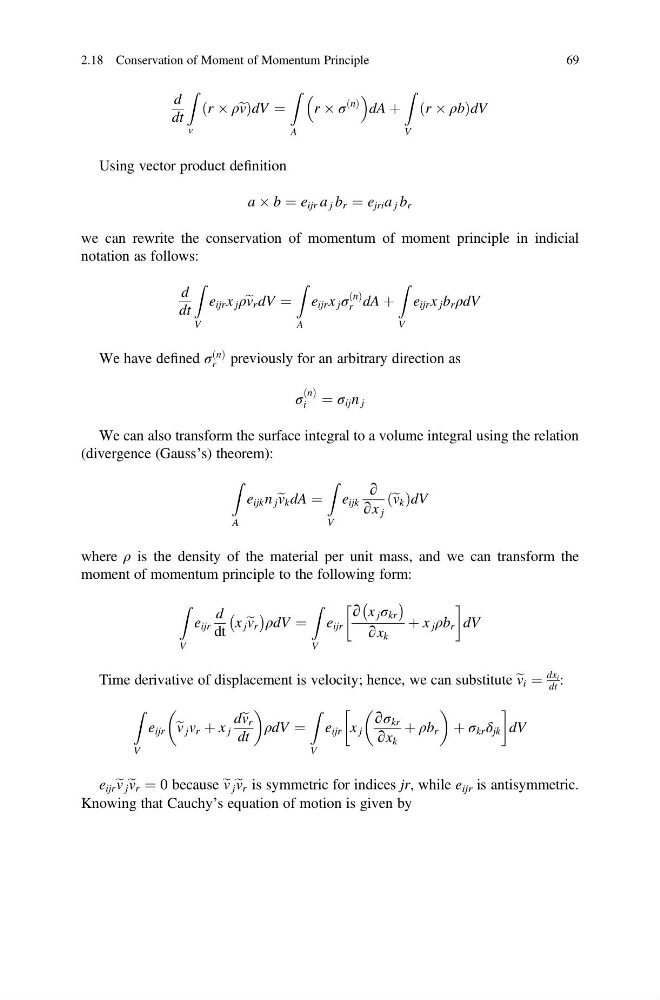
d
dt
Z
v
r  ρe v
ð
ÞdV ¼
Z
A
r  σ
n
ð Þ
dA þ
Z
V
r  ρb
ð
ÞdV
Using vector product definition
a  b ¼ e ijr a j b r ¼ e jri a j b r
we can rewrite the conservation of momentum of moment principle in indicial
notation as follows:
d
dt
Z
V
e ijr x j ρe v r dV ¼
Z
A
e ijr x j σ
n
ð Þ
r dA þ
Z
V
e ijr x j b r ρdV
We have defined σ
n
ð Þ
r previously for an arbitrary direction as
σ
n
ð Þ
i ¼ σ ij n j
We can also transform the surface integral to a volume integral using the relation
(divergence (Gauss’s) theorem):
Z
A
e ijk n j e v k dA ¼
Z
V
e ijk
∂
∂x j
e v k
ð ÞdV
where ρ is the density of the material per unit mass, and we can transform the
moment of momentum principle to the following form:
Z
V
e ijr
d
dt
x j e v r
À
Á ρdV ¼
Z
V
e ijr
∂ x j σ kr
À
Á
∂x k
þ x j ρb r
!
dV
Time derivative of displacement is velocity; hence, we can substitute e v i ¼
dx i
dt :
Z
V
e ijr e v j v r þ x j
de v r
dt
ρdV ¼
Z
V
e ijr x j
∂σ kr
∂x k
þ ρb r
þ σ kr δ jk
!
dV
e ijr e v j e v r ¼ 0 because e v j e v r is symmetric for indices jr, while e ijr is antisymmetric.
Knowing that Cauchy’s equation of motion is given by
2.18 Conservation of Moment of Momentum Principle
69
dt
Z
v
r  ρe v
ð
ÞdV ¼
Z
A
r  σ
n
ð Þ
dA þ
Z
V
r  ρb
ð
ÞdV
Using vector product definition
a  b ¼ e ijr a j b r ¼ e jri a j b r
we can rewrite the conservation of momentum of moment principle in indicial
notation as follows:
d
dt
Z
V
e ijr x j ρe v r dV ¼
Z
A
e ijr x j σ
n
ð Þ
r dA þ
Z
V
e ijr x j b r ρdV
We have defined σ
n
ð Þ
r previously for an arbitrary direction as
σ
n
ð Þ
i ¼ σ ij n j
We can also transform the surface integral to a volume integral using the relation
(divergence (Gauss’s) theorem):
Z
A
e ijk n j e v k dA ¼
Z
V
e ijk
∂
∂x j
e v k
ð ÞdV
where ρ is the density of the material per unit mass, and we can transform the
moment of momentum principle to the following form:
Z
V
e ijr
d
dt
x j e v r
À
Á ρdV ¼
Z
V
e ijr
∂ x j σ kr
À
Á
∂x k
þ x j ρb r
!
dV
Time derivative of displacement is velocity; hence, we can substitute e v i ¼
dx i
dt :
Z
V
e ijr e v j v r þ x j
de v r
dt
ρdV ¼
Z
V
e ijr x j
∂σ kr
∂x k
þ ρb r
þ σ kr δ jk
!
dV
e ijr e v j e v r ¼ 0 because e v j e v r is symmetric for indices jr, while e ijr is antisymmetric.
Knowing that Cauchy’s equation of motion is given by
2.18 Conservation of Moment of Momentum Principle
69