

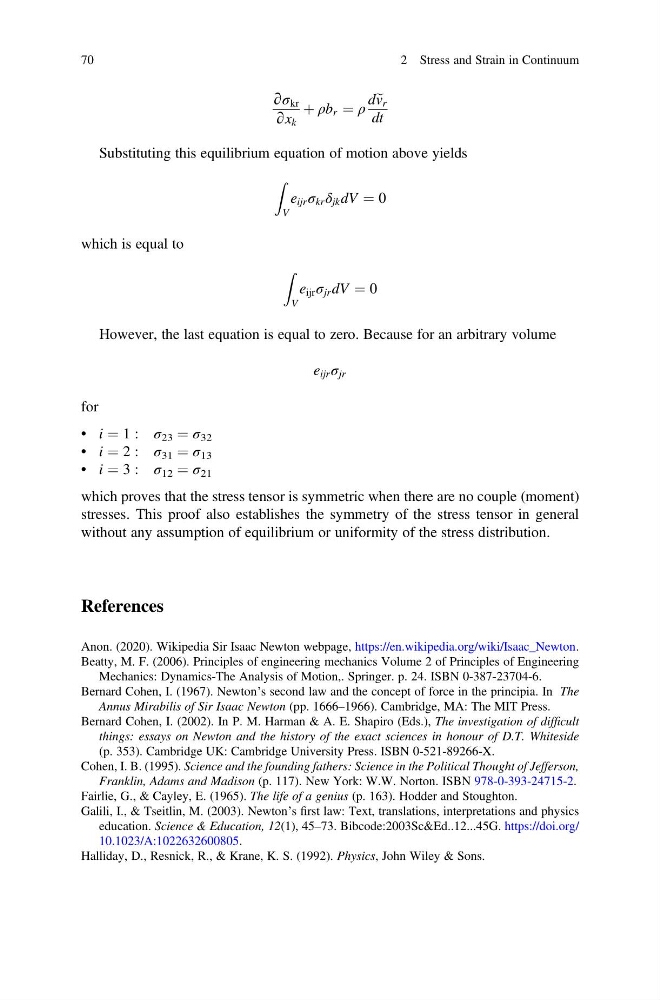
∂σ kr
∂x k
þ ρb r ¼ ρ
de v r
dt
Substituting this equilibrium equation of motion above yields
Z
V
e ijr σ kr δ jk dV ¼ 0
which is equal to
Z
V
e ijr σ jr dV ¼ 0
However, the last equation is equal to zero. Because for an arbitrary volume
e ijr σ jr
for
• i ¼ 1 : σ 23 ¼ σ 32
• i ¼ 2 : σ 31 ¼ σ 13
• i ¼ 3 : σ 12 ¼ σ 21
which proves that the stress tensor is symmetric when there are no couple (moment)
stresses. This proof also establishes the symmetry of the stress tensor in general
without any assumption of equilibrium or uniformity of the stress distribution.
References
Anon. (2020). Wikipedia Sir Isaac Newton webpage, https://en.wikipedia.org/wiki/Isaac_Newton.
Beatty, M. F. (2006). Principles of engineering mechanics Volume 2 of Principles of Engineering
Mechanics: Dynamics-The Analysis of Motion,. Springer. p. 24. ISBN 0-387-23704-6.
Bernard Cohen, I. (1967). Newton’s second law and the concept of force in the principia. In The
Annus Mirabilis of Sir Isaac Newton (pp. 1666–1966). Cambridge, MA: The MIT Press.
Bernard Cohen, I. (2002). In P. M. Harman & A. E. Shapiro (Eds.), The investigation of difficult
things: essays on Newton and the history of the exact sciences in honour of D.T. Whiteside
(p. 353). Cambridge UK: Cambridge University Press. ISBN 0-521-89266-X.
Cohen, I. B. (1995). Science and the founding fathers: Science in the Political Thought of Jefferson,
Franklin, Adams and Madison (p. 117). New York: W.W. Norton. ISBN 978-0-393-24715-2.
Fairlie, G., & Cayley, E. (1965). The life of a genius (p. 163). Hodder and Stoughton.
Galili, I., & Tseitlin, M. (2003). Newton’s first law: Text, translations, interpretations and physics
education. Science & Education, 12(1), 45–73. Bibcode:2003Sc&Ed..12...45G. https://doi.org/
10.1023/A:1022632600805.
Halliday, D., Resnick, R., & Krane, K. S. (1992). Physics, John Wiley & Sons.
70
2 Stress and Strain in Continuum
∂x k
þ ρb r ¼ ρ
de v r
dt
Substituting this equilibrium equation of motion above yields
Z
V
e ijr σ kr δ jk dV ¼ 0
which is equal to
Z
V
e ijr σ jr dV ¼ 0
However, the last equation is equal to zero. Because for an arbitrary volume
e ijr σ jr
for
• i ¼ 1 : σ 23 ¼ σ 32
• i ¼ 2 : σ 31 ¼ σ 13
• i ¼ 3 : σ 12 ¼ σ 21
which proves that the stress tensor is symmetric when there are no couple (moment)
stresses. This proof also establishes the symmetry of the stress tensor in general
without any assumption of equilibrium or uniformity of the stress distribution.
References
Anon. (2020). Wikipedia Sir Isaac Newton webpage, https://en.wikipedia.org/wiki/Isaac_Newton.
Beatty, M. F. (2006). Principles of engineering mechanics Volume 2 of Principles of Engineering
Mechanics: Dynamics-The Analysis of Motion,. Springer. p. 24. ISBN 0-387-23704-6.
Bernard Cohen, I. (1967). Newton’s second law and the concept of force in the principia. In The
Annus Mirabilis of Sir Isaac Newton (pp. 1666–1966). Cambridge, MA: The MIT Press.
Bernard Cohen, I. (2002). In P. M. Harman & A. E. Shapiro (Eds.), The investigation of difficult
things: essays on Newton and the history of the exact sciences in honour of D.T. Whiteside
(p. 353). Cambridge UK: Cambridge University Press. ISBN 0-521-89266-X.
Cohen, I. B. (1995). Science and the founding fathers: Science in the Political Thought of Jefferson,
Franklin, Adams and Madison (p. 117). New York: W.W. Norton. ISBN 978-0-393-24715-2.
Fairlie, G., & Cayley, E. (1965). The life of a genius (p. 163). Hodder and Stoughton.
Galili, I., & Tseitlin, M. (2003). Newton’s first law: Text, translations, interpretations and physics
education. Science & Education, 12(1), 45–73. Bibcode:2003Sc&Ed..12...45G. https://doi.org/
10.1023/A:1022632600805.
Halliday, D., Resnick, R., & Krane, K. S. (1992). Physics, John Wiley & Sons.
70
2 Stress and Strain in Continuum