

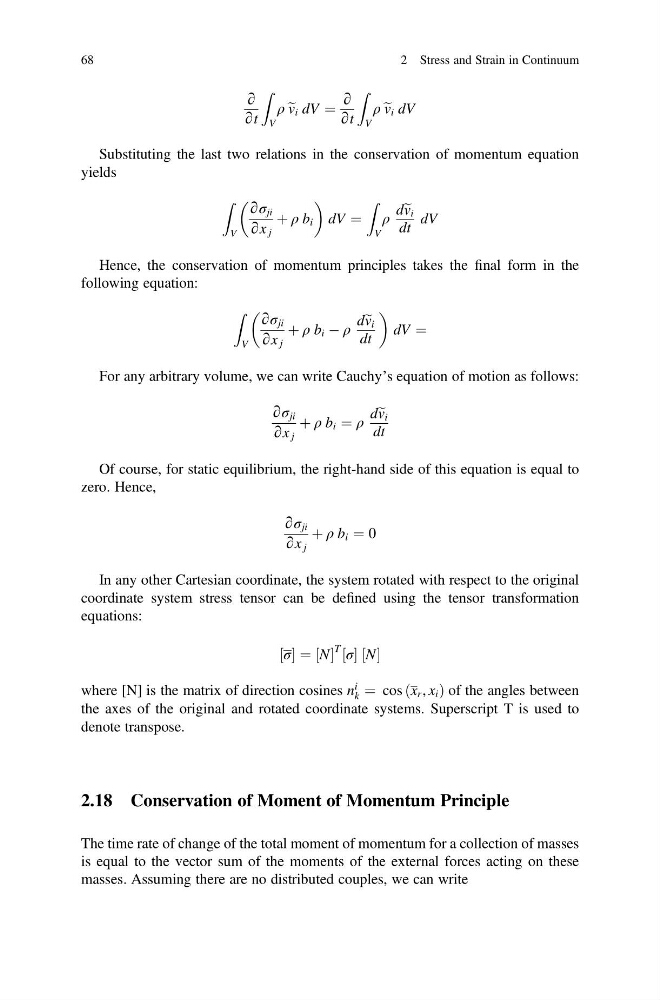
∂
∂t
Z
V
ρ e v i dV ¼
∂
∂t
Z
V
ρ e v i dV
Substituting the last two relations in the conservation of momentum equation
yields
Z
V
∂σ ji
∂x j
þ ρ b i
dV ¼
Z
V
ρ
de v i
dt
dV
Hence, the conservation of momentum principles takes the final form in the
following equation:
Z
V
∂σ ji
∂x j
þ ρ b i À ρ
de v i
dt
dV ¼
For any arbitrary volume, we can write Cauchy’s equation of motion as follows:
∂σ ji
∂x j
þ ρ b i ¼ ρ
de v i
dt
Of course, for static equilibrium, the right-hand side of this equation is equal to
zero. Hence,
∂σ ji
∂x j
þ ρ b i ¼ 0
In any other Cartesian coordinate, the system rotated with respect to the original
coordinate system stress tensor can be defined using the tensor transformation
equations:
σ
½ ¼ N
½
T σ
½ N
½
where [N] is the matrix of direction cosines n
i
k ¼ cos x r , x i
ð
Þof the angles between
the axes of the original and rotated coordinate systems. Superscript T is used to
denote transpose.
2.18 Conservation of Moment of Momentum Principle
The time rate of change of the total moment of momentum for a collection of masses
is equal to the vector sum of the moments of the external forces acting on these
masses. Assuming there are no distributed couples, we can write
68
2 Stress and Strain in Continuum
∂t
Z
V
ρ e v i dV ¼
∂
∂t
Z
V
ρ e v i dV
Substituting the last two relations in the conservation of momentum equation
yields
Z
V
∂σ ji
∂x j
þ ρ b i
dV ¼
Z
V
ρ
de v i
dt
dV
Hence, the conservation of momentum principles takes the final form in the
following equation:
Z
V
∂σ ji
∂x j
þ ρ b i À ρ
de v i
dt
dV ¼
For any arbitrary volume, we can write Cauchy’s equation of motion as follows:
∂σ ji
∂x j
þ ρ b i ¼ ρ
de v i
dt
Of course, for static equilibrium, the right-hand side of this equation is equal to
zero. Hence,
∂σ ji
∂x j
þ ρ b i ¼ 0
In any other Cartesian coordinate, the system rotated with respect to the original
coordinate system stress tensor can be defined using the tensor transformation
equations:
σ
½ ¼ N
½
T σ
½ N
½
where [N] is the matrix of direction cosines n
i
k ¼ cos x r , x i
ð
Þof the angles between
the axes of the original and rotated coordinate systems. Superscript T is used to
denote transpose.
2.18 Conservation of Moment of Momentum Principle
The time rate of change of the total moment of momentum for a collection of masses
is equal to the vector sum of the moments of the external forces acting on these
masses. Assuming there are no distributed couples, we can write
68
2 Stress and Strain in Continuum