

there are three unknown displacements, six unknown stresses, and six unknown
strains. Therefore, the number of equations is equal to the number of unknowns.
In most computational mechanics boundary value problems, usually the displacements are included as unknowns, as in displacement-based finite element method.
As a result we do not need the compatibility equations. However, in force-based
analysis methods, compatibility functions become necessary.
In summary, when displacements are not explicitly retained as unknowns, the
compatibility conditions (this should actually be called the compatibility of the
displacement field) are needed to make sure that strain field leads to a continuous
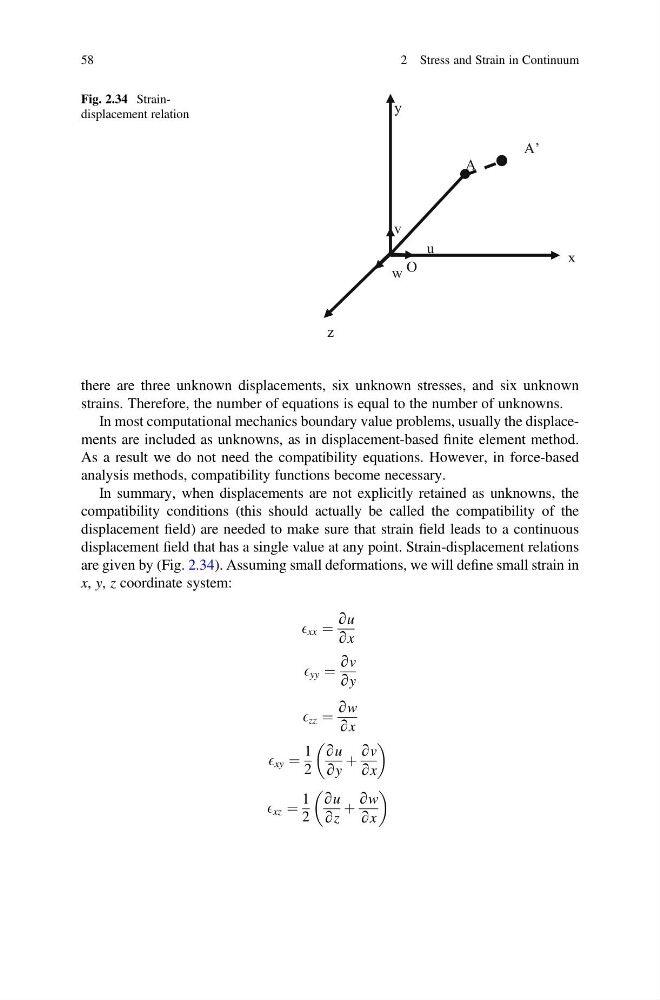
displacement field that has a single value at any point. Strain-displacement relations
are given by (Fig. 2.34). Assuming small deformations, we will define small strain in
x, y, z coordinate system:
E xx ¼
∂u
∂x
E yy ¼
∂v
∂y
E zz ¼
∂w
∂x
E xy ¼
1
2
∂u
∂y
þ
∂v
∂x
E xz ¼
1
2
∂u
∂z
þ
∂w
∂x
x
y
z
A
A’
v
w
u
O
Fig. 2.34 Straindisplacement relation
58
2 Stress and Strain in Continuum
strains. Therefore, the number of equations is equal to the number of unknowns.
In most computational mechanics boundary value problems, usually the displacements are included as unknowns, as in displacement-based finite element method.
As a result we do not need the compatibility equations. However, in force-based
analysis methods, compatibility functions become necessary.
In summary, when displacements are not explicitly retained as unknowns, the
compatibility conditions (this should actually be called the compatibility of the
displacement field) are needed to make sure that strain field leads to a continuous
displacement field that has a single value at any point. Strain-displacement relations
are given by (Fig. 2.34). Assuming small deformations, we will define small strain in
x, y, z coordinate system:
E xx ¼
∂u
∂x
E yy ¼
∂v
∂y
E zz ¼
∂w
∂x
E xy ¼
1
2
∂u
∂y
þ
∂v
∂x
E xz ¼
1
2
∂u
∂z
þ
∂w
∂x
x
y
z
A
A’
v
w
u
O
Fig. 2.34 Straindisplacement relation
58
2 Stress and Strain in Continuum