

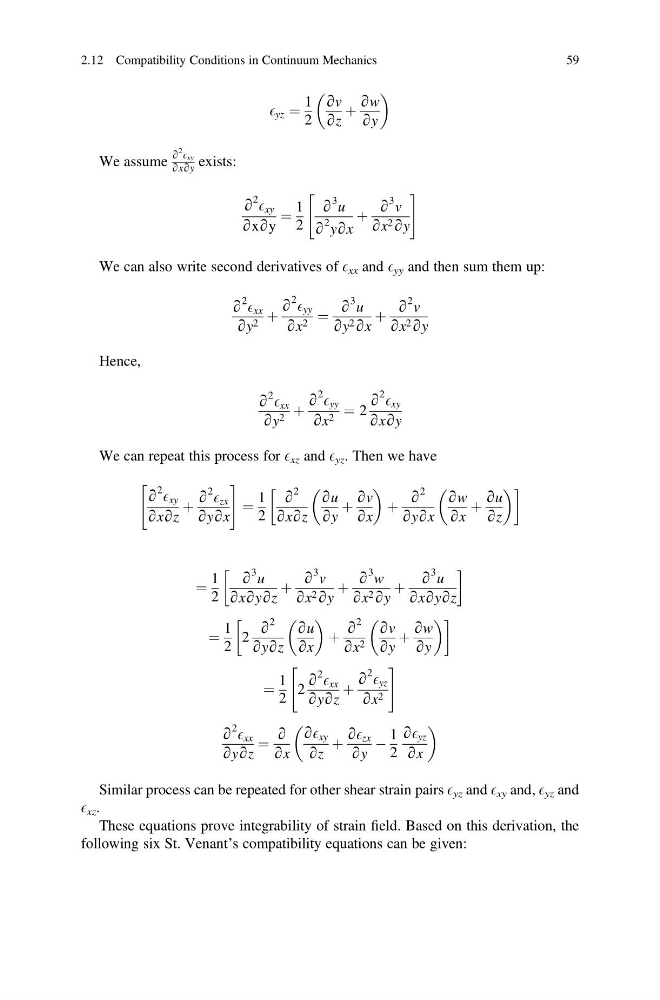
E yz ¼
1
2
∂v
∂z
þ
∂w
∂y
We assume
∂
2 E xy
∂x∂y
exists:
∂
2 E xy
∂x∂y
¼
1
2
∂
3 u
∂
2 y∂x
þ
∂
3 v
∂x 2 ∂y
"
#
We can also write second derivatives of E xx and E yy and then sum them up:
∂
2 E xx
∂y 2 þ
∂
2 E yy
∂x 2 ¼
∂
3 u
∂y 2 ∂x
þ
∂
2 v
∂x 2 ∂y
Hence,
∂
2 E xx
∂y 2 þ
∂
2 E yy
∂x 2 ¼ 2
∂
2 E xy
∂x∂y
We can repeat this process for E xz and E yz . Then we have
∂
2 E xy
∂x∂z
þ
∂
2 E zx
∂y∂x
"
#
¼
1
2
∂
2
∂x∂z
∂u
∂y
þ
∂v
∂x
þ
∂
2
∂y∂x
∂w
∂x
þ
∂u
∂z
!
¼
1
2
∂
3 u
∂x∂y∂z
þ
∂
3 v
∂x 2 ∂y
þ
∂
3 w
∂x 2 ∂y
þ
∂
3 u
∂x∂y∂z
!
¼
1
2
2
∂
2
∂y∂z
∂u
∂x
þ
∂
2
∂x 2
∂v
∂y
þ
∂w
∂y
!
¼
1
2
2
∂
2 E xx
∂y∂z
þ
∂
2 E yz
∂x 2
"
#
∂
2 E xx
∂y∂z
¼
∂
∂x
∂E xy
∂z
þ
∂E zx
∂y
À
1
2
∂E yz
∂x
Similar process can be repeated for other shear strain pairs E yz and E xy and, E yz and
E xz .
These equations prove integrability of strain field. Based on this derivation, the
following six St. Venant’s compatibility equations can be given:
2.12 Compatibility Conditions in Continuum Mechanics
59
1
2
∂v
∂z
þ
∂w
∂y
We assume
∂
2 E xy
∂x∂y
exists:
∂
2 E xy
∂x∂y
¼
1
2
∂
3 u
∂
2 y∂x
þ
∂
3 v
∂x 2 ∂y
"
#
We can also write second derivatives of E xx and E yy and then sum them up:
∂
2 E xx
∂y 2 þ
∂
2 E yy
∂x 2 ¼
∂
3 u
∂y 2 ∂x
þ
∂
2 v
∂x 2 ∂y
Hence,
∂
2 E xx
∂y 2 þ
∂
2 E yy
∂x 2 ¼ 2
∂
2 E xy
∂x∂y
We can repeat this process for E xz and E yz . Then we have
∂
2 E xy
∂x∂z
þ
∂
2 E zx
∂y∂x
"
#
¼
1
2
∂
2
∂x∂z
∂u
∂y
þ
∂v
∂x
þ
∂
2
∂y∂x
∂w
∂x
þ
∂u
∂z
!
¼
1
2
∂
3 u
∂x∂y∂z
þ
∂
3 v
∂x 2 ∂y
þ
∂
3 w
∂x 2 ∂y
þ
∂
3 u
∂x∂y∂z
!
¼
1
2
2
∂
2
∂y∂z
∂u
∂x
þ
∂
2
∂x 2
∂v
∂y
þ
∂w
∂y
!
¼
1
2
2
∂
2 E xx
∂y∂z
þ
∂
2 E yz
∂x 2
"
#
∂
2 E xx
∂y∂z
¼
∂
∂x
∂E xy
∂z
þ
∂E zx
∂y
À
1
2
∂E yz
∂x
Similar process can be repeated for other shear strain pairs E yz and E xy and, E yz and
E xz .
These equations prove integrability of strain field. Based on this derivation, the
following six St. Venant’s compatibility equations can be given:
2.12 Compatibility Conditions in Continuum Mechanics
59