

_
E
à ¼ D À E
Ã
Á L þ L
T
Á E
Ã
À
Á
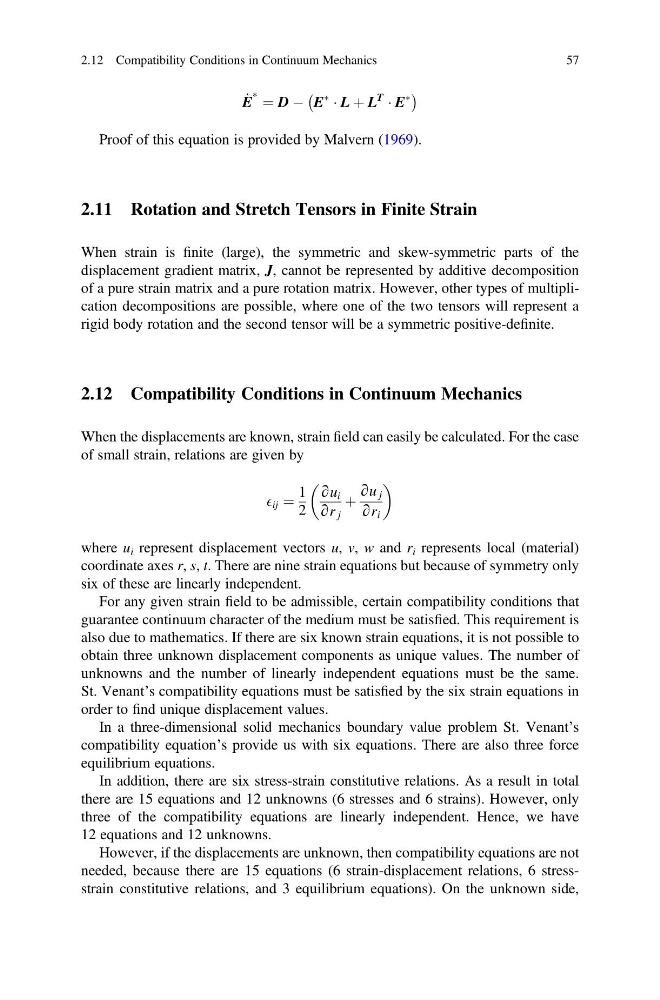
Proof of this equation is provided by Malvern (1969).
2.11 Rotation and Stretch Tensors in Finite Strain
When strain is finite (large), the symmetric and skew-symmetric parts of the
displacement gradient matrix, J, cannot be represented by additive decomposition
of a pure strain matrix and a pure rotation matrix. However, other types of multiplication decompositions are possible, where one of the two tensors will represent a
rigid body rotation and the second tensor will be a symmetric positive-definite.
2.12 Compatibility Conditions in Continuum Mechanics
When the displacements are known, strain field can easily be calculated. For the case
of small strain, relations are given by
E ij ¼
1
2
∂u i
∂r j
þ
∂u j
∂r i
where u i represent displacement vectors u, v, w and r i represents local (material)
coordinate axes r, s, t. There are nine strain equations but because of symmetry only
six of these are linearly independent.
For any given strain field to be admissible, certain compatibility conditions that
guarantee continuum character of the medium must be satisfied. This requirement is
also due to mathematics. If there are six known strain equations, it is not possible to
obtain three unknown displacement components as unique values. The number of
unknowns and the number of linearly independent equations must be the same.
St. Venant’s compatibility equations must be satisfied by the six strain equations in
order to find unique displacement values.
In a three-dimensional solid mechanics boundary value problem St. Venant’s
compatibility equation’s provide us with six equations. There are also three force
equilibrium equations.
In addition, there are six stress-strain constitutive relations. As a result in total
there are 15 equations and 12 unknowns (6 stresses and 6 strains). However, only
three of the compatibility equations are linearly independent. Hence, we have
12 equations and 12 unknowns.
However, if the displacements are unknown, then compatibility equations are not
needed, because there are 15 equations (6 strain-displacement relations, 6 stressstrain constitutive relations, and 3 equilibrium equations). On the unknown side,
2.12 Compatibility Conditions in Continuum Mechanics
57
E
à ¼ D À E
Ã
Á L þ L
T
Á E
Ã
À
Á
Proof of this equation is provided by Malvern (1969).
2.11 Rotation and Stretch Tensors in Finite Strain
When strain is finite (large), the symmetric and skew-symmetric parts of the
displacement gradient matrix, J, cannot be represented by additive decomposition
of a pure strain matrix and a pure rotation matrix. However, other types of multiplication decompositions are possible, where one of the two tensors will represent a
rigid body rotation and the second tensor will be a symmetric positive-definite.
2.12 Compatibility Conditions in Continuum Mechanics
When the displacements are known, strain field can easily be calculated. For the case
of small strain, relations are given by
E ij ¼
1
2
∂u i
∂r j
þ
∂u j
∂r i
where u i represent displacement vectors u, v, w and r i represents local (material)
coordinate axes r, s, t. There are nine strain equations but because of symmetry only
six of these are linearly independent.
For any given strain field to be admissible, certain compatibility conditions that
guarantee continuum character of the medium must be satisfied. This requirement is
also due to mathematics. If there are six known strain equations, it is not possible to
obtain three unknown displacement components as unique values. The number of
unknowns and the number of linearly independent equations must be the same.
St. Venant’s compatibility equations must be satisfied by the six strain equations in
order to find unique displacement values.
In a three-dimensional solid mechanics boundary value problem St. Venant’s
compatibility equation’s provide us with six equations. There are also three force
equilibrium equations.
In addition, there are six stress-strain constitutive relations. As a result in total
there are 15 equations and 12 unknowns (6 stresses and 6 strains). However, only
three of the compatibility equations are linearly independent. Hence, we have
12 equations and 12 unknowns.
However, if the displacements are unknown, then compatibility equations are not
needed, because there are 15 equations (6 strain-displacement relations, 6 stressstrain constitutive relations, and 3 equilibrium equations). On the unknown side,
2.12 Compatibility Conditions in Continuum Mechanics
57