

F ij
 à ¼
∂x i
∂r j
!
The first index identifies the row and the second index identifies the column.
When Eulerian description is used and deformation gradient is defined with
respect to deformed configuration (the spatial deformation gradient F
21 ), relations
between spatial coordinate x and local (material) coordinates r is given by
dr ¼ F
À1
Á dx
or in indicial matrix notation,
dr i
f g ¼
∂r i
∂x j
!
dx j
From the last equation, we can infer that the spatial deformation gradient, F
21 , at
point x is inverse of the deformation gradient tensor F
Therefore,
F Á F
À1
¼ I
can be written between the deformation gradient tensor and the spatial deformation
gradient tensor, where I is the unit matrix.
Strain is a human construct. It is not a physical quantity that can be measured
directly like displacement or time. It is defined to be able to formulate material
behavior using mathematics. Because strain is not a direct physical quantity, it can be
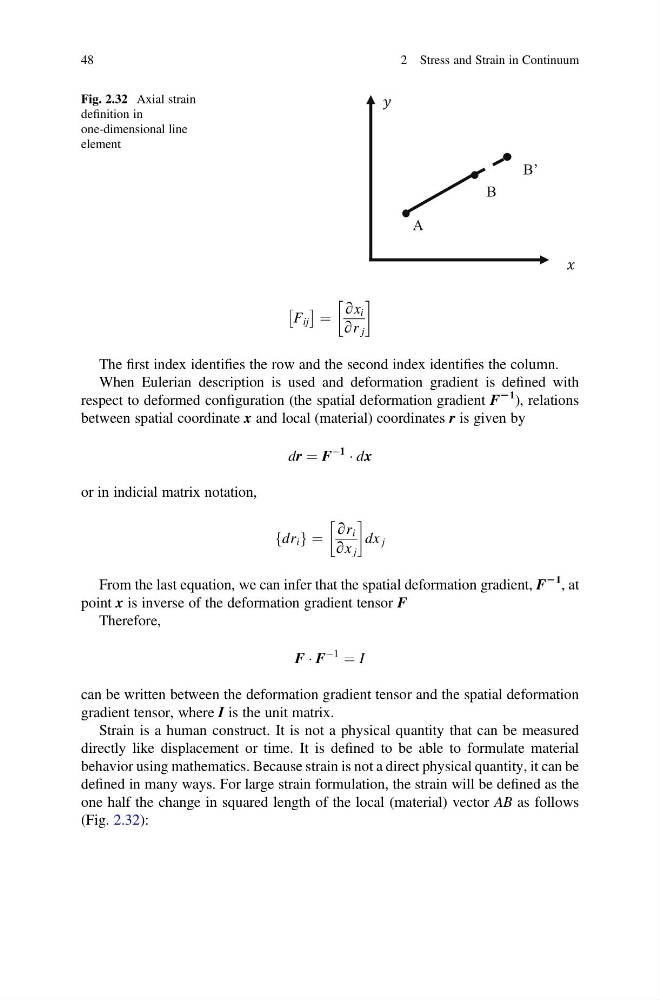
defined in many ways. For large strain formulation, the strain will be defined as the
one half the change in squared length of the local (material) vector AB as follows
(Fig. 2.32):
A
B
B’
Fig. 2.32 Axial strain
definition in
one-dimensional line
element
48
2 Stress and Strain in Continuum
 à ¼
∂x i
∂r j
!
The first index identifies the row and the second index identifies the column.
When Eulerian description is used and deformation gradient is defined with
respect to deformed configuration (the spatial deformation gradient F
21 ), relations
between spatial coordinate x and local (material) coordinates r is given by
dr ¼ F
À1
Á dx
or in indicial matrix notation,
dr i
f g ¼
∂r i
∂x j
!
dx j
From the last equation, we can infer that the spatial deformation gradient, F
21 , at
point x is inverse of the deformation gradient tensor F
Therefore,
F Á F
À1
¼ I
can be written between the deformation gradient tensor and the spatial deformation
gradient tensor, where I is the unit matrix.
Strain is a human construct. It is not a physical quantity that can be measured
directly like displacement or time. It is defined to be able to formulate material
behavior using mathematics. Because strain is not a direct physical quantity, it can be
defined in many ways. For large strain formulation, the strain will be defined as the
one half the change in squared length of the local (material) vector AB as follows
(Fig. 2.32):
A
B
B’
Fig. 2.32 Axial strain
definition in
one-dimensional line
element
48
2 Stress and Strain in Continuum