

and phase change are assumed to account for small portion of the total entropy
generation. Of course including their contribution would be more accurate. In the
derivation below, for the sake of completeness, and clarity, some obvious thermodynamics relations are re-stated.
According to the second law of thermodynamics for any macroscopic system, the
entropy, S, of the system is a state function.
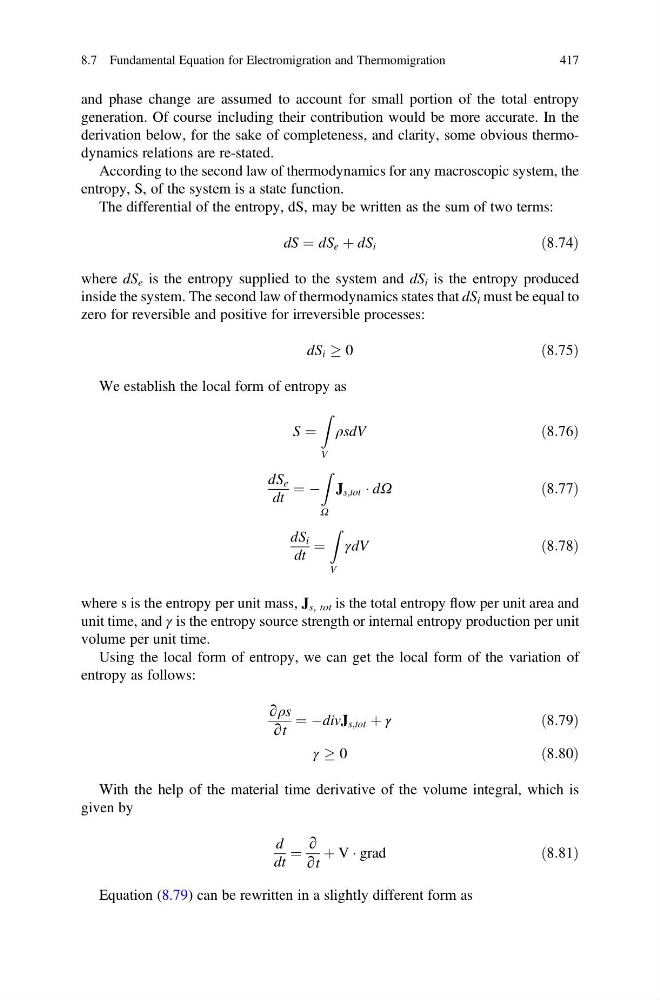
The differential of the entropy, dS, may be written as the sum of two terms:
dS ¼ dS e þ dS i
ð8:74Þ
where dS e is the entropy supplied to the system and dS i is the entropy produced
inside the system. The second law of thermodynamics states that dS i must be equal to
zero for reversible and positive for irreversible processes:
dS i ! 0
ð8:75Þ
We establish the local form of entropy as
S ¼
Z
V
ρsdV
ð8:76Þ
dS e
dt
¼ À
Z
Ω
J s,tot Á dΩ
ð8:77Þ
dS i
dt
¼
Z
V
γdV
ð8:78Þ
where s is the entropy per unit mass, J s, tot is the total entropy flow per unit area and
unit time, and γ is the entropy source strength or internal entropy production per unit
volume per unit time.
Using the local form of entropy, we can get the local form of the variation of
entropy as follows:
∂ρs
∂t
¼ ÀdivJ s,tot þ γ
ð8:79Þ
γ ! 0
ð8:80Þ
With the help of the material time derivative of the volume integral, which is
given by
d
dt
¼
∂
∂t
þ V Á grad
ð8:81Þ
Equation (8.79) can be rewritten in a slightly different form as
8.7 Fundamental Equation for Electromigration and Thermomigration
417
generation. Of course including their contribution would be more accurate. In the
derivation below, for the sake of completeness, and clarity, some obvious thermodynamics relations are re-stated.
According to the second law of thermodynamics for any macroscopic system, the
entropy, S, of the system is a state function.
The differential of the entropy, dS, may be written as the sum of two terms:
dS ¼ dS e þ dS i
ð8:74Þ
where dS e is the entropy supplied to the system and dS i is the entropy produced
inside the system. The second law of thermodynamics states that dS i must be equal to
zero for reversible and positive for irreversible processes:
dS i ! 0
ð8:75Þ
We establish the local form of entropy as
S ¼
Z
V
ρsdV
ð8:76Þ
dS e
dt
¼ À
Z
Ω
J s,tot Á dΩ
ð8:77Þ
dS i
dt
¼
Z
V
γdV
ð8:78Þ
where s is the entropy per unit mass, J s, tot is the total entropy flow per unit area and
unit time, and γ is the entropy source strength or internal entropy production per unit
volume per unit time.
Using the local form of entropy, we can get the local form of the variation of
entropy as follows:
∂ρs
∂t
¼ ÀdivJ s,tot þ γ
ð8:79Þ
γ ! 0
ð8:80Þ
With the help of the material time derivative of the volume integral, which is
given by
d
dt
¼
∂
∂t
þ V Á grad
ð8:81Þ
Equation (8.79) can be rewritten in a slightly different form as
8.7 Fundamental Equation for Electromigration and Thermomigration
417