

Z
V
∂δϕ
∂x
Á
1
R
Á
∂ϕ
∂x
dV ¼ 0
ð8:69Þ
Introducing δϕ ¼ N
T
Á δϕ
N into the above equation yields
Z
V
∂N
T
∂x
Á
1
R
Á
∂ϕ
∂x
dV
δϕ
N
¼ 0
ð8:70Þ
From Eq. (8.70) we can obtain the stiffness terms
K
ϕϕ
nþ1
h
i
¼
Z
V
∂N
T
∂x
Á
1
R
Á
∂N
∂x
dV
ð8:71Þ
The influence of temperature change on the current field can be taken into
consideration by adding the following term:
K
ϕT
nþ1
h
i
¼
Z
V
∂N
T
∂x
Á E Á
1
R
2
∂R
∂T nþ1
Á NdV
ð8:72Þ
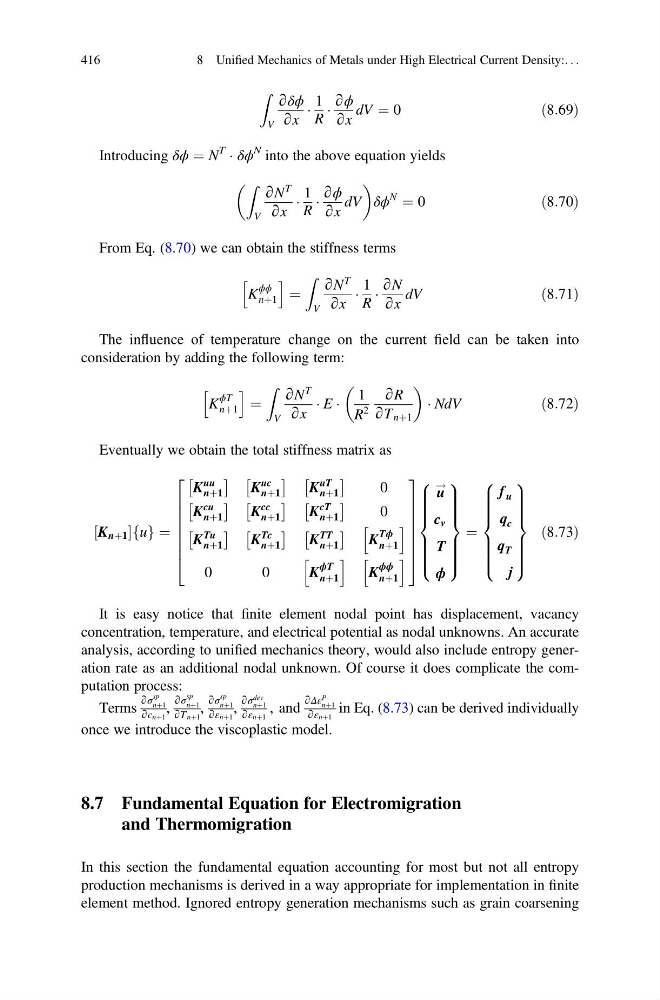
Eventually we obtain the total stiffness matrix as
K nþ1
½
u
f g ¼
K
uu
nþ1
Â
Ã
K
uc
nþ1
Â
Ã
K
uT
nþ1
Â
Ã
0
K
cu
nþ1
Â
Ã
K
cc
nþ1
Â
Ã
K
cT
nþ1
Â
Ã
0
K
Tu
nþ1
Â
Ã
K
Tc
nþ1
Â
Ã
K
TT
nþ1
Â
Ã
K
Tϕ
nþ1
h
i
0
0
K
ϕT
nþ1
h
i
K
ϕϕ
nþ1
h
i
2
6
6
6
6
6
6
4
3
7
7
7
7
7
7
5
u
!
c v
T
ϕ
8
> > > > > <
> > > > > :
9
> > > > > =
> > > > > ;
¼
f u
q c
q T
j
8
> > > > > <
> > > > > :
9
> > > > > =
> > > > > ;
ð8:73Þ
It is easy notice that finite element nodal point has displacement, vacancy
concentration, temperature, and electrical potential as nodal unknowns. An accurate
analysis, according to unified mechanics theory, would also include entropy generation rate as an additional nodal unknown. Of course it does complicate the computation process:
Terms
∂σ
sp
nþ1
∂c nþ1
,
∂σ
sp
nþ1
∂T nþ1
,
∂σ
sp
nþ1
∂ε nþ1
,
∂σ
dev
nþ1
∂ε nþ1
, and
∂Δε
P
nþ1
∂ε nþ1
in Eq. (8.73) can be derived individually
once we introduce the viscoplastic model.
8.7 Fundamental Equation for Electromigration
and Thermomigration
In this section the fundamental equation accounting for most but not all entropy
production mechanisms is derived in a way appropriate for implementation in finite
element method. Ignored entropy generation mechanisms such as grain coarsening
416
8 Unified Mechanics of Metals under High Electrical Current Density:. . .
V
∂δϕ
∂x
Á
1
R
Á
∂ϕ
∂x
dV ¼ 0
ð8:69Þ
Introducing δϕ ¼ N
T
Á δϕ
N into the above equation yields
Z
V
∂N
T
∂x
Á
1
R
Á
∂ϕ
∂x
dV
δϕ
N
¼ 0
ð8:70Þ
From Eq. (8.70) we can obtain the stiffness terms
K
ϕϕ
nþ1
h
i
¼
Z
V
∂N
T
∂x
Á
1
R
Á
∂N
∂x
dV
ð8:71Þ
The influence of temperature change on the current field can be taken into
consideration by adding the following term:
K
ϕT
nþ1
h
i
¼
Z
V
∂N
T
∂x
Á E Á
1
R
2
∂R
∂T nþ1
Á NdV
ð8:72Þ
Eventually we obtain the total stiffness matrix as
K nþ1
½
u
f g ¼
K
uu
nþ1
Â
Ã
K
uc
nþ1
Â
Ã
K
uT
nþ1
Â
Ã
0
K
cu
nþ1
Â
Ã
K
cc
nþ1
Â
Ã
K
cT
nþ1
Â
Ã
0
K
Tu
nþ1
Â
Ã
K
Tc
nþ1
Â
Ã
K
TT
nþ1
Â
Ã
K
Tϕ
nþ1
h
i
0
0
K
ϕT
nþ1
h
i
K
ϕϕ
nþ1
h
i
2
6
6
6
6
6
6
4
3
7
7
7
7
7
7
5
u
!
c v
T
ϕ
8
> > > > > <
> > > > > :
9
> > > > > =
> > > > > ;
¼
f u
q c
q T
j
8
> > > > > <
> > > > > :
9
> > > > > =
> > > > > ;
ð8:73Þ
It is easy notice that finite element nodal point has displacement, vacancy
concentration, temperature, and electrical potential as nodal unknowns. An accurate
analysis, according to unified mechanics theory, would also include entropy generation rate as an additional nodal unknown. Of course it does complicate the computation process:
Terms
∂σ
sp
nþ1
∂c nþ1
,
∂σ
sp
nþ1
∂T nþ1
,
∂σ
sp
nþ1
∂ε nþ1
,
∂σ
dev
nþ1
∂ε nþ1
, and
∂Δε
P
nþ1
∂ε nþ1
in Eq. (8.73) can be derived individually
once we introduce the viscoplastic model.
8.7 Fundamental Equation for Electromigration
and Thermomigration
In this section the fundamental equation accounting for most but not all entropy
production mechanisms is derived in a way appropriate for implementation in finite
element method. Ignored entropy generation mechanisms such as grain coarsening
416
8 Unified Mechanics of Metals under High Electrical Current Density:. . .