

ρ
ds
dt
¼ ÀdivJ s þ γ
ð8:82Þ
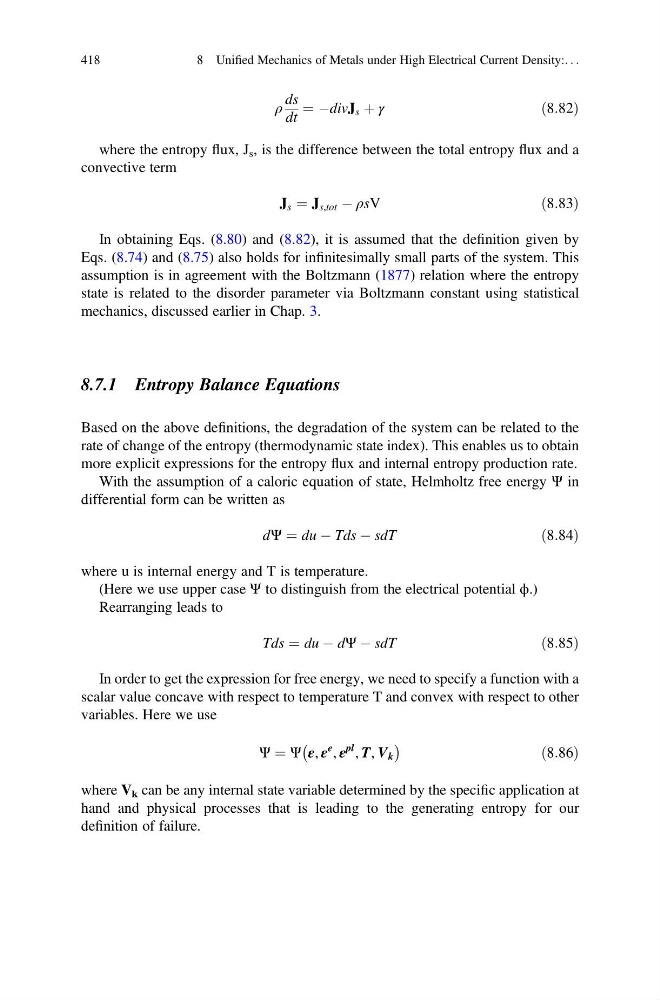
where the entropy flux, J s , is the difference between the total entropy flux and a
convective term
J s ¼ J s,tot À ρsV
ð8:83Þ
In obtaining Eqs. (8.80) and (8.82), it is assumed that the definition given by
Eqs. (8.74) and (8.75) also holds for infinitesimally small parts of the system. This
assumption is in agreement with the Boltzmann (1877) relation where the entropy
state is related to the disorder parameter via Boltzmann constant using statistical
mechanics, discussed earlier in Chap. 3.
8.7.1 Entropy Balance Equations
Based on the above definitions, the degradation of the system can be related to the
rate of change of the entropy (thermodynamic state index). This enables us to obtain
more explicit expressions for the entropy flux and internal entropy production rate.
With the assumption of a caloric equation of state, Helmholtz free energy Ψ in
differential form can be written as
dΨ ¼ du À Tds À sdT
ð8:84Þ
where u is internal energy and T is temperature.
(Here we use upper case Ψ to distinguish from the electrical potential ϕ.)
Rearranging leads to
Tds ¼ du À dΨ À sdT
ð8:85Þ
In order to get the expression for free energy, we need to specify a function with a
scalar value concave with respect to temperature T and convex with respect to other
variables. Here we use
Ψ ¼ Ψ ε, ε
e , ε
pl , T, V k
À
Á
ð8:86Þ
where V k can be any internal state variable determined by the specific application at
hand and physical processes that is leading to the generating entropy for our
definition of failure.
418
8 Unified Mechanics of Metals under High Electrical Current Density:. . .
ds
dt
¼ ÀdivJ s þ γ
ð8:82Þ
where the entropy flux, J s , is the difference between the total entropy flux and a
convective term
J s ¼ J s,tot À ρsV
ð8:83Þ
In obtaining Eqs. (8.80) and (8.82), it is assumed that the definition given by
Eqs. (8.74) and (8.75) also holds for infinitesimally small parts of the system. This
assumption is in agreement with the Boltzmann (1877) relation where the entropy
state is related to the disorder parameter via Boltzmann constant using statistical
mechanics, discussed earlier in Chap. 3.
8.7.1 Entropy Balance Equations
Based on the above definitions, the degradation of the system can be related to the
rate of change of the entropy (thermodynamic state index). This enables us to obtain
more explicit expressions for the entropy flux and internal entropy production rate.
With the assumption of a caloric equation of state, Helmholtz free energy Ψ in
differential form can be written as
dΨ ¼ du À Tds À sdT
ð8:84Þ
where u is internal energy and T is temperature.
(Here we use upper case Ψ to distinguish from the electrical potential ϕ.)
Rearranging leads to
Tds ¼ du À dΨ À sdT
ð8:85Þ
In order to get the expression for free energy, we need to specify a function with a
scalar value concave with respect to temperature T and convex with respect to other
variables. Here we use
Ψ ¼ Ψ ε, ε
e , ε
pl , T, V k
À
Á
ð8:86Þ
where V k can be any internal state variable determined by the specific application at
hand and physical processes that is leading to the generating entropy for our
definition of failure.
418
8 Unified Mechanics of Metals under High Electrical Current Density:. . .