

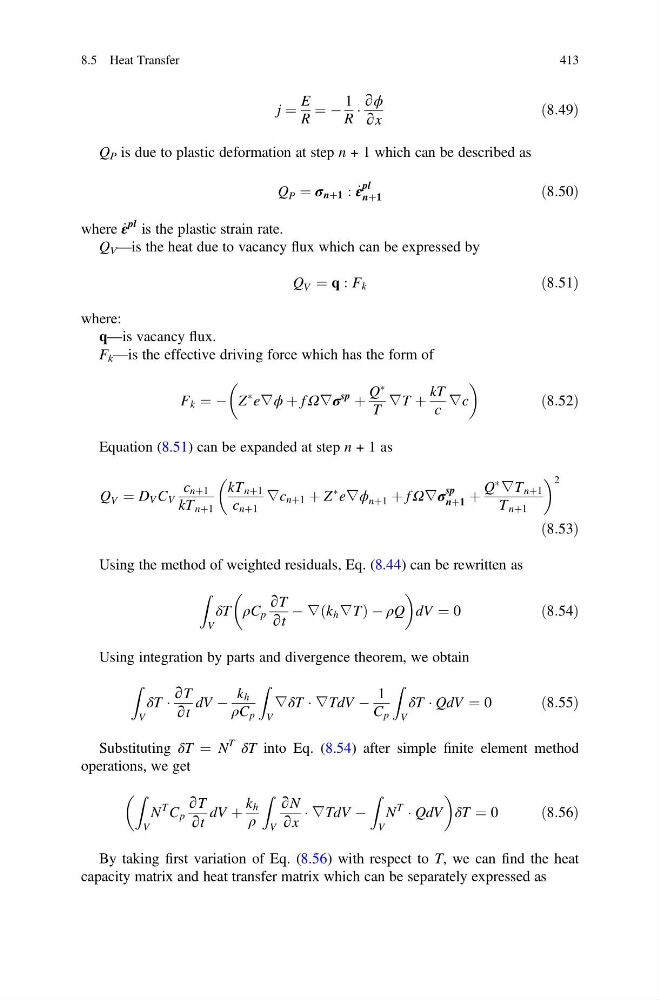
j ¼
E
R
¼ À
1
R
Á
∂ϕ
∂x
ð8:49Þ
Q P is due to plastic deformation at step n + 1 which can be described as
Q P ¼ σ nþ1 : _
ε
pl
nþ1
ð8:50Þ
where _
ε
pl is the plastic strain rate.
Q V —is the heat due to vacancy flux which can be expressed by
Q V ¼ q : F k
ð8:51Þ
where:
q—is vacancy flux.
F k —is the effective driving force which has the form of
F k ¼ À Z
à e∇ϕ þ f Ω∇σ
sp
þ
Q
Ã
T
∇T þ
kT
c
∇c
ð8:52Þ
Equation (8.51) can be expanded at step n + 1 as
Q V ¼ D V C V
c nþ1
kT nþ1
kT nþ1
c nþ1
∇c nþ1 þ Z
à e∇ϕ nþ1 þ f Ω∇σ
sp
nþ1 þ
Q
Ã
∇T nþ1
T nþ1
2
ð8:53Þ
Using the method of weighted residuals, Eq. (8.44) can be rewritten as
Z
V
δT ρC p
∂T
∂t
À ∇ k h ∇T
ð
ÞÀρQ
dV ¼ 0
ð8:54Þ
Using integration by parts and divergence theorem, we obtain
Z
V
δT Á
∂T
∂t
dV À
k h
ρC p
Z
V
∇δT Á ∇TdV À
1
C p
Z
V
δT Á QdV ¼ 0
ð8:55Þ
Substituting δT ¼ N
T
δT into Eq. (8.54) after simple finite element method
operations, we get
Z
V
N
T C p
∂T
∂t
dV þ
k h
ρ
Z
V
∂N
∂x
Á ∇TdV À
Z
V
N
T
Á QdV
δT ¼ 0
ð8:56Þ
By taking first variation of Eq. (8.56) with respect to T, we can find the heat
capacity matrix and heat transfer matrix which can be separately expressed as
8.5 Heat Transfer
413
E
R
¼ À
1
R
Á
∂ϕ
∂x
ð8:49Þ
Q P is due to plastic deformation at step n + 1 which can be described as
Q P ¼ σ nþ1 : _
ε
pl
nþ1
ð8:50Þ
where _
ε
pl is the plastic strain rate.
Q V —is the heat due to vacancy flux which can be expressed by
Q V ¼ q : F k
ð8:51Þ
where:
q—is vacancy flux.
F k —is the effective driving force which has the form of
F k ¼ À Z
à e∇ϕ þ f Ω∇σ
sp
þ
Q
Ã
T
∇T þ
kT
c
∇c
ð8:52Þ
Equation (8.51) can be expanded at step n + 1 as
Q V ¼ D V C V
c nþ1
kT nþ1
kT nþ1
c nþ1
∇c nþ1 þ Z
à e∇ϕ nþ1 þ f Ω∇σ
sp
nþ1 þ
Q
Ã
∇T nþ1
T nþ1
2
ð8:53Þ
Using the method of weighted residuals, Eq. (8.44) can be rewritten as
Z
V
δT ρC p
∂T
∂t
À ∇ k h ∇T
ð
ÞÀρQ
dV ¼ 0
ð8:54Þ
Using integration by parts and divergence theorem, we obtain
Z
V
δT Á
∂T
∂t
dV À
k h
ρC p
Z
V
∇δT Á ∇TdV À
1
C p
Z
V
δT Á QdV ¼ 0
ð8:55Þ
Substituting δT ¼ N
T
δT into Eq. (8.54) after simple finite element method
operations, we get
Z
V
N
T C p
∂T
∂t
dV þ
k h
ρ
Z
V
∂N
∂x
Á ∇TdV À
Z
V
N
T
Á QdV
δT ¼ 0
ð8:56Þ
By taking first variation of Eq. (8.56) with respect to T, we can find the heat
capacity matrix and heat transfer matrix which can be separately expressed as
8.5 Heat Transfer
413