

C
TT
nþ1
Â
à ¼
Z
V
N
T
Á
C P
Δt
Á NdV
ð8:57Þ
K
1
TT
Â
à ¼
Z
V
∂N
T
∂x
Á
k h
ρ
Á
∂N
∂x
dV
ð8:58Þ
K
2
TT
Â
à ¼
Z
V
N
T Á
∂Q
J
nþ1
∂T nþ1
Á NdV
¼
Z
V
N
T Á À
1
R
2
∂R
∂T nþ1
∂ϕ nþ1
∂x
Á
∂ϕ nþ1
∂x
À
∂ϕ nþ1
∂x
Á
∂Δϕ nþ1
∂x
þ
1
3
∂Δϕ nþ1
∂x
Á
∂Δϕ nþ1
∂x
Á NdV
ð8:59Þ
K
3
TT
Â
à ¼
Z
V
N
T Á
∂Q
V
nþ1
∂T nþ1
Á NdV
¼
Z
V
N
T Á
D V C V c nþ1
k
Á
F
k
nþ1 Á N À 2F
k
nþ1
k∇c nþ1
c nþ1
Á N þ f Ω
∂σ
sp
nþ1
∂T nþ1
Á N þ
Q
Ã
T nþ1
Á
∂N
∂x
À
Q
à ∇T nþ1
T
2
nþ1
Á N
"
#
T
2
nþ1
dV
ð8:60Þ
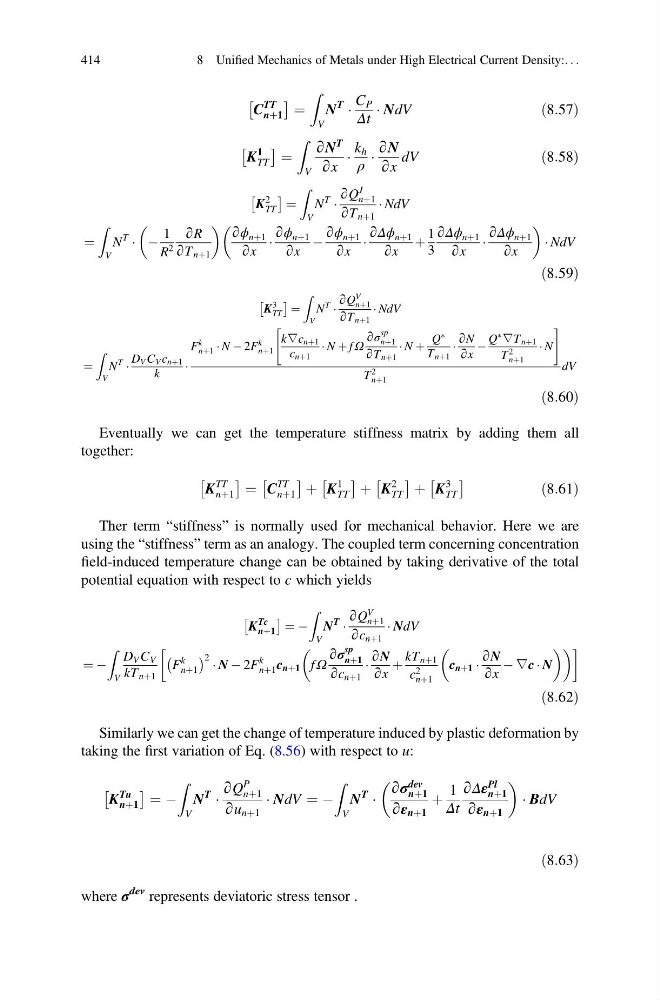
Eventually we can get the temperature stiffness matrix by adding them all
together:
K
TT
nþ1
Â
à ¼ C
TT
nþ1
Â
à þ K
1
TT
Â
à þ K
2
TT
Â
à þ K
3
TT
Â
Ã
ð8:61Þ
Ther term “stiffness” is normally used for mechanical behavior. Here we are
using the “stiffness” term as an analogy. The coupled term concerning concentration
field-induced temperature change can be obtained by taking derivative of the total
potential equation with respect to c which yields
K
Tc
nþ1
Â
à ¼ À
Z
V
N
T Á
∂Q
V
nþ1
∂c nþ1
Á NdV
¼ À
Z
V
D V C V
kT nþ1
F
k
nþ1
À
Á 2 Á N À 2F
k
nþ1 c nþ1 f Ω
∂σ
sp
nþ1
∂c nþ1
Á
∂N
∂x
þ
kT nþ1
c 2
nþ1
c nþ1 Á
∂N
∂x
À ∇c Á N
!
ð8:62Þ
Similarly we can get the change of temperature induced by plastic deformation by
taking the first variation of Eq. (8.56) with respect to u:
K
Tu
nþ1
Â
à ¼ À
Z
V
N
T
Á
∂Q
P
nþ1
∂u nþ1
Á NdV ¼ À
Z
V
N
T
Á
∂σ
dev
nþ1
∂ε nþ1
þ
1
Δt
∂Δε
Pl
nþ1
∂ε nþ1
Á BdV
ð8:63Þ
where σ
dev represents deviatoric stress tensor .
414
8 Unified Mechanics of Metals under High Electrical Current Density:. . .
TT
nþ1
Â
à ¼
Z
V
N
T
Á
C P
Δt
Á NdV
ð8:57Þ
K
1
TT
Â
à ¼
Z
V
∂N
T
∂x
Á
k h
ρ
Á
∂N
∂x
dV
ð8:58Þ
K
2
TT
Â
à ¼
Z
V
N
T Á
∂Q
J
nþ1
∂T nþ1
Á NdV
¼
Z
V
N
T Á À
1
R
2
∂R
∂T nþ1
∂ϕ nþ1
∂x
Á
∂ϕ nþ1
∂x
À
∂ϕ nþ1
∂x
Á
∂Δϕ nþ1
∂x
þ
1
3
∂Δϕ nþ1
∂x
Á
∂Δϕ nþ1
∂x
Á NdV
ð8:59Þ
K
3
TT
Â
à ¼
Z
V
N
T Á
∂Q
V
nþ1
∂T nþ1
Á NdV
¼
Z
V
N
T Á
D V C V c nþ1
k
Á
F
k
nþ1 Á N À 2F
k
nþ1
k∇c nþ1
c nþ1
Á N þ f Ω
∂σ
sp
nþ1
∂T nþ1
Á N þ
Q
Ã
T nþ1
Á
∂N
∂x
À
Q
à ∇T nþ1
T
2
nþ1
Á N
"
#
T
2
nþ1
dV
ð8:60Þ
Eventually we can get the temperature stiffness matrix by adding them all
together:
K
TT
nþ1
Â
à ¼ C
TT
nþ1
Â
à þ K
1
TT
Â
à þ K
2
TT
Â
à þ K
3
TT
Â
Ã
ð8:61Þ
Ther term “stiffness” is normally used for mechanical behavior. Here we are
using the “stiffness” term as an analogy. The coupled term concerning concentration
field-induced temperature change can be obtained by taking derivative of the total
potential equation with respect to c which yields
K
Tc
nþ1
Â
à ¼ À
Z
V
N
T Á
∂Q
V
nþ1
∂c nþ1
Á NdV
¼ À
Z
V
D V C V
kT nþ1
F
k
nþ1
À
Á 2 Á N À 2F
k
nþ1 c nþ1 f Ω
∂σ
sp
nþ1
∂c nþ1
Á
∂N
∂x
þ
kT nþ1
c 2
nþ1
c nþ1 Á
∂N
∂x
À ∇c Á N
!
ð8:62Þ
Similarly we can get the change of temperature induced by plastic deformation by
taking the first variation of Eq. (8.56) with respect to u:
K
Tu
nþ1
Â
à ¼ À
Z
V
N
T
Á
∂Q
P
nþ1
∂u nþ1
Á NdV ¼ À
Z
V
N
T
Á
∂σ
dev
nþ1
∂ε nþ1
þ
1
Δt
∂Δε
Pl
nþ1
∂ε nþ1
Á BdV
ð8:63Þ
where σ
dev represents deviatoric stress tensor .
414
8 Unified Mechanics of Metals under High Electrical Current Density:. . .