

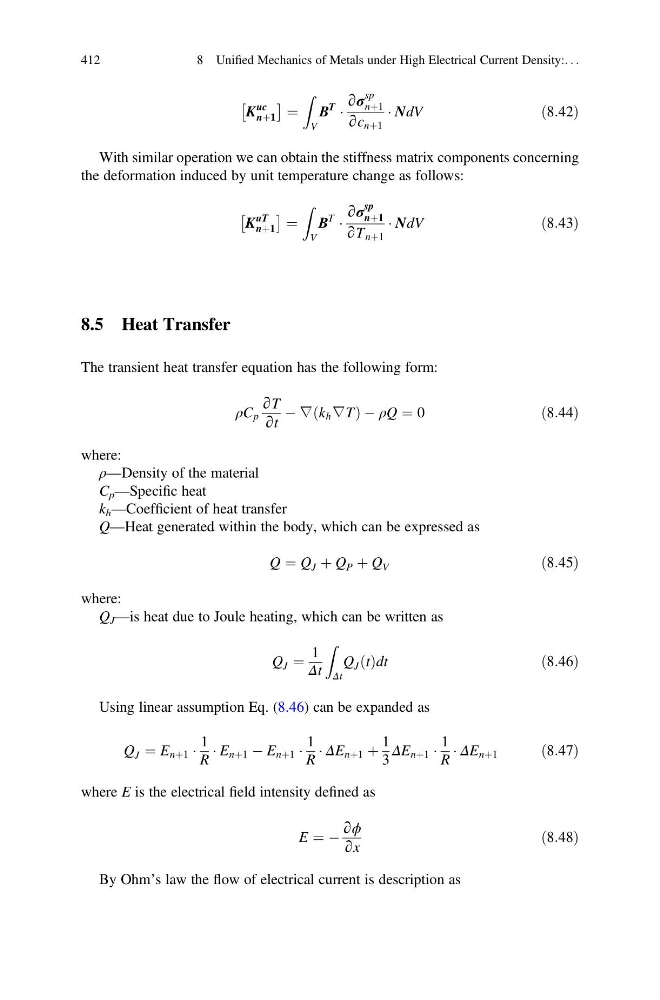
K
uc
nþ1
Â
à ¼
Z
V
Β
T
Á
∂σ
sp
nþ1
∂c nþ1
Á NdV
ð8:42Þ
With similar operation we can obtain the stiffness matrix components concerning
the deformation induced by unit temperature change as follows:
K
uT
nþ1
Â
à ¼
Z
V
Β
T
Á
∂σ
sp
nþ1
∂T nþ1
Á NdV
ð8:43Þ
8.5 Heat Transfer
The transient heat transfer equation has the following form:
ρC p
∂T
∂t
À ∇ k h ∇T
ð
ÞÀρQ ¼ 0
ð8:44Þ
where:
ρ—Density of the material
C p —Specific heat
k h —Coefficient of heat transfer
Q—Heat generated within the body, which can be expressed as
Q ¼ Q J þ Q P þ Q V
ð8:45Þ
where:
Q J —is heat due to Joule heating, which can be written as
Q J ¼
1
Δt
Z
Δt
Q J t
ð Þdt
ð8:46Þ
Using linear assumption Eq. (8.46) can be expanded as
Q J ¼ E nþ1 Á
1
R
Á E nþ1 À E nþ1 Á
1
R
Á ΔE nþ1 þ
1
3
ΔE nþ1 Á
1
R
Á ΔE nþ1
ð8:47Þ
where E is the electrical field intensity defined as
E ¼ À
∂ϕ
∂x
ð8:48Þ
By Ohm’s law the flow of electrical current is description as
412
8 Unified Mechanics of Metals under High Electrical Current Density:. . .
uc
nþ1
Â
à ¼
Z
V
Β
T
Á
∂σ
sp
nþ1
∂c nþ1
Á NdV
ð8:42Þ
With similar operation we can obtain the stiffness matrix components concerning
the deformation induced by unit temperature change as follows:
K
uT
nþ1
Â
à ¼
Z
V
Β
T
Á
∂σ
sp
nþ1
∂T nþ1
Á NdV
ð8:43Þ
8.5 Heat Transfer
The transient heat transfer equation has the following form:
ρC p
∂T
∂t
À ∇ k h ∇T
ð
ÞÀρQ ¼ 0
ð8:44Þ
where:
ρ—Density of the material
C p —Specific heat
k h —Coefficient of heat transfer
Q—Heat generated within the body, which can be expressed as
Q ¼ Q J þ Q P þ Q V
ð8:45Þ
where:
Q J —is heat due to Joule heating, which can be written as
Q J ¼
1
Δt
Z
Δt
Q J t
ð Þdt
ð8:46Þ
Using linear assumption Eq. (8.46) can be expanded as
Q J ¼ E nþ1 Á
1
R
Á E nþ1 À E nþ1 Á
1
R
Á ΔE nþ1 þ
1
3
ΔE nþ1 Á
1
R
Á ΔE nþ1
ð8:47Þ
where E is the electrical field intensity defined as
E ¼ À
∂ϕ
∂x
ð8:48Þ
By Ohm’s law the flow of electrical current is description as
412
8 Unified Mechanics of Metals under High Electrical Current Density:. . .