

Proper approach would also take a derivative of the total potential with respect to
entropy and find the related stiffness matrices. However, that will add entropy as a
nodal unknown to our equations. For the sake of computational simplicity, we take
the entropy generation rate values from the previous step and calculate them at the
Gauss integration point. Assuming the increments are small, the error should be
small. However, this simplification is not mathematically true, and does contribute to
error.
8.4 Newtonian Mechanics Force Equilibrium
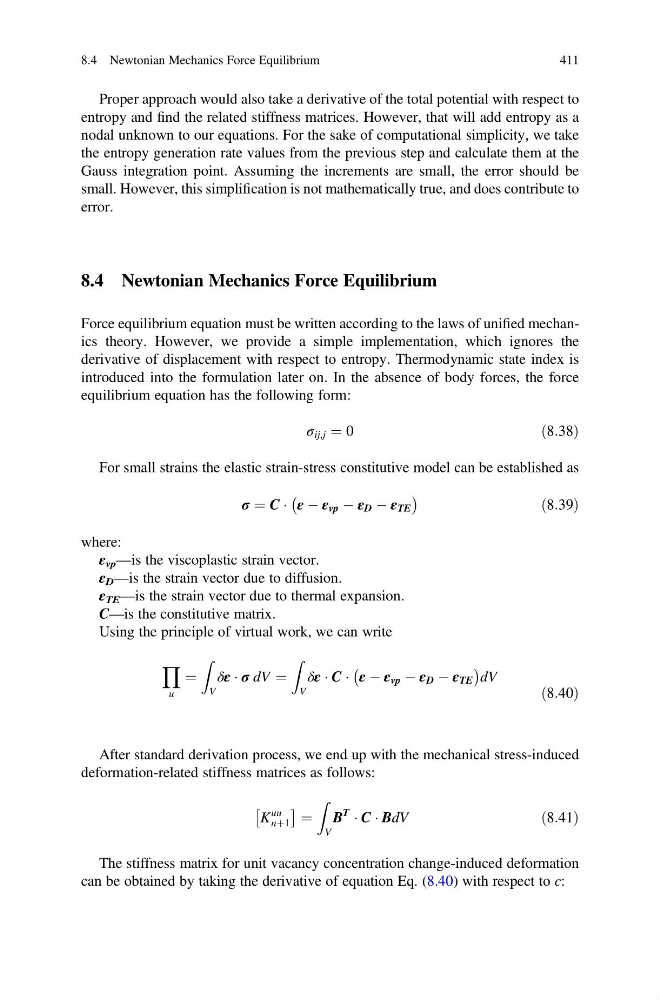
Force equilibrium equation must be written according to the laws of unified mechanics theory. However, we provide a simple implementation, which ignores the
derivative of displacement with respect to entropy. Thermodynamic state index is
introduced into the formulation later on. In the absence of body forces, the force
equilibrium equation has the following form:
σ ij,j ¼ 0
ð8:38Þ
For small strains the elastic strain-stress constitutive model can be established as
σ ¼ C Á ε À ε vp À ε D À ε TE
À
Á
ð8:39Þ
where:
ε vp —is the viscoplastic strain vector.
ε D —is the strain vector due to diffusion.
ε TE —is the strain vector due to thermal expansion.
C—is the constitutive matrix.
Using the principle of virtual work, we can write
Y
u
¼
Z
V
δε Á σ dV ¼
Z
V
δε Á C Á ε À ε vp À ε D À ε TE
À
Á
dV
ð8:40Þ
After standard derivation process, we end up with the mechanical stress-induced
deformation-related stiffness matrices as follows:
K
uu
nþ1
Â
à ¼
Z
V
B
T
Á C Á BdV
ð8:41Þ
The stiffness matrix for unit vacancy concentration change-induced deformation
can be obtained by taking the derivative of equation Eq. (8.40) with respect to c:
8.4 Newtonian Mechanics Force Equilibrium
411
entropy and find the related stiffness matrices. However, that will add entropy as a
nodal unknown to our equations. For the sake of computational simplicity, we take
the entropy generation rate values from the previous step and calculate them at the
Gauss integration point. Assuming the increments are small, the error should be
small. However, this simplification is not mathematically true, and does contribute to
error.
8.4 Newtonian Mechanics Force Equilibrium
Force equilibrium equation must be written according to the laws of unified mechanics theory. However, we provide a simple implementation, which ignores the
derivative of displacement with respect to entropy. Thermodynamic state index is
introduced into the formulation later on. In the absence of body forces, the force
equilibrium equation has the following form:
σ ij,j ¼ 0
ð8:38Þ
For small strains the elastic strain-stress constitutive model can be established as
σ ¼ C Á ε À ε vp À ε D À ε TE
À
Á
ð8:39Þ
where:
ε vp —is the viscoplastic strain vector.
ε D —is the strain vector due to diffusion.
ε TE —is the strain vector due to thermal expansion.
C—is the constitutive matrix.
Using the principle of virtual work, we can write
Y
u
¼
Z
V
δε Á σ dV ¼
Z
V
δε Á C Á ε À ε vp À ε D À ε TE
À
Á
dV
ð8:40Þ
After standard derivation process, we end up with the mechanical stress-induced
deformation-related stiffness matrices as follows:
K
uu
nþ1
Â
à ¼
Z
V
B
T
Á C Á BdV
ð8:41Þ
The stiffness matrix for unit vacancy concentration change-induced deformation
can be obtained by taking the derivative of equation Eq. (8.40) with respect to c:
8.4 Newtonian Mechanics Force Equilibrium
411