

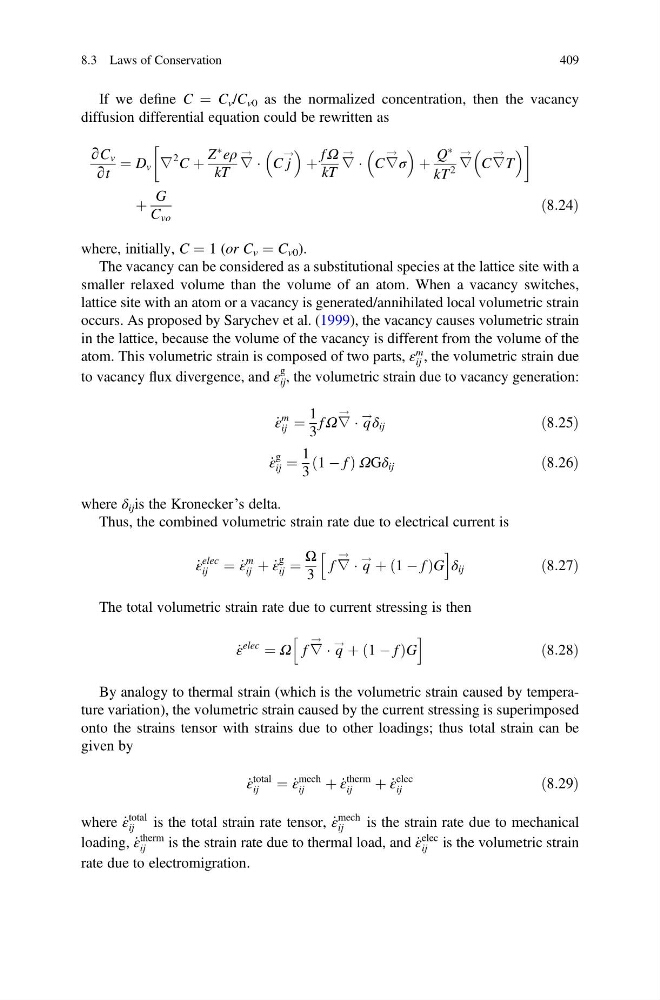
If we define C ¼ C v /C v0 as the normalized concentration, then the vacancy
diffusion differential equation could be rewritten as
∂C v
∂t
¼ D v ∇
2 C þ
Z
à eρ
kT
∇
! Á C j
!
þ
f Ω
kT
∇
! Á C∇
! σ
þ
Q
Ã
kT
2
∇
!
C∇
!
T
!
þ
G
C vo
ð8:24Þ
where, initially, C ¼ 1 (or C v ¼ C v0 ).
The vacancy can be considered as a substitutional species at the lattice site with a
smaller relaxed volume than the volume of an atom. When a vacancy switches,
lattice site with an atom or a vacancy is generated/annihilated local volumetric strain
occurs. As proposed by Sarychev et al. (1999), the vacancy causes volumetric strain
in the lattice, because the volume of the vacancy is different from the volume of the
atom. This volumetric strain is composed of two parts, ε
m
ij , the volumetric strain due
to vacancy flux divergence, and ε
g
ij , the volumetric strain due to vacancy generation:
_
ε
m
ij ¼
1
3
f Ω∇
! Á q
!
δ ij
ð8:25Þ
_
ε
g
ij ¼
1
3
1 À f
ð
ÞΩGδ ij
ð8:26Þ
where δ ij is the Kronecker’s delta.
Thus, the combined volumetric strain rate due to electrical current is
_
ε
elec
ij
¼ _
ε
m
ij þ _
ε
g
ij ¼
Ω
3
f ∇
! Á q
! þ 1 À f
ð
ÞG
h
i
δ ij
ð8:27Þ
The total volumetric strain rate due to current stressing is then
_
ε
elec
¼ Ω f ∇
! Á q
! þ 1 À f
ð
ÞG
h
i
ð8:28Þ
By analogy to thermal strain (which is the volumetric strain caused by temperature variation), the volumetric strain caused by the current stressing is superimposed
onto the strains tensor with strains due to other loadings; thus total strain can be
given by
_
ε
total
ij
¼ _
ε
mech
ij
þ _
ε
therm
ij
þ _
ε
elec
ij
ð8:29Þ
where _
ε
total
ij
is the total strain rate tensor, _
ε
mech
ij
is the strain rate due to mechanical
loading, _
ε
therm
ij
is the strain rate due to thermal load, and _
ε
elec
ij is the volumetric strain
rate due to electromigration.
8.3 Laws of Conservation
409
diffusion differential equation could be rewritten as
∂C v
∂t
¼ D v ∇
2 C þ
Z
à eρ
kT
∇
! Á C j
!
þ
f Ω
kT
∇
! Á C∇
! σ
þ
Q
Ã
kT
2
∇
!
C∇
!
T
!
þ
G
C vo
ð8:24Þ
where, initially, C ¼ 1 (or C v ¼ C v0 ).
The vacancy can be considered as a substitutional species at the lattice site with a
smaller relaxed volume than the volume of an atom. When a vacancy switches,
lattice site with an atom or a vacancy is generated/annihilated local volumetric strain
occurs. As proposed by Sarychev et al. (1999), the vacancy causes volumetric strain
in the lattice, because the volume of the vacancy is different from the volume of the
atom. This volumetric strain is composed of two parts, ε
m
ij , the volumetric strain due
to vacancy flux divergence, and ε
g
ij , the volumetric strain due to vacancy generation:
_
ε
m
ij ¼
1
3
f Ω∇
! Á q
!
δ ij
ð8:25Þ
_
ε
g
ij ¼
1
3
1 À f
ð
ÞΩGδ ij
ð8:26Þ
where δ ij is the Kronecker’s delta.
Thus, the combined volumetric strain rate due to electrical current is
_
ε
elec
ij
¼ _
ε
m
ij þ _
ε
g
ij ¼
Ω
3
f ∇
! Á q
! þ 1 À f
ð
ÞG
h
i
δ ij
ð8:27Þ
The total volumetric strain rate due to current stressing is then
_
ε
elec
¼ Ω f ∇
! Á q
! þ 1 À f
ð
ÞG
h
i
ð8:28Þ
By analogy to thermal strain (which is the volumetric strain caused by temperature variation), the volumetric strain caused by the current stressing is superimposed
onto the strains tensor with strains due to other loadings; thus total strain can be
given by
_
ε
total
ij
¼ _
ε
mech
ij
þ _
ε
therm
ij
þ _
ε
elec
ij
ð8:29Þ
where _
ε
total
ij
is the total strain rate tensor, _
ε
mech
ij
is the strain rate due to mechanical
loading, _
ε
therm
ij
is the strain rate due to thermal load, and _
ε
elec
ij is the volumetric strain
rate due to electromigration.
8.3 Laws of Conservation
409