

The dependence of mass transport in strip length was explained by the effect of
stress gradient. When electromigration process transports Al atoms from cathode to
anode, the anode will be in compression while the cathode will be in tension. Based
on the Nabarro-Herring model of equilibrium vacancy concentration in a stressed
solid, the tensile region has more and the compressive region has fewer vacancies.
As a result, there exists a vacancy concentration gradient decreasing from cathode to
anode side. The stress gradient induces an atomic flux of Al diffusing from anode to
cathode, and it opposes the Al flux driven by electromigration from cathode to
anode.
Blech length comes into effect when a thin film is subjected to current density
with blocking boundary conditions. A stress gradient is produced which provides a
mass transport force in opposition to the electromigration. If current density is
sufficiently low, a stress gradient will be generated that can stop electron wind
force driven diffusion.
The stress gradient depends on the length of the strip; the shorter the thin film
strip, the greater the gradient. At a certain length defined as the critical length, the
stress gradient is large enough to counterbalance electromigration, so no depletion at
the cathode or extrusion at the anode occurs. The critical length can be calculated
when the net force due to electromigration and stress gradient is nonexistence, as
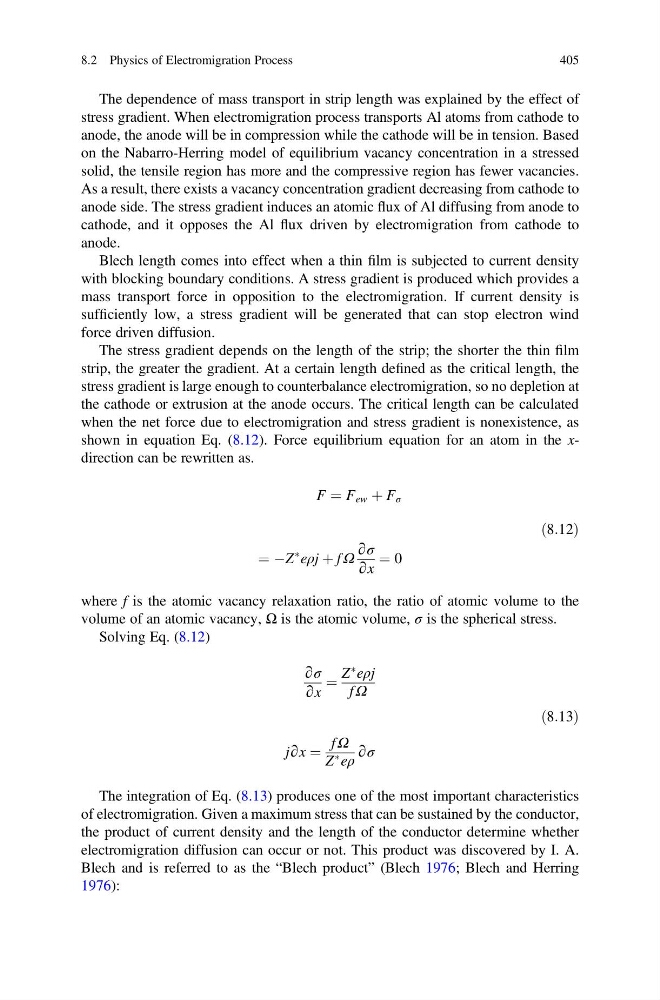
shown in equation Eq. (8.12). Force equilibrium equation for an atom in the xdirection can be rewritten as.
F ¼ F ew þ F σ
¼ ÀZ
à eρj þ f Ω
∂σ
∂x
¼ 0
ð8:12Þ
where f is the atomic vacancy relaxation ratio, the ratio of atomic volume to the
volume of an atomic vacancy, Ω is the atomic volume, σ is the spherical stress.
Solving Eq. (8.12)
∂σ
∂x
¼
Z
à eρj
f Ω
j∂x ¼
f Ω
Z
à eρ
∂σ
ð8:13Þ
The integration of Eq. (8.13) produces one of the most important characteristics
of electromigration. Given a maximum stress that can be sustained by the conductor,
the product of current density and the length of the conductor determine whether
electromigration diffusion can occur or not. This product was discovered by I. A.
Blech and is referred to as the “Blech product” (Blech 1976; Blech and Herring
1976):
8.2 Physics of Electromigration Process
405
stress gradient. When electromigration process transports Al atoms from cathode to
anode, the anode will be in compression while the cathode will be in tension. Based
on the Nabarro-Herring model of equilibrium vacancy concentration in a stressed
solid, the tensile region has more and the compressive region has fewer vacancies.
As a result, there exists a vacancy concentration gradient decreasing from cathode to
anode side. The stress gradient induces an atomic flux of Al diffusing from anode to
cathode, and it opposes the Al flux driven by electromigration from cathode to
anode.
Blech length comes into effect when a thin film is subjected to current density
with blocking boundary conditions. A stress gradient is produced which provides a
mass transport force in opposition to the electromigration. If current density is
sufficiently low, a stress gradient will be generated that can stop electron wind
force driven diffusion.
The stress gradient depends on the length of the strip; the shorter the thin film
strip, the greater the gradient. At a certain length defined as the critical length, the
stress gradient is large enough to counterbalance electromigration, so no depletion at
the cathode or extrusion at the anode occurs. The critical length can be calculated
when the net force due to electromigration and stress gradient is nonexistence, as
shown in equation Eq. (8.12). Force equilibrium equation for an atom in the xdirection can be rewritten as.
F ¼ F ew þ F σ
¼ ÀZ
à eρj þ f Ω
∂σ
∂x
¼ 0
ð8:12Þ
where f is the atomic vacancy relaxation ratio, the ratio of atomic volume to the
volume of an atomic vacancy, Ω is the atomic volume, σ is the spherical stress.
Solving Eq. (8.12)
∂σ
∂x
¼
Z
à eρj
f Ω
j∂x ¼
f Ω
Z
à eρ
∂σ
ð8:13Þ
The integration of Eq. (8.13) produces one of the most important characteristics
of electromigration. Given a maximum stress that can be sustained by the conductor,
the product of current density and the length of the conductor determine whether
electromigration diffusion can occur or not. This product was discovered by I. A.
Blech and is referred to as the “Blech product” (Blech 1976; Blech and Herring
1976):
8.2 Physics of Electromigration Process
405