

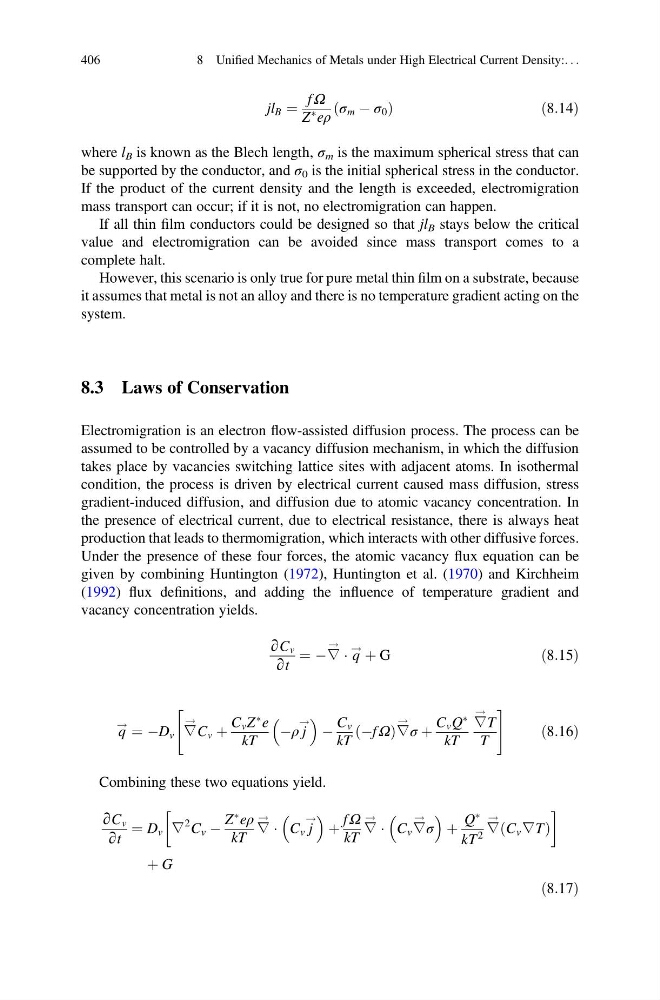
jl B ¼
f Ω
Z
à eρ
σ m À σ 0
ð
Þ
ð 8:14Þ
where l B is known as the Blech length, σ m is the maximum spherical stress that can
be supported by the conductor, and σ 0 is the initial spherical stress in the conductor.
If the product of the current density and the length is exceeded, electromigration
mass transport can occur; if it is not, no electromigration can happen.
If all thin film conductors could be designed so that jl B stays below the critical
value and electromigration can be avoided since mass transport comes to a
complete halt.
However, this scenario is only true for pure metal thin film on a substrate, because
it assumes that metal is not an alloy and there is no temperature gradient acting on the
system.
8.3 Laws of Conservation
Electromigration is an electron flow-assisted diffusion process. The process can be
assumed to be controlled by a vacancy diffusion mechanism, in which the diffusion
takes place by vacancies switching lattice sites with adjacent atoms. In isothermal
condition, the process is driven by electrical current caused mass diffusion, stress
gradient-induced diffusion, and diffusion due to atomic vacancy concentration. In
the presence of electrical current, due to electrical resistance, there is always heat
production that leads to thermomigration, which interacts with other diffusive forces.
Under the presence of these four forces, the atomic vacancy flux equation can be
given by combining Huntington (1972), Huntington et al. (1970) and Kirchheim
(1992) flux definitions, and adding the influence of temperature gradient and
vacancy concentration yields.
∂C v
∂t
¼ À∇
! Á q
! þ G
ð8:15Þ
q
! ¼ ÀD v ∇
!
C v þ
C v Z
à e
kT
Àρ j
!
À
C v
kT
Àf Ω
ð
Þ∇
! σ þ
C v Q
Ã
kT
∇
!
T
T
"
#
ð8:16Þ
Combining these two equations yield.
∂C v
∂t
¼ D v ∇
2 C v À
Z
à eρ
kT
∇
! Á C v j
!
þ
f Ω
kT
∇
! Á C v ∇
! σ
þ
Q
Ã
kT
2
∇
!
C v ∇T
ð
Þ
!
þ G
ð8:17Þ
406
8 Unified Mechanics of Metals under High Electrical Current Density:. . .
f Ω
Z
à eρ
σ m À σ 0
ð
Þ
ð 8:14Þ
where l B is known as the Blech length, σ m is the maximum spherical stress that can
be supported by the conductor, and σ 0 is the initial spherical stress in the conductor.
If the product of the current density and the length is exceeded, electromigration
mass transport can occur; if it is not, no electromigration can happen.
If all thin film conductors could be designed so that jl B stays below the critical
value and electromigration can be avoided since mass transport comes to a
complete halt.
However, this scenario is only true for pure metal thin film on a substrate, because
it assumes that metal is not an alloy and there is no temperature gradient acting on the
system.
8.3 Laws of Conservation
Electromigration is an electron flow-assisted diffusion process. The process can be
assumed to be controlled by a vacancy diffusion mechanism, in which the diffusion
takes place by vacancies switching lattice sites with adjacent atoms. In isothermal
condition, the process is driven by electrical current caused mass diffusion, stress
gradient-induced diffusion, and diffusion due to atomic vacancy concentration. In
the presence of electrical current, due to electrical resistance, there is always heat
production that leads to thermomigration, which interacts with other diffusive forces.
Under the presence of these four forces, the atomic vacancy flux equation can be
given by combining Huntington (1972), Huntington et al. (1970) and Kirchheim
(1992) flux definitions, and adding the influence of temperature gradient and
vacancy concentration yields.
∂C v
∂t
¼ À∇
! Á q
! þ G
ð8:15Þ
q
! ¼ ÀD v ∇
!
C v þ
C v Z
à e
kT
Àρ j
!
À
C v
kT
Àf Ω
ð
Þ∇
! σ þ
C v Q
Ã
kT
∇
!
T
T
"
#
ð8:16Þ
Combining these two equations yield.
∂C v
∂t
¼ D v ∇
2 C v À
Z
à eρ
kT
∇
! Á C v j
!
þ
f Ω
kT
∇
! Á C v ∇
! σ
þ
Q
Ã
kT
2
∇
!
C v ∇T
ð
Þ
!
þ G
ð8:17Þ
406
8 Unified Mechanics of Metals under High Electrical Current Density:. . .