

where E m and E f are, respectively, the energies of motion and formation for the
moving atom and β is a dimensionless fraction less than 1 which gives the fraction of
the motion energy carried by the moving atom. From Eq. (8.11) we can see that Q*
can be either positive or negative depending on the magnitude of the energies of
motion and formation. According to Huntington et al. (1970), β was reported to be
about 0.81; hence Q* is estimated to be about 1ev, which is close to the experimental
result of 0.23ev.
8.2.5 Stress Gradient Diffusion Driving Force
Due to mass transport from cathode to anode, or from the high-temperature side to
low-temperature side, there are more vacancies on the one side and more mass on the
other side. Consequently, on the mass accumulation side, atoms are subjected to
compression, and on the vacancy accumulation side, atoms are subjected to tension.
Therefore, there is a stress gradient between the two sides of the continuum. This
stress gradient is also another diffusion driving force. Tensile stress makes diffusion
easier, and compressive stress makes diffusion more difficult.
The role of mechanical stress gradients as a driving force in conjunction with
electromigration was first explored in a series of experiments by Blech (1976) and
Blech and Herring (1976). It was shown that a critical current density threshold
exists below which Al mass transport is arrested in a thin film sample. This threshold
was found to be inversely proportional to the thin film Al stripe length. It was
suggested that electromigration in short segment tends to induce back-stress when
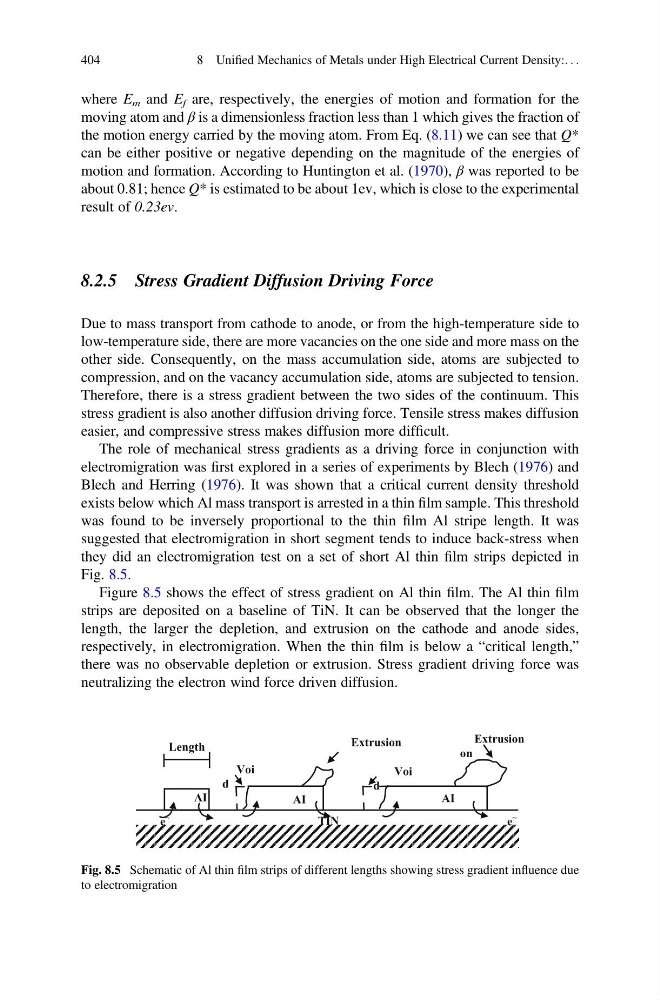
they did an electromigration test on a set of short Al thin film strips depicted in
Fig. 8.5.
Figure 8.5 shows the effect of stress gradient on Al thin film. The Al thin film
strips are deposited on a baseline of TiN. It can be observed that the longer the
length, the larger the depletion, and extrusion on the cathode and anode sides,
respectively, in electromigration. When the thin film is below a “critical length,”
there was no observable depletion or extrusion. Stress gradient driving force was
neutralizing the electron wind force driven diffusion.
AI
AI
AI
Voi
d
Extrusion
Voi
d
Extrusion
on
Length
e
~
e
~
TIN
Fig. 8.5 Schematic of Al thin film strips of different lengths showing stress gradient influence due
to electromigration
404
8 Unified Mechanics of Metals under High Electrical Current Density:. . .
moving atom and β is a dimensionless fraction less than 1 which gives the fraction of
the motion energy carried by the moving atom. From Eq. (8.11) we can see that Q*
can be either positive or negative depending on the magnitude of the energies of
motion and formation. According to Huntington et al. (1970), β was reported to be
about 0.81; hence Q* is estimated to be about 1ev, which is close to the experimental
result of 0.23ev.
8.2.5 Stress Gradient Diffusion Driving Force
Due to mass transport from cathode to anode, or from the high-temperature side to
low-temperature side, there are more vacancies on the one side and more mass on the
other side. Consequently, on the mass accumulation side, atoms are subjected to
compression, and on the vacancy accumulation side, atoms are subjected to tension.
Therefore, there is a stress gradient between the two sides of the continuum. This
stress gradient is also another diffusion driving force. Tensile stress makes diffusion
easier, and compressive stress makes diffusion more difficult.
The role of mechanical stress gradients as a driving force in conjunction with
electromigration was first explored in a series of experiments by Blech (1976) and
Blech and Herring (1976). It was shown that a critical current density threshold
exists below which Al mass transport is arrested in a thin film sample. This threshold
was found to be inversely proportional to the thin film Al stripe length. It was
suggested that electromigration in short segment tends to induce back-stress when
they did an electromigration test on a set of short Al thin film strips depicted in
Fig. 8.5.
Figure 8.5 shows the effect of stress gradient on Al thin film. The Al thin film
strips are deposited on a baseline of TiN. It can be observed that the longer the
length, the larger the depletion, and extrusion on the cathode and anode sides,
respectively, in electromigration. When the thin film is below a “critical length,”
there was no observable depletion or extrusion. Stress gradient driving force was
neutralizing the electron wind force driven diffusion.
AI
AI
AI
Voi
d
Extrusion
Voi
d
Extrusion
on
Length
e
~
e
~
TIN
Fig. 8.5 Schematic of Al thin film strips of different lengths showing stress gradient influence due
to electromigration
404
8 Unified Mechanics of Metals under High Electrical Current Density:. . .