

F
!
em ¼ F
!
wind þ F
!
direct
¼ ÀZ wind þ Z el
ð
Þ eE
!
¼ Z
à eE
!
¼ Z
à eρj
ð8:7Þ
where e is the electron charge, E
!
is the electric field potential (V/cm), ρ is the
resistance, j is the current density Amp/cm
2 , and Z
* is a dimensionless quantity
called the effective charge (also called the effective nuclear charge or the effective
valence), which is the combined net attractive positive charge of nuclear protons
acting on valence electrons. When a charged particle penetrates through condensed
matter, it polarizes the medium, which in turn reacts, back slowing down the
penetrating particle. In order to introduce a measure of the inertia of ions (Brandt
and Kitagawa 1982) introduced the concept of effective charge. The effective
charge, Z
* , relates how a diffusing atom interacts with the conducting electrons.
The interaction with the conduction band electrons is a complex function of the
electronic structure, a quantum mechanical effect. The effective charge is defined in
terms of the stopping power of the charge Z(S) and power of the proton moving in
the same medium at the same velocity (S p ) by (Barberan and Echenique 1986).
Z
Ã
¼ S=S p
À
Á1
2
ð8:8Þ
Z
* is usually negative in metal conductors due to the influence of the “electron
wind” (Ye et al. 2004a, b, c, d). For high conductivity metals, i.e., Al or Cu, the value
of Z
* is about À1.0 (Lloyd et al. 2004). For pure tin, Z
* value was reported to range
from À80 to À160 (Kuz'menko and Osirovskii 1962; Lodding 1965; Sun and
Ohring 1976). For single-crystalline Sn, Z
* value was reported to range from À10
to À16, while for polycrystalline Sn is À12 at about 200
C. These values seem to be
favored by Sorbello’s electromigration theory, which predicted the effective charge
number for Sn at 185
C as À10 (Sorbello 1973). His theory is based on pseudo
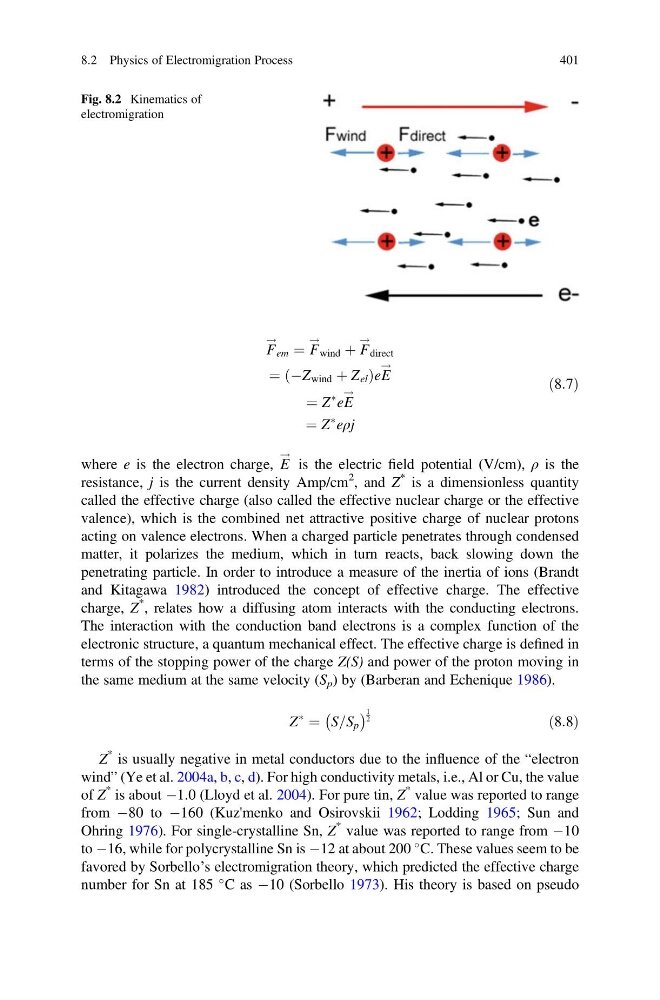
Fig. 8.2 Kinematics of
electromigration
8.2 Physics of Electromigration Process
401
!
em ¼ F
!
wind þ F
!
direct
¼ ÀZ wind þ Z el
ð
Þ eE
!
¼ Z
à eE
!
¼ Z
à eρj
ð8:7Þ
where e is the electron charge, E
!
is the electric field potential (V/cm), ρ is the
resistance, j is the current density Amp/cm
2 , and Z
* is a dimensionless quantity
called the effective charge (also called the effective nuclear charge or the effective
valence), which is the combined net attractive positive charge of nuclear protons
acting on valence electrons. When a charged particle penetrates through condensed
matter, it polarizes the medium, which in turn reacts, back slowing down the
penetrating particle. In order to introduce a measure of the inertia of ions (Brandt
and Kitagawa 1982) introduced the concept of effective charge. The effective
charge, Z
* , relates how a diffusing atom interacts with the conducting electrons.
The interaction with the conduction band electrons is a complex function of the
electronic structure, a quantum mechanical effect. The effective charge is defined in
terms of the stopping power of the charge Z(S) and power of the proton moving in
the same medium at the same velocity (S p ) by (Barberan and Echenique 1986).
Z
Ã
¼ S=S p
À
Á1
2
ð8:8Þ
Z
* is usually negative in metal conductors due to the influence of the “electron
wind” (Ye et al. 2004a, b, c, d). For high conductivity metals, i.e., Al or Cu, the value
of Z
* is about À1.0 (Lloyd et al. 2004). For pure tin, Z
* value was reported to range
from À80 to À160 (Kuz'menko and Osirovskii 1962; Lodding 1965; Sun and
Ohring 1976). For single-crystalline Sn, Z
* value was reported to range from À10
to À16, while for polycrystalline Sn is À12 at about 200
C. These values seem to be
favored by Sorbello’s electromigration theory, which predicted the effective charge
number for Sn at 185
C as À10 (Sorbello 1973). His theory is based on pseudo
Fig. 8.2 Kinematics of
electromigration
8.2 Physics of Electromigration Process
401