

potential calculation of driving force for atomic migration in metals in the presence
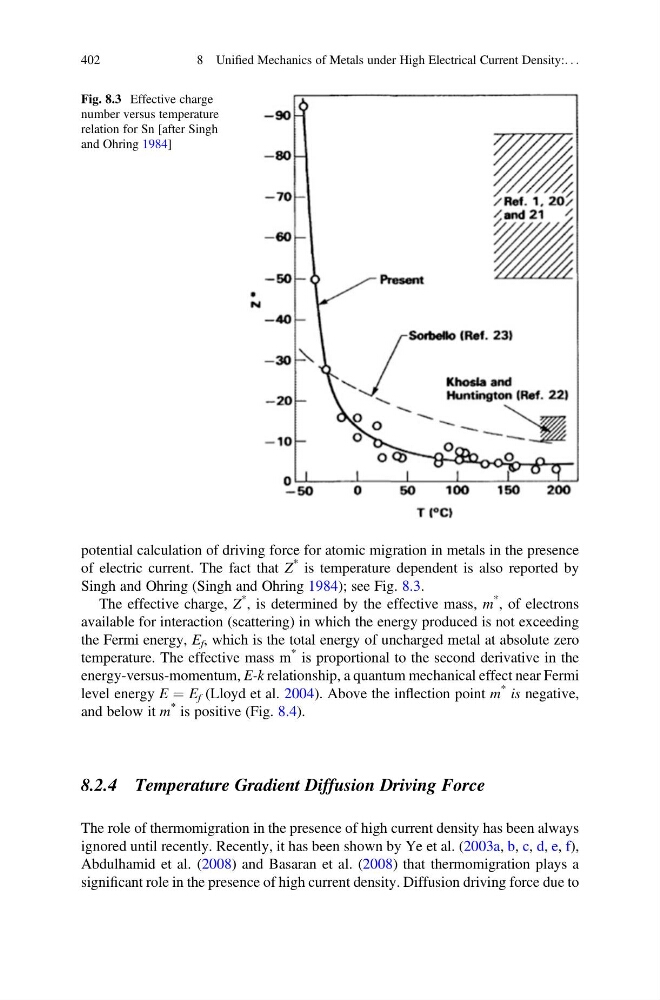
of electric current. The fact that Z
* is temperature dependent is also reported by
Singh and Ohring (Singh and Ohring 1984); see Fig. 8.3.
The effective charge, Z
* , is determined by the effective mass, m
* , of electrons
available for interaction (scattering) in which the energy produced is not exceeding
the Fermi energy, E f , which is the total energy of uncharged metal at absolute zero
temperature. The effective mass m
* is proportional to the second derivative in the
energy-versus-momentum, E-k relationship, a quantum mechanical effect near Fermi
level energy E ¼ E f (Lloyd et al. 2004). Above the inflection point m
* is negative,
and below it m
* is positive (Fig. 8.4).
8.2.4 Temperature Gradient Diffusion Driving Force
The role of thermomigration in the presence of high current density has been always
ignored until recently. Recently, it has been shown by Ye et al. (2003a, b, c, d, e, f),
Abdulhamid et al. (2008) and Basaran et al. (2008) that thermomigration plays a
significant role in the presence of high current density. Diffusion driving force due to
Fig. 8.3 Effective charge
number versus temperature
relation for Sn [after Singh
and Ohring 1984]
402
8 Unified Mechanics of Metals under High Electrical Current Density:. . .
of electric current. The fact that Z
* is temperature dependent is also reported by
Singh and Ohring (Singh and Ohring 1984); see Fig. 8.3.
The effective charge, Z
* , is determined by the effective mass, m
* , of electrons
available for interaction (scattering) in which the energy produced is not exceeding
the Fermi energy, E f , which is the total energy of uncharged metal at absolute zero
temperature. The effective mass m
* is proportional to the second derivative in the
energy-versus-momentum, E-k relationship, a quantum mechanical effect near Fermi
level energy E ¼ E f (Lloyd et al. 2004). Above the inflection point m
* is negative,
and below it m
* is positive (Fig. 8.4).
8.2.4 Temperature Gradient Diffusion Driving Force
The role of thermomigration in the presence of high current density has been always
ignored until recently. Recently, it has been shown by Ye et al. (2003a, b, c, d, e, f),
Abdulhamid et al. (2008) and Basaran et al. (2008) that thermomigration plays a
significant role in the presence of high current density. Diffusion driving force due to
Fig. 8.3 Effective charge
number versus temperature
relation for Sn [after Singh
and Ohring 1984]
402
8 Unified Mechanics of Metals under High Electrical Current Density:. . .